
Autumn 2026 Transition to Newly Qualified Nurse (NRS-X324-0)
Autumn 2026
Academic Year: Academic Year 2026-2027
This final-year module is designed to support your transition from student to registered nurse by consolidating and advancing your knowledge, skills, and professional identity. It builds on the foundational concepts of accountability introduced earlier in the programme and extends these to cover your responsibilities in upholding legal, ethical, and regulatory standards at the point of registration.
As you begin to lead and coordinate care in clinical settings, the module will help you develop competencies in managing a group of patients, delivering person-centred care, and applying effective prioritisation and delegation strategies. Classroom-based learning will complement your practice experiences to reinforce these key aspects of care delivery.
You will also focus on developing supervision and feedback skills essential for clinical practice, alongside exploring your individual leadership style and the dynamics of working within interprofessional teams. You will be encouraged to critically evaluate your role within the healthcare team and how you contribute to safe, effective, and collaborative care.
A core element of the module is career preparation. You will be guided through securing your first registered nursing post, from job searching and application to interview preparation, and explore a range of future career pathways within the profession.
Assessment is centred on creating your professional portfolio, which provides evidence of your development in these areas. This will include critical reflections supported by theoretical frameworks and insights drawn from your clinical practice.
As you begin to lead and coordinate care in clinical settings, the module will help you develop competencies in managing a group of patients, delivering person-centred care, and applying effective prioritisation and delegation strategies. Classroom-based learning will complement your practice experiences to reinforce these key aspects of care delivery.
You will also focus on developing supervision and feedback skills essential for clinical practice, alongside exploring your individual leadership style and the dynamics of working within interprofessional teams. You will be encouraged to critically evaluate your role within the healthcare team and how you contribute to safe, effective, and collaborative care.
A core element of the module is career preparation. You will be guided through securing your first registered nursing post, from job searching and application to interview preparation, and explore a range of future career pathways within the profession.
Assessment is centred on creating your professional portfolio, which provides evidence of your development in these areas. This will include critical reflections supported by theoretical frameworks and insights drawn from your clinical practice.
Autumn 2026 Environmental Physiology (SES-X309-0)
Autumn 2026
Academic Year: Academic Year 2026-2027
Note: this module has a prerequisite SES020N207. This module enables students to develop a detailed and comprehensive understanding of the physiological demands of extreme environments - what happens when you try to climb Everest? What happens if you try to cross the Sahara? What happens if you try to cross the Antarctic? The module will be very practical-based. Students will collect data in a number of simulated environments in the environmental chamber and will choose one of these experiments to write-up as a laboratory report. An exam will assess students' theoretical knowledge of the key concepts covered.
Autumn 2026 Advanced Manual Therapy Techniques and Clinical Application (SPT-X304-0)
Autumn 2026
Academic Year: Academic Year 2026-2027
This professionally focused module aims to consolidate the theoretical principles and further develop your practical skills in manual therapy. It develops advanced manual therapy techniques, integrating evidence-based assessment, treatment, and rehabilitation strategies. It focuses on clinical reasoning, hands-on techniques, and emerging technologies, preparing students for real-world professional practice. You will refine your ability to apply manual therapy techniques, including Maitland, Mulligan, and Combined Movement Theory. Digital integration (e.g. AI-driven assessment tools, wearable motion sensors) is incorporated to align with modern rehabilitation trends and embed digital case-based learning to explore virtual injury simulations for enhanced decision-making.
Topics covered will include principles of treatment and application of manual therapy, therapeutic effects, indications, and contraindications for the use of manual mobilisations, both peripheral and spinal. Review of clinical anatomy and introduction of manual therapy techniques to the Hip Joint; Knee Complex; Ankle Complex; Shoulder Complex; Elbow Complex; Wrist and Hand.
Throughout this module, you will also consider functional anatomy and biomechanics surrounding clinical assessment of joint function and kinematics, as well as develop critical appraisal skills to evaluate current trends and methods, exploring their application and effectiveness. This module will continue to develop you as an evidence-based practitioner; tailoring techniques for diverse populations, including paediatric and geriatric patients, providing a good opportunity for you to learn how to work as part of a multidisciplinary team (MDT) with other healthcare practitioners. You will continue to develop your awareness of the legal and ethical considerations as a sports therapist, particularly around these modalities.
Weekly lectures will be used to consolidate key principles of manual therapy mobilisations and review clinical anatomy of each region. Weekly practical sessions will apply theory into practice, enabling you to further enhance your practical, interpersonal communication, skills. Seminars will provide opportunities for critical discussion and problem solving through a range of clinical scenarios and case studies, and current concepts within the research, and enabling you to further develop your clinical reasoning.
Autumn 2026 Transition to Newly Qualified Nurse (CNR-X324-0)
Autumn 2026
Academic Year: Academic Year 2026-2027
This final-year module is designed to support your transition from student to registered nurse by consolidating and advancing your knowledge, skills, and professional identity. It builds on the foundational concepts of accountability introduced earlier in the programme and extends these to cover your responsibilities in upholding legal, ethical, and regulatory standards at the point of registration.
As you begin to lead and coordinate care in clinical settings, the module will help you develop competencies in managing a group of patients, delivering person-centred care, and applying effective prioritisation and delegation strategies. Classroom-based learning will complement your practice experiences to reinforce these key aspects of care delivery.
You will also focus on developing supervision and feedback skills essential for clinical practice, alongside exploring your individual leadership style and the dynamics of working within interprofessional teams. You will be encouraged to critically evaluate your role within the healthcare team and how you contribute to safe, effective, and collaborative care.
A core element of the module is career preparation. You will be guided through securing your first registered nursing post, from job searching and application to interview preparation, and explore a range of future career pathways within the profession.
Assessment is centred on creating your professional portfolio, which provides evidence of your development in these areas. This will include critical reflections supported by theoretical frameworks and insights drawn from your clinical practice.
As you begin to lead and coordinate care in clinical settings, the module will help you develop competencies in managing a group of patients, delivering person-centred care, and applying effective prioritisation and delegation strategies. Classroom-based learning will complement your practice experiences to reinforce these key aspects of care delivery.
You will also focus on developing supervision and feedback skills essential for clinical practice, alongside exploring your individual leadership style and the dynamics of working within interprofessional teams. You will be encouraged to critically evaluate your role within the healthcare team and how you contribute to safe, effective, and collaborative care.
A core element of the module is career preparation. You will be guided through securing your first registered nursing post, from job searching and application to interview preparation, and explore a range of future career pathways within the profession.
Assessment is centred on creating your professional portfolio, which provides evidence of your development in these areas. This will include critical reflections supported by theoretical frameworks and insights drawn from your clinical practice.
Autumn 2026 Transforming Practice for Health and Social Care (CNR-N200-0)
Autumn 2026
Academic Year: Academic Year 2026-2027
This module continues students learning of research skills for health care practice, supporting their development as critical consumers of research and emphasising the concept of evidence-based practice to transform practice. Students will develop their critical appraisal skills of quantitative, qualitative, and mixed methods, research design, research ethics and data analysis in the context of person-centred care. Students will enhance their skills in literature searching and synthesising primary and secondary research to derive meaning and application to practice. The importance of evidence-based practice to guide assessment and treatment will continue alongside the value of data analysis to review effectiveness of practice and services provided. Students will explore further the contributions of interprofessional perspectives to holistic care in the health and social care settings and consider the value of collaboration in healthcare research. From their learning in this module and a critical review of the evidence, students will plan a scoping review in an area of their choice to be completed in year 3/level 6.
Digital healthcare will continue to be examined in terms of the opportunities and challenges for practice, including the ethical and effective use of AI as a tool to support their research practice. Life-long learning and continuing professional development continue to be emphasised as vital for a graduate professional. In the third year of their courses, students will apply the knowledge and skills developed in this module in the undertaking of a research project/capstone project, inclusive of the opportunity for a scoping review. The research skills and scholarly thinking developed in this module will also be utilised in all other modules and practice-based learning
Autumn 2026 Foundations for Nursing Associates (CNR-C123-0)
Autumn 2026
Academic Year: Academic Year 2026-2027
This year-long module is designed to empower you as a student nursing associate as you transition into studying in Higher Education. It will lay the foundational knowledge you need to begin your career as a Nursing Associate, with a focus on platforms 1 and 3 of the Future Nurse: Standards of Proficiencies for Nursing Associates (NMC, 2018).
Throughout the module, you will receive support in developing both academic and nursing skills. There will be a strong emphasis on the skills you need to successfully demonstrate your learning and understanding as you progress through the programme. You will develop your academic writing, literature searching, and referencing skills, while also honing your digital literacy to help you navigate digital technologies such as generative AI.
The module content will help you build the theoretical knowledge required to become a safe, efficient, reflective, and accountable professional. You will explore core nursing theory, including effective professional relationships, the nursing process, assessment tools, person-centred care, adverse childhood experiences, and trauma-informed care. You will also be introduced to key nursing policies that shape how nurses and nursing associates conduct themselves in a diverse and ever-evolving healthcare environment.
To demonstrate your learning, you will be assessed using real-world case studies and by showing your ability to use reflective tools such as reflective models and a SLOT analysis.
As part of the module, you will take part in varied learning activities, with a focus on small group teaching such as seminars and workshops. You will also engage in asynchronous digital learning activities. Support will be available throughout the module from the nursing faculty and members of the service users and carers group. By the end of the module, you will not only be prepared to succeed in your academic studies, but also begin to think critically, act compassionately, and move forward with integrity as a future professional.
Throughout the module, you will receive support in developing both academic and nursing skills. There will be a strong emphasis on the skills you need to successfully demonstrate your learning and understanding as you progress through the programme. You will develop your academic writing, literature searching, and referencing skills, while also honing your digital literacy to help you navigate digital technologies such as generative AI.
The module content will help you build the theoretical knowledge required to become a safe, efficient, reflective, and accountable professional. You will explore core nursing theory, including effective professional relationships, the nursing process, assessment tools, person-centred care, adverse childhood experiences, and trauma-informed care. You will also be introduced to key nursing policies that shape how nurses and nursing associates conduct themselves in a diverse and ever-evolving healthcare environment.
To demonstrate your learning, you will be assessed using real-world case studies and by showing your ability to use reflective tools such as reflective models and a SLOT analysis.
As part of the module, you will take part in varied learning activities, with a focus on small group teaching such as seminars and workshops. You will also engage in asynchronous digital learning activities. Support will be available throughout the module from the nursing faculty and members of the service users and carers group. By the end of the module, you will not only be prepared to succeed in your academic studies, but also begin to think critically, act compassionately, and move forward with integrity as a future professional.
Autumn 2026 Foundations of Children’s Nursing (CNR-C119-0)
Autumn 2026
Academic Year: Academic Year 2026-2027
This year-long module is designed to empower you as you transition into studying in Higher Education. It will also lay the foundational knowledge you need to begin your career as a Children’s Nurse, focusing on platforms 1, 3, and 4 of the Future Nurse: Standards of Proficiencies for Registered Nurses (NMC, 2024). You will receive support in developing both your academic and nursing skills.
The module will focus on the skills you need to successfully demonstrate your learning and understanding as you progress through the programme. You will develop your academic writing, literature searching, and referencing skills, while also honing your digital literacy so you can confidently navigate digital technologies such as generative AI.
The content will help you build the underpinning theoretical knowledge needed to become a safe, efficient, reflective, and accountable professional. You will explore core nursing theory such as effective professional relationships, the nursing process, assessment tools, and person-centred care. You will also be introduced to key nursing policies that govern how nurses conduct themselves as professionals in a diversified and ever-changing healthcare landscape.
To demonstrate your learning, you will complete assessments based on real-world case studies and show your ability to use reflective tools such as reflective models and a SLOT analysis.
You will take part in varied learning activities, with a strong focus on small-group teaching through seminars and workshops. You will also engage in digital learning activities that run asynchronously within the module.
Throughout, you will be supported by the nursing faculty and members of the service users and carers group.
By the end of the module, you will not only be prepared to succeed in your academic studies, but you will also begin to think critically, act compassionately, and move forward with integrity as a future professional.
The module will focus on the skills you need to successfully demonstrate your learning and understanding as you progress through the programme. You will develop your academic writing, literature searching, and referencing skills, while also honing your digital literacy so you can confidently navigate digital technologies such as generative AI.
The content will help you build the underpinning theoretical knowledge needed to become a safe, efficient, reflective, and accountable professional. You will explore core nursing theory such as effective professional relationships, the nursing process, assessment tools, and person-centred care. You will also be introduced to key nursing policies that govern how nurses conduct themselves as professionals in a diversified and ever-changing healthcare landscape.
To demonstrate your learning, you will complete assessments based on real-world case studies and show your ability to use reflective tools such as reflective models and a SLOT analysis.
You will take part in varied learning activities, with a strong focus on small-group teaching through seminars and workshops. You will also engage in digital learning activities that run asynchronously within the module.
Throughout, you will be supported by the nursing faculty and members of the service users and carers group.
By the end of the module, you will not only be prepared to succeed in your academic studies, but you will also begin to think critically, act compassionately, and move forward with integrity as a future professional.
Autumn 2026 OTHN212- Enabling and Facilitating Participation (OTH-N212-0)
Autumn 2026
Academic Year: Academic Year 2026-2027
The aim of this module is to enhance learners’ knowledge and critical skills in current practices and explore more complex areas of practice. This module deepens the learners’ understanding of occupational therapy interventions through exploration of the profession’s philosophies and practice in complex health and social care settings and in a range of diverse contexts. Students will continue their case-based approach to evaluate the human experience of occupation and theoretical concepts from occupational science. Models of occupational therapy and the occupational therapy process will continue to inform their professional reasoning of occupational therapy intervention choices. Case studies could include: Frailty; PTSD; Emotional Instability; Spinal Cord Injury; Schizoaffective Disorder; Traumatic Brain Injury; Profound Physical and Learning Difficulties; Palliative and End of Life Care; Motor Neurone Disease – Major adaptations to the Home; Addiction; Brachial Plexus Lesion; Bi-Polar Disorder and Forensic Mental Health; Long Covid; Cerebral Palsy (work in the school); Chronic Pain; postnatal depression; DCD; and employment. These case studies will be evaluated annually with partners to ensure they are authentic.
Links from other modules: Students will use learning from their completed level 4 modules to understand how the biological, psychological, and social aspects of human science impact on occupational participation in more complex and emerging areas of practice. They will use evidence-based practice to inform their intervention decisions, and support for their professional reasoning. Furthermore, placements in level 5 support the application of theory to practice.
Autumn 2026 Practice Based Learning 1, 2 and 3 (PTH-P205-0)
Autumn 2026
Academic Year: Academic Year 2026-2027
Students are required to undertake 5 external placements across their three years of study: 1 placement in year 1, 2 placements in year 2, and 2 placements in year 3. Students will undertake a wide range of placements across the three years of the programme to offer opportunities that develop profession specific and transferable skills across a range of settings that reflects current health and social care provision. Whilst on placement, students will be supervised and assessed in accordance with the HCPC Standards of Education and Training Guidance (2021) and the CSP Principles of Practice-Based Learning (2022).
Placements are non-credit bearing, but students are required to pass all placements to complete their degree and meet the requirement for registration with the HCPC and CSP of 1000 practice hours.
Autumn 2026 Independent Project 4 (20 credits) (Level 7) (LHS-PR20-0)
Autumn 2026
Academic Year: Academic Year 2026-2027
This module can be taken by students at the discretion of the Programme Leader. It provides flexibility within the student’s home programme to accommodate students who, for example, transfer late into the programme or have exceptional circumstances that mean they could not otherwise attain the necessary credits to complete at postgraduate level. This module provides an opportunity for students to undertake an independent project on approved subject-related topics which balances directed and independent learning at an advanced level. The topics will relate directly to the student’s home programme by allowing the student to pursue aspects of intellectual or professional interest that connect to their specialist discipline. Students will identify areas of focus, which must be agreed by the programme team to ensure they fit coherently within the overall programme of study and are pitched appropriately for postgraduate-level enquiry. The Independent Project gives the student the opportunity to draw on scholarly literature, professional practice and/or areas of personal academic interest, thus demonstrating advanced critical thinking skills, intellectual independence, professional judgement and effective self-management. It also allows the student to extend their engagement beyond the set curriculum, deepening their expertise and personalising their postgraduate learning experience. In some cases, the content of the Independent Project must be taken from modules missed or failed. The tutor will advise on this.
Autumn 2026 Independent Project 5 (10 credits) (Level 7) (LHS-PR10-0)
Autumn 2026
Academic Year: Academic Year 2026-2027
This module can be taken by students at the discretion of the Programme Leader. It provides flexibility within the student’s home programme to accommodate students who, for example, transfer late into the programme or have exceptional circumstances that mean they could not otherwise attain the necessary credits to complete at postgraduate level. This module provides an opportunity for students to undertake a focused independent project on an approved subject-related topic, balancing directed and independent learning at an advanced level. The topic will relate directly to the student’s home programme by allowing the student to pursue an aspect of intellectual or professional interest that connects to their specialist discipline. Students will identify an area of focus, which must be agreed by the programme team to ensure it fits coherently within the overall programme of study and is pitched appropriately for postgraduate-level enquiry. The Independent Project gives the student the opportunity to draw on scholarly literature, professional practice and/or areas of personal academic interest, thus demonstrating advanced critical thinking skills, intellectual independence, professional judgement and effective self-management. It also allows the student to extend their engagement beyond the set curriculum, deepening their expertise and personalising their postgraduate learning experience. In some cases, the content of the Independent Project must be taken from a module missed or failed. The tutor will advise on this.
Autumn 2026 Foundations of Children’s Nursing (NRS-C119-0)
Autumn 2026
Academic Year: Academic Year 2026-2027
This year-long module is designed to empower you as you transition into studying in Higher Education. It will also lay the foundational knowledge you need to begin your career as a Children’s Nurse, focusing on platforms 1, 3, and 4 of the Future Nurse: Standards of Proficiencies for Registered Nurses (NMC, 2024). You will receive support in developing both your academic and nursing skills.
The module will focus on the skills you need to successfully demonstrate your learning and understanding as you progress through the programme. You will develop your academic writing, literature searching, and referencing skills, while also honing your digital literacy so you can confidently navigate digital technologies such as generative AI.
The content will help you build the underpinning theoretical knowledge needed to become a safe, efficient, reflective, and accountable professional. You will explore core nursing theory such as effective professional relationships, the nursing process, assessment tools, and person-centred care. You will also be introduced to key nursing policies that govern how nurses conduct themselves as professionals in a diversified and ever-changing healthcare landscape.
To demonstrate your learning, you will complete assessments based on real-world case studies and show your ability to use reflective tools such as reflective models and a SLOT analysis.
You will take part in varied learning activities, with a strong focus on small-group teaching through seminars and workshops. You will also engage in digital learning activities that run asynchronously within the module.
Throughout, you will be supported by the nursing faculty and members of the service users and carers group.
By the end of the module, you will not only be prepared to succeed in your academic studies, but you will also begin to think critically, act compassionately, and move forward with integrity as a future professional.
Autumn 2026 Independent Project 3 (40 credits) (Level 6) (LHS-XR40-0)
Autumn 2026
Academic Year: Academic Year 2026-2027
This module can be taken by students at the discretion of the Programme Leader. It provides flexibility within the student’s home programme to accommodate students who, for example, transfer late into the programme or have exceptional circumstances that mean they could not otherwise attain the necessary credits to progress.
This module provides an opportunity for students to undertake a project on approved subject-related topics which balances directed and independent learning. The topics will relate directly to the student’s home programme by allowing the student to consider aspects of interest to them that relate to the discipline they are studying. Students will choose the areas of focus but these must be agreed by the programme team to ensure that they fit coherently to the overall programme of study.
The Independent Project gives the student the opportunity to draw on first-hand experience and/or areas of personal interest, thus demonstrating critical thinking skills, independence, motivation and time management. It also allows the student to go beyond the set syllabus of their degree, thus personalising their learning experience.
Autumn 2026 Optimising Nutritional Care (HEA-X312-0)
Autumn 2026
Academic Year: Academic Year 2026-2027
Professionally focused education and evidenced-based practice are embedded throughout the learning. Content is informed by research, international guidelines and clinical practice; taught by expert academics. Case studies reflect the multicultural student population and the globalised world we live in; by increasing awareness we challenge the biases and non-inclusive practices in health research and clinical practice. Throughout the module you are encouraged to contribute to discussions regarding current topics in clinical nutrition, inclusive of digital health technologies, environmental sustainability and global influences. You are encouraged to share your prior knowledge and experiences enriching the learning environment and promoting a deeper understanding of different viewpoints. You will be required to consider professional standards of ethics, conduct and performance, applied to nutrition communication and practice. Your learning will be grounded in professionally focused education and evidence-based practice. You will explore content shaped by the latest research, international guidelines, and real-world clinical practice - all taught by expert academics. Case studies are designed to reflect our diverse student community and the globalised world we live in, helping you become more aware of biases and non-inclusive practices in health research and clinical settings.
Throughout the module, you will be encouraged to take part in discussions on current topics in clinical nutrition, including digital health technologies, environmental sustainability, and global influences. Your prior knowledge and experiences are valuable and by sharing them, you will enrich the learning environment and deepen everyone’s understanding of different perspectives.
You’ll also be expected to engage with professional standards of ethics, conduct, and performance, and apply them to your communication and practice in nutrition.
The module aims to enable you to:
• develop an evidenced-based understanding of nutrition conditions that can be practically applied in person-centred nutrition practice;
• engage in, and contribute to, current debates and controversies within clinical nutrition using evidence-based information;
• critically evaluate and discuss current issues in clinical nutrition, including digital health, environmental sustainability, and global health influences;
• equip you with the knowledge and skills needed to optimise nutritional care across diverse clinical settings, ensuring safe, ethical, and person-centred practice.
Autumn 2026 Delivery of Safe and Effective Person-centred Care (NRS-C114-0)
Autumn 2026
Academic Year: Academic Year 2026-2027
This module will introduce students to the nursing process: assessment, planning, implementation and evaluation (APIE). This will support the Nursing Associate in their role of delivering and monitoring person centred care in a range of environments. Students will explore how to identify priorities, set goals and support people to make decisions about their care. They will learn how to participate in holistic assessment of physical, mental, cognitive, behavioural and wellbeing status and medication usage for individuals across the lifespan. They will use a range of frameworks, tools, techniques, investigations and communication skills. When considering planning and implementing care, students will also be introduced to concepts of shared and ethical decision making. Students will draw on and develop their knowledge of anatomy and physiology, pathophysiology and fundamental pharmacology. Students will also explore the essential components of holistic and evidence-based person-centred care such as dignity, sexuality, sleep, comfort, hygiene, skin integrity, nutrition, hydration, bladder and bowel care, mobility, respiratory care, infection control, end of life care, pain control and medicine management. This will build upon their nursing skills already gained from Care Delivery Part 1 in the Clinical Simulation Centre and skills and experiences they have gained in both their host clinical environment and external clinical placement. From a pathophysiological perspective, students will start to consider common long term conditions and co-morbidities such as diabetes, respiratory disease, heart disease, cancer and mental health conditions across the lifespan. The module will also consider culturally sensitive care alongside considering vulnerable individuals and groups.
Autumn 2026 Independent Project 3 (20 credits) (Level 6) (LHS-XR20-0)
Autumn 2026
Academic Year: Academic Year 2026-2027
This module can be taken by students at the discretion of the Programme Leader. It provides flexibility within the student’s home programme to accommodate students who, for example, transfer late into the programme or have exceptional circumstances that mean they could not otherwise attain the necessary credits to progress.
This module provides an opportunity for students to undertake an independent project on approved subject-related topics which balances directed and independent learning. The topics will relate directly to the student’s home programme by allowing the student to consider aspects of interest to them that relate to the discipline they are studying. Students will choose the areas of focus but these must be agreed by the programme team to ensure that they fit coherently to the overall programme of study.
The Independent Project gives the student the opportunity to draw on first-hand experience and/or areas of personal interest, thus demonstrating critical thinking skills, independence, motivation and time management. It also allows the student to go beyond the set syllabus of their degree, thus personalising their learning experience. In some cases, the content of the Independent Project must be taken from modules missed or failed. The tutor will advise on this.
Autumn 2026 Health, Physical Activity, and Primary Care (PTH-L005-0)
Autumn 2026
Academic Year: Academic Year 2026-2027
This module aims to explore the role of the physiotherapist in health, physical activity, and primary care. Students will explore the role of physiotherapists in primary care, this will build on content in previous modules that focused on scope of practice and emerging roles within the profession. Students will gain an understanding of the wider determinants of health acknowledging the impact of social, economic, and environmental factors on health and well-being. Students will develop a detailed understanding of exercise physiology and apply this knowledge in the context of exercise prescription. Students will build on their learning in previous modules to explore the impact of biopsychosocial factors on physical activity and inactivity to understand the challenges to health promotion in different populations and settings. Students will explore how psychology, sociology and cultural diversity inform an understanding of health, illness, and disease. Students will consider the impact of role modelling physical activity behaviour and develop the skills to optimise active participation by physiotherapy service users such that they can empower individuals to make sustainable behavioural changes including social prescribing. Students will understand the value other health professionals play in promoting and supporting health and wellbeing. The advantages and disadvantages of telehealth for health promotion in diverse individuals and populations will be considered. Themes that will continue through this module include equality, diversity and inclusion (EDI) and inclusive practice, effective communication, self-awareness, strong teamwork and interprofessional working to provide holistic people centred care and optimal outcomes.
Autumn 2026 Independent Project 3 (10 credits) (Level 6) (LHS-XR10-0)
Autumn 2026
Academic Year: Academic Year 2026-2027
This module can be taken by students at the discretion of the Programme Leader. It provides flexibility within the student’s home programme to accommodate students who, for example, transfer late into the programme or have exceptional circumstances that mean they could not otherwise attain the necessary credits to progress.
This module provides an opportunity for students to undertake an independent project on approved subject-related topics which balances directed and independent learning. The topics will relate directly to the student’s programme by allowing the student to consider aspects of interest to them that relate to the discipline they are studying. Students will choose the areas of focus and the format for the assignment in consultation with their tutor to ensure that they fit coherently to the overall programme of study.
The Independent Project gives the student the opportunity to draw on first-hand experience and/or areas of personal interest, thus demonstrating critical thinking skills, independence, motivation and time management. It also allows the student to go beyond the set syllabus of their degree, thus personalising their learning experience. In some cases, the content of the Independent Project must be taken from modules missed or failed. The tutor will advise on this.
Autumn 2026 Independent Project 1 (40 credits) (Level 4) (LHS-CR40-0)
Autumn 2026
Academic Year: Academic Year 2026-2027
This module can be taken by students at the discretion of the Programme Leader. It provides flexibility within the student’s home programme to accommodate students who, for example, transfer late into the programme or have exceptional circumstances that mean they could not otherwise attain the necessary credits to progress to Level 5.
This module provides an opportunity for students to undertake an independent project on approved subject-related topics which balances directed and independent learning. The topics will relate directly to the student’s home programme by allowing the student to consider aspects of interest to them that relate to the discipline they are studying. Students will choose the areas of focus and the format for the assignment in consultation with their tutor to ensure that they fit coherently to the overall programme of study.
The Independent Project gives the student the opportunity to draw on first-hand experience and/or areas of personal interest, thus demonstrating critical thinking skills, independence, motivation and time management. It also allows the student to go beyond the set syllabus of their degree, thus personalising their learning experience. In some cases, the content of the Independent Project must be taken from modules missed or failed. The tutor will advise on this.
Autumn 2026 Innovate and Impact in Life and Health Sciences (LHS-X305-0)
Autumn 2026
Academic Year: Support and Other Sites
This capstone module aims to provide you with the opportunity to apply theoretical knowledge to real problems in the relevant field of study. Through independent and collaborative projects, you will assess a need in your discipline, gather relevant evidence, and apply analytical and critical thinking skills to develop and implement a capstone project.
You will build upon the fundamental skills that they acquired during your programme of study, including problem-solving, research and communication, to effectively plan and deliver their projects. Capstone projects can take various forms, ranging from community-based initiatives to innovative business and service improvement plans, ensuring relevance across all Life and Health Sciences Disciplines. Capstone project requirements will align with individual programme and PSRB (Professional, Statutory & Regulatory Body) standards.
PSRBs taken into consideration include:
Association for Nutrition (AfN)
British Association of Sport and Exercise Sciences (BASES)
British Dietetics Association (BDA)
Chartered Institute for the Management of Sport and Physical Activity (CIMSPA)
Institute of Biomedical Sciences (IBMS)
Nursing and Midwifery Council (NMC)
Royal Society of Biology (RSoB)
Society of Sports Therapists (SST)
Project structure
The capstone project consists of several key stages:
1. Identifying the issue – Defining the problem with the field, supported by evidence from regulatory bodies and other reliable sources (e.g. World Health Organisation, National Health Services or National Institute for Health and Care Excellence).
2. Proposing a plan – Developing a structured approach to address the identified issue.
3. Implementation or Feasibility Planning - Executing the project or outlining a detailed implementation plan.
4. Final Report or Equivalent Output – Documenting findings, processes, and conclusions in a structure format.
Example capstone projects:
• Developing educational resources (e.g. videos or toolkits).
• Engaging with community-based projects.
• Service improvement audit or enhancement plan.
• Design of a service improvement project to bridge a current gap in relevant field of practice.
Feasibility and Ethics
You are encouraged to base your project in real-world practice. While capstone projects may be hypothetical, they should be realistic in its scope and feasibility.
Ethical approval and/or health and safety risk assessments must be addressed. Where these are required, approval must be obtained before commencement of the project. For theoretical projects, you should discuss how ethical approval would be obtained in practice.
Supervision and Support
You will be allocated a supervisor or participate in small tutorial groups with an allocated member of staff. It is your responsibility to maintain regular contact with their supervisor. Supervisors will help establish a realistic timeframe for project completion or, for hypothetical projects, a projected timeframe for implementation.
In addition, you will have access to support lectures covering key topics such as research methodology, project management and academic writing skills.
Individual vs. Group Projects
Capstone projects may be completed individually or as part of a group. For group projects:
• The role for each student must be carefully decided and agreed upon before project commencement.
• The project plan must be approved by staff.
• Each student must submit an individual written report.This capstone module aims to provide you with the opportunity to apply theoretical knowledge to real problems in the relevant field of study. Through independent and collaborative projects, you will assess a need in your discipline, gather relevant evidence, and apply analytical and critical thinking skills to develop and implement a capstone project.
You will build upon the fundamental skills that they acquired during your programme of study, including problem-solving, research and communication, to effectively plan and deliver their projects. Capstone projects can take various forms, ranging from community-based initiatives to innovative business and service improvement plans, ensuring relevance across all Life and Health Sciences Disciplines. Capstone project requirements will align with individual programme and PSRB (Professional, Statutory & Regulatory Body) standards.
PSRBs taken into consideration include:
Association for Nutrition (AfN)
British Association of Sport and Exercise Sciences (BASES)
British Dietetics Association (BDA)
Chartered Institute for the Management of Sport and Physical Activity (CIMSPA)
Institute of Biomedical Sciences (IBMS)
Nursing and Midwifery Council (NMC)
Royal Society of Biology (RSoB)
Society of Sports Therapists (SST)
Project structure
The capstone project consists of several key stages:
1. Identifying the issue – Defining the problem with the field, supported by evidence from regulatory bodies and other reliable sources (e.g. World Health Organisation, National Health Services or National Institute for Health and Care Excellence).
2. Proposing a plan – Developing a structured approach to address the identified issue.
3. Implementation or Feasibility Planning - Executing the project or outlining a detailed implementation plan.
4. Final Report or Equivalent Output – Documenting findings, processes, and conclusions in a structure format.
Example capstone projects:
• Developing educational resources (e.g. videos or toolkits).
• Engaging with community-based projects.
• Service improvement audit or enhancement plan.
• Design of a service improvement project to bridge a current gap in relevant field of practice.
Feasibility and Ethics
You are encouraged to base your project in real-world practice. While capstone projects may be hypothetical, they should be realistic in its scope and feasibility.
Ethical approval and/or health and safety risk assessments must be addressed. Where these are required, approval must be obtained before commencement of the project. For theoretical projects, you should discuss how ethical approval would be obtained in practice.
Supervision and Support
You will be allocated a supervisor or participate in small tutorial groups with an allocated member of staff. It is your responsibility to maintain regular contact with their supervisor. Supervisors will help establish a realistic timeframe for project completion or, for hypothetical projects, a projected timeframe for implementation.
In addition, you will have access to support lectures covering key topics such as research methodology, project management and academic writing skills.
Individual vs. Group Projects
Capstone projects may be completed individually or as part of a group. For group projects:
• The role for each student must be carefully decided and agreed upon before project commencement.
• The project plan must be approved by staff.
• Each student must submit an individual written report.
Autumn 2026 Sport and Exercise Rehabilitation 1 (SPT-N201-0)
Autumn 2026
Academic Year: Academic Year 2026-2027
This module will provide the student with the theoretical knowledge and practical skills to plan and implement safe and effective, progressive rehabilitation programmes that are both injury and functional specific and address the individual needs of the patient. The module will cover rehabilitation advancement through the stages of injury, considering key components at each stage for a range of acute and chronic presentations for all regions. The student will develop confidence and competence to provide rehabilitation, ensuring optimal return to function, with a reduced risk of reinjury.
Topics covered will include principles of training, exercise strategies for improving range of movement, muscular strength, endurance and power, aerobic endurance and anaerobic power, re-establishing and advancing sensori-motor control, stages of rehabilitation and the planning and implementing of progressive rehabilitation programmes, evaluating progression and strategies for injury prevention. Consideration will be given to the psychological impact of injury and the effect on adherence and compliance.
Weekly lectures will be used to introduce key topics and the theoretical underpinning of rehabilitation and progression through the stages of rehabilitation for a range of injuries. Weekly practical sessions will apply theory into practice, enabling students to develop the practical rehabilitation, coaching and interpersonal communication skills required in rehabilitation. Seminars will introduce students to discussion and problem-solving using case studies, current concepts within the research, enabling students to develop their clinical reasoning.
Autumn 2026 Applications of Research (LHS-X304-0)
Autumn 2026
Academic Year: Support and Other Sites
This module provides students with the opportunity to acquire a coherent and detailed understanding of a specialist research topic. Students carry out a sustained and rigorous research project in which they must deploy rigorously scientific techniques of investigation and analysis. Students will select suitable research project topics in consultation with their supervising tutor and students are expected to carry out the project.
The research project enables students to showcase their advanced practical and investigative skills, as well as written and oral presentation abilities. Support is provided through common lectures, tutorial sessions, formative feedback on investigative progress and assessed outputs, where applicable, supervision of laboratory or field work. Students develop autonomy in driving their projects, utilising literature to devise and sustain arguments in their chosen area. The research process also fosters close engagement with the ethical and regulatory compliance requirements, including Health and Safety, with appropriate supervision and resources to support high-quality projects.
Permissible approaches for data collection include laboratory investigations, bioinformatics (including structural modelling), and quantitative and qualitative surveys, systematic reviews and meta-analyses (In Occupational Therapy and Physiotherapy programmes only, a scoping review would be acceptable). Some laboratory projects may be offered in a small group setting or involve the use of shared reagents and or equipment to explore variations on a common theme shared by several students. Supervisors are selected based on the relevance of their research expertise, where possible.
Each student is allocated a project supervisor. While students are responsible for maintaining regular contact, supervisor’s collaborate with them to establish a realistic schedule for completing the research.
Note: For Biomedical Science, Zoology, Health Sciences and Biological Science students, this module is a must-pass research experience and cannot be condoned nor compensated.
Autumn 2026 Enabling Occupational Participation (OTH-L002-0)
Autumn 2026
Academic Year: Academic Year 2026-2027
The aim of this module is to develop students’ knowledge of how the biological, psychological and social aspects of human science impact on occupational participation. Students will explore their understanding of human function and dysfunction and recovery through the biopsychosocial model.
Four elements make up this module:
- Anatomy
- Physiology
- Psychology
- Sociology
Links to other modules: The module runs concurrently with one other module for the integration of learning to inform occupational therapy practice:
- Foundations of Occupational Therapy Practice to apply their science learning to case studies and how this informs occupational therapy practice;
While not concurrent, these modules will be informed by the students’ completion of the Enabling Occupational Participation module:
- Research Methods to be a consumer of research for informing professional practice;
- Professional Skills for Health for the employment of professional practice and career development through CPD;
- Placement 1.
Autumn 2026 Independent Project 1 (20 credits) (Level 4) (LHS-CR20-0)
Autumn 2026
Academic Year: Academic Year 2026-2027
This module can be taken by students at the discretion of the Programme Leader. It provides flexibility within the student’s home programme to accommodate students who, for example, transfer late into the programme or have exceptional circumstances that mean they could not otherwise attain the necessary credits to progress to Level 5.
This module provides an opportunity for students to undertake an independent project on approved subject-related topics which balances directed and independent learning. The topics will relate directly to the student’s programme by allowing the student to consider aspects of interest to them that relate to the discipline they are studying. Students will choose the areas of focus and the format for the assignment in consultation with their tutor to ensure that they fit coherently to the overall programme of study.
The Independent Project gives the student the opportunity to draw on first-hand experience and/or areas of personal interest, thus demonstrating critical thinking skills, independence, motivation and time management. It also allows the student to go beyond the set syllabus of their degree, thus personalising their learning experience. In some cases, the content of the Independent Project must be taken from modules missed or failed. The tutor will advise on this.
Autumn 2026 Independent Project 2 (10 credits) (Level 5) (LHS-NR10-0)
Autumn 2026
Academic Year: Academic Year 2026-2027
This module can be taken by students at the discretion of the Programme Leader. It provides flexibility within the student’s home programme to accommodate students who, for example, transfer late into the programme or have exceptional circumstances that mean they could not otherwise attain the necessary credits to progress to Level 6.
This module provides an opportunity for students to undertake an independent project on approved subject-related topics which balances directed and independent learning. The topics will relate directly to the student’s programme by allowing the student to consider aspects of interest to them that relate to the discipline they are studying. Students will choose the areas of focus and the format for the assignment in consultation with their tutor to ensure that they fit coherently to the overall programme of study.
The Independent Project gives the student the opportunity to draw on first-hand experience and/or areas of personal interest, thus demonstrating critical thinking skills, independence, motivation and time management. It also allows the student to go beyond the set syllabus of their degree, thus personalising their learning experience. In some cases, the content of the Independent Project must be taken from modules missed or failed. The tutor will advise on this.
Autumn 2026 Exercise Physiology and Prescription (PTH-N201-0)
Autumn 2026
Academic Year: Support and Other Sites
This module will support students in developing a detailed understanding of exercise physiology and the principles of exercise prescription. Students will study the science of human performance and consider the relationships between physical activity and the structure and function of the human body. The content will build on previous knowledge to develop the learner’s skills of assessment and clinical reasoning within the context of exercise prescription. The design of exercise programmes will be explored, considering physiological, biomechanical, and psychological factors of the individual. The module will explore how body systems interact and respond to different modes of exercise and adapt to different types of exercise training. Students will consider how intensity, frequency and mode of exercise affects the human body and the impact of exercise in different populations. Students will also explore how technology can be used to assess exercise performance and support individuals to engage with exercise programmes. There will also be content that investigates digital literacy and digital inequality within this context.
Autumn 2026 Independent Project 1 (10 credits) (Level 4) (LHS-CR10-0)
Autumn 2026
Academic Year: Academic Year 2026-2027
This module can be taken by students at the discretion of the Programme Leader. It provides flexibility within the student’s home programme to accommodate students who, for example, transfer late into the programme or have exceptional circumstances that mean they could not otherwise attain the necessary credits to progress.
This module provides an opportunity for students to undertake an independent project on approved subject-related topics which balances directed and independent learning. The topics will relate directly to the student’s programme by allowing the student to consider aspects of interest to them that relate to the discipline they are studying. Students will choose the areas of focus and the format for the assignment in consultation with their tutor to ensure that they fit coherently to the overall programme of study.
The Independent Project gives the student the opportunity to draw on first-hand experience and/or areas of personal interest, thus demonstrating critical thinking skills, independence, motivation and time management. It also allows the student to go beyond the set syllabus of their degree, thus personalising their learning experience. In some cases, the content of the Independent Project must be taken from modules missed or failed. The tutor will advise on this.
Autumn 2026 Principles of Care for Children and Young People (NRS-N208-0)
Autumn 2026
Academic Year: Academic Year 2026-2027
This module will build on the students learning from year one and enable them to develop a foundation of knowledge which will underpin all nursing care provided to children and their families. It will examine the key developmental stages that cross the age spectrum of 0-19, allowing students to plan and deliver care which will enhance the childs development and help them to reach their full potential. It will also enable the student to gain insight into the identification and management of when development is not meeting expected norms. This module will explore both fundamental and different approaches to communication and care that may be required when caring for children of different ages and those with additional requirements or learning disabilities. The student will learn the impact that long term illness can have on normal developmental expectation in a child or young person and identify strategies to alleviate these impacts through integrated and multidisciplinary working practices.
This module will also explore the importance of partnership working with the child and their parent/ guardian/ care giver. Conversely, students will also develop a knowledge and appreciation of other professional roles working with children such as social care, therapies, schools and other specialist roles. Focus will be placed on the importance of excellent communication across all services to ensure the successful care of children and young people.
Students will learn and examine the pivotal role that nurses have in acting as an advocate for the child, young person and their families. They will explore how to listen and interpret the needs and wants of that child and their parent/guardian/carer and how to vocalise these to the wider multi professional team. The module will also provide the student with a thorough understanding of the complex nature of consent in children and young people, including who can provide this consent and when a child deemed Fraser competent.
This module will explore the topic of safeguarding children and young people in further depth, building on knowledge from year one. This will include how to recognise the different types of abuse and how this abuse can impact on childrens ability to reach their full potential and what measures can be put in place to minimise this impact.
Students will also gain insight into the challenges faced when transferring care from childrens services to the adult sector, identifying ways to prepare young adults and their parents/ guardians/ care givers for this transition and exploring current policy and guidance in this area in addition to hearing from service users of their experiences of this.
Autumn 2026 Principles of Mental Health Care (NRS-N206-0)
Autumn 2026
Academic Year: Academic Year 2026-2027
This module will introduce students to core concepts of theory and practice utilised when working with people experiencing common mental health problems, such as depression and anxiety disorders. Students will also further explore the parity of esteem between physical and mental health. Prevention of illness and health promotion for both physical and mental wellbeing will feature heavily throughout the module. Students will also explore where mental health issues appear along the lifespan, including in children and young people. Students will be supported to develop succinct collaborative interventions to address these needs in individuals from diverse populations. Evidence has shown there is a higher prevalence of nutritional, cardiovascular, viral and respiratory disease for individuals suffering with poor mental health. Students will revisit core anatomy, physiology and pathophysiology to underpin holistic assessment of both physical health and mental health and the interactions between these systems. Theory and application of mental health law, including the Mental Health Act (1983) and Mental Capacity Act (2005) are also covered. Students will explore how these legislative frameworks can be applied within both physical and mental health settings whilst ensuring practice is conducted with the least restrictive and most collaborative, person-centred approach. To support this, students will be taught the process of conducting mental state examinations and mental capacity assessments, with opportunities to practice these in the Clinical Simulation Centre.
Autumn 2026 Pharmacology and Medicines Management (NRS-N203-0)
Autumn 2026
Academic Year: Academic Year 2026-2027
This module will prepare students for their role in medicines administration and optimisation, particularly in community and primary care settings. Students will revisit what they have learnt in the Year 1 Applied Human Biology module and develop their knowledge of pharmacology, pharmacodynamics and pharmacokinetics. Students will apply this to the assessment of people when collecting data about physical, mental, cognitive and behavioural status. A range of common medications used across the lifespan will be explored, including their usage and indications, although students will focus on their own field(s) of practice. Students will learn to recognise the effects of medicines, allergies, drug sensitivities, side effects, contraindications, incompatibilities, adverse reactions, overdose, prescribing errors and the impact of polypharmacy and over the counter medication usage. The module will also cover the principles of safe and effective administration and optimisation of medicines in accordance with local and national policies, including storage, transportation and disposal. Students will consider their role in supporting people to maintain independence through self-administration of medication in community and primary care. They will also discuss how to work in partnership with people and explore concepts such as concordance. The module will also explore the various routes of administration and link this to practice of skills in the Clinical Simulation Centre. Students will also apply what they have learnt to the medicines management assessment in the Practice Assessment Document (PAD). Students will study how prescriptions are generated, the role of generic, unlicensed, and off-label prescribing and an understanding of the potential risks associated with these approaches to prescribing. Students will start to plan for progressing to a prescribing qualification following registration. The module will also explore digital advances in medicines management such e-Prescribing.
Autumn 2026 Management of Long-term Conditions (NRS-N202-0)
Autumn 2026
Academic Year: Academic Year 2026-2027
The management of long-term conditions is a key focus for nurses working in community and primary care settings. This module will build on what students have learnt in Year 1 and develop their understanding of ongoing needs resulting from long-term conditions and multiple co-morbidities. Common long-term conditions will be investigated such as mental health conditions, diabetes, stroke, dementia, cancer, heart failure, respiratory disease, Parkinson's disease, multiple sclerosis and chronic wounds. Students will revisit their assessment skills when collecting data on people's physical, mental, cognitive, behavioural and social care needs. There will be an emphasis on working in partnership with people, their families and carers to plan person-centred care. Students will be encouraged to explore the ongoing impact of lifestyle choices and social circumstances. They will learn how to support people to make healthy choices and to maintain independence through physical exercise and keeping active, for example. Students will develop their care planning skills further and study evidence-based guidelines which underpin care. The influence of health and social care policy and health economics will also be considered. The focus of the module will be situated firmly in community and primary care settings, including care homes, hospices. Students will examine the role of the community nurse in providing care for common long-term conditions, such as cancer, outside of specialist services. There will also be a focus on hospital avoidance, discharge planning and interagency collaboration through integrated health and care services.
Autumn 2026 Transforming Practice for Health and Social Care (LHS-N202-0) (Year-long)
Autumn 2026
Academic Year: Academic Year 2026-2027
This module continues students learning of research skills for health care practice, supporting their development as critical consumers of research and emphasising the concept of evidence-based practice to transform practice. Students will develop their critical appraisal skills of quantitative, qualitative, and mixed methods, research design, research ethics and data analysis in the context of person-centred care. Students will enhance their skills in literature searching and synthesising primary and secondary research to derive meaning and application to practice. The importance of evidence-based practice to guide assessment and treatment will continue alongside the value of data analysis to review effectiveness of practice and services provided. Students will explore further the contributions of interprofessional perspectives to holistic care in the health and social care settings and consider the value of collaboration in healthcare research. From their learning in this module and a critical review of the evidence, students will plan a scoping review in an area of their choice to be completed in year 3/level 6.
Digital healthcare will continue to be examined in terms of the opportunities and challenges for practice, including the ethical and effective use of AI as a tool to support their research practice. Life-long learning and continuing professional development continue to be emphasised as vital for a graduate professional. In the third year of their courses, students will apply the knowledge and skills developed in this module in the undertaking of a research project/capstone project, inclusive of the opportunity for a scoping review. The research skills and scholarly thinking developed in this module will also be utilised in all other modules and practice-based learning
Autumn 2026 Promoting Health and Well-being across the Lifespan (NRS-C113-0)
Autumn 2026
Academic Year: Academic Year 2026-2027
Students will be introduced to contemporary perspectives of health and social care within the UK whilst considering the key, preventable long-term conditions that are the focus of UK Health Security Agency and Office for Health Improvements and Disparities. The module will include the aims and principles of health promotion, protection and improvement and the prevention of ill health. Module content will facilitate the development of health promotion skills, and the ability to monitor and review the effectiveness of health promotion interventions. Students will learn about their role in addressing health inequalities and safeguarding vulnerable groups and individuals. The module will explore how people’s life choices may impact on future health and wellbeing needs, as well other social influences, individual circumstances and health literacy. The focus will be on the shift towards prevention of ill health and supporting people to make informed choices about how to manage health challenges in order to maximise their quality of life and improve health outcomes. Students will be introduced to the concept of parity of esteem whilst considering the health and development of the child and young people, through to studying how the aging process affects the older adult.
Autumn 2026 Nursing Practice Part 1 (NRS-C105-0)
Autumn 2026
Academic Year: Academic Year 2026-2027
This module introduces the student to the concept of practice learning which students will undertake through clinical placements throughout the programme. The module focuses on the development of the professional values, knowledge and skills needed to deliver safe, effective, compassionate and evidence-based person-centred care. The module will prepare students for each placement to ensure learning is maximised. There is particular preparation prior to the first placement to ensure students understand what is expected of them and that they have met all the requirements for mandatory training. Students will undertake learning in the Clinical Simulation Centre to practice and develop their clinical skills. This will also help to integrate theory and practice. The focus of practice learning will be on developing skills for working within community and primary care settings. However, students will also undertake acute hospital placements to ensure they fully understand the role of acute care and the interface between in hospital and out-of-hospital settings. All students will undertake a placement pathway relevant to their field(s) of practice. Students will also address the NMC and EU requirements (where relevant) with regards to experiencing the full range of care environments.
In addition to demonstrating achievement of the Professional Values and fulfilling all mandatory Part-specific requirements, students must complete the requisite number of practice and simulation learning hours associated with the Part in order to be eligible for progression to the next Part and to meet NMC registration requirements at the end of the final Part for the programme. Where a student has a shortfall exceeding 80hours of practice learning for the Part, the Nursing Practice module will be deemed incomplete, and the student will be unable to progress to the subsequent Part. For a student in their final Part of the programme, the total number of practice learning hours for the programme must be achieved for their degree to be awarded and recommendation for NMC registration*.
NB *NMC registration requirements at the end of the programme is minimum 2300 hours for the BSc Nursing programmes and 3200 hours for the MSci Nursing dual registration programme.
Autumn 2026 Developing Professional Relationships in Nursing (NRS-C101-0)
Autumn 2026
Academic Year: Academic Year 2026-2027
The ability to develop professional relationships with a diverse range of people across the lifespan is a core skill in nursing. Within this module, students will explore the values, attitudes, knowledge and skills needed to communicate with people in both therapeutic and professional relationships. The context will include service users, their families, carers and colleagues. Students will also consider the nurse's role within the interdisciplinary team, particularly in community and primary care settings. Students will examine the professional values which underpin The Code (NMC 2018): Professional standards of practice and behaviour for nurses and midwives and the Chief Nursing Officer's 6C's. Trust within health and care relationships will be explored in relation to empathy, transparency and the professional duty of candour. Students will learn what is meant by anti-discriminatory practice and examine concepts of equality, diversity, inclusivity and cultural competence. The key legal and ethical principles which guide the nurse's role as an accountable professional whilst delivering person-centred care will also be explored. Students are also introduced to the concepts of partnership working and shared decision-making with people, their families and carers. The module will cover the scope and basis of human communication, the common barriers to effective communication and how these can be minimised. Students will practice and develop a range of communication skills, seek feedback on their performance and reflect on their development. Students will also examine their own emotional intelligence and consider the importance of developing resilience as a practitioner. Students will also discuss the demands of professional practice, the importance of monitoring signs of vulnerability in themselves or colleagues and actions that can be taken to minimise risks to health and wellbeing. This module will help students to start developing critical thinking skills to enable them to find, read and understand relevant information. It will also introduce the concept of evidence-based practice. Finally, students will learn the importance of professional communication in the public domain through social media.
Autumn 2026 Integrated Care and Leadership in Practice (CNR-N230-0)
Autumn 2026
Academic Year: Academic Year 2026-2027
Autumn 2026 Foundations of Adult Nursing (NRS-C117-0)
Autumn 2026
Academic Year: Academic Year 2026-2027
This year-long module is designed to empower you as you transition into studying in Higher Education. It will also lay the foundational knowledge you need to begin your career as an Adult Nurse, focusing on platforms 1, 3, and 4 of the Future Nurse: Standards of Proficiencies for Registered Nurses (NMC, 2024). You will receive support in developing both your academic and nursing skills.
The module will focus on the skills you need to successfully demonstrate your learning and understanding as you progress through the programme. You will develop your academic writing, literature searching, and referencing skills, while also honing your digital literacy so you can confidently navigate digital technologies such as generative AI.
The content will help you build the underpinning theoretical knowledge needed to become a safe, efficient, reflective, and accountable professional. You will explore core nursing theory such as effective professional relationships, the nursing process, assessment tools, and person-centred care. You will also be introduced to key nursing policies that govern how nurses conduct themselves as professionals in a diversified and ever-changing healthcare landscape.
To demonstrate your learning, you will complete assessments based on real-world case studies and show your ability to use reflective tools such as reflective models and a SLOT analysis.
You will take part in varied learning activities, with a strong focus on small-group teaching through seminars and workshops. You will also engage in digital learning activities that run asynchronously within the module.
Throughout, you will be supported by the nursing faculty and members of the service users and carers group.
By the end of the module, you will not only be prepared to succeed in your academic studies, but you will also begin to think critically, act compassionately, and move forward with integrity as a future professional.
Autumn 2026 Biopsychology and Lifestyle Medicine in Clinical Neuroscience (HEP-L009-0)
Autumn 2026
Academic Year: Support and Other Sites
The global burden of neurological diseases is growing, and in this module, you will discuss a wide range of approaches to address health care needs in clinical neuroscience from individual, national and international perspectives. This module is grounded in clinical neuroscience, biopsychology, neurology, and lifestyle medicine. Biopsychology is a subset of neuroscience that explores behaviour and mental processes; and lifestyle medicine encompasses areas such as nutrition, physical activity, sleep and the minimisation of harmful substances and behaviours and acknowledges the need for action on socio-economic determinants of health. The module recognises the perspectives of diverse stakeholders and different cultures, and explores health inequities, such as differences in dementia prevalence among racial and ethnic groups. Furthermore, there is a growing appreciation of the importance of preventative rather than reactive strategies in clinical neuroscience, for example it has been reported that 45% of dementia cases could be prevented by addressing modifiable risk factors, and this module will also consider these areas. There is also a focus on exploring the “lived experience” and considering patient perspectives in the design and implementation of research. This module directly addresses Goals 3, 4, 5, 6, 9, and 12 of the United Nations Sustainable Development Goals and deals with specific highlighted issues such as vaccination, water purity and air pollution. This module is orientated to employability and contains content on different career pathways in the field
Autumn 2026 Human Evolution and Adaptation (BSS-X309-0)
Autumn 2026
Academic Year: Support and Other Sites
This module explores the evolution of our species, from the fossil evidence of now-extinct species to modern human adaptations to our changing physical and cultural environment. The first few sessions introduce the basics of human skeletal anatomy, teaching students the name and the morphology of human bones, as well as how it is possible to learn about the biological sex, age-at-death and health of an individual based on skeletal remains. The middle section of the module discusses the genetic and fossil evidence of human evolution since our divergence from chimpanzees. Finally, the last section of the module focuses on the adaptations that made humans such a successful cosmopolitan species, how cultural and biological co-evolution interacted in our species, and how predicted changes in climate and the environment are likely to affect our future evolution.
Autumn 2026 Obesity and Metabolism (HEP-L115-0)
Autumn 2026
Academic Year: Academic Year 2026-2027
Obesity has been described as a new pandemic problem. It affects populations and individuals not only in both the developed world but also the emerging countries and certain demographics in developing countries. Obesity is a major risk factor for many metabolic disorders such as cardiovascular disease, pre-diabetic conditions, diabetes and cancer, and it is also considered a disease in its own right. The module will provide students with an understanding of the multi-factorial aetiology of obesity and related metabolic disorders both in individuals and populations. It will examine how current and novel dietary, pharmacological and surgical interventions can be used to treat obesity and metabolic disorders. Using examples of recent research this module will critically discuss areas such as appetite regulating hormones, AMP Kinase, phytochemicals and the gut microbiota. The module will promote critical awareness about key areas of research, helping prepare students for the Dissertation or Research Project module.
Autumn 2026 Transforming Practice for Health and Social Care (LHS-N202-0)
Autumn 2026
Academic Year: Academic Year 2026-2027
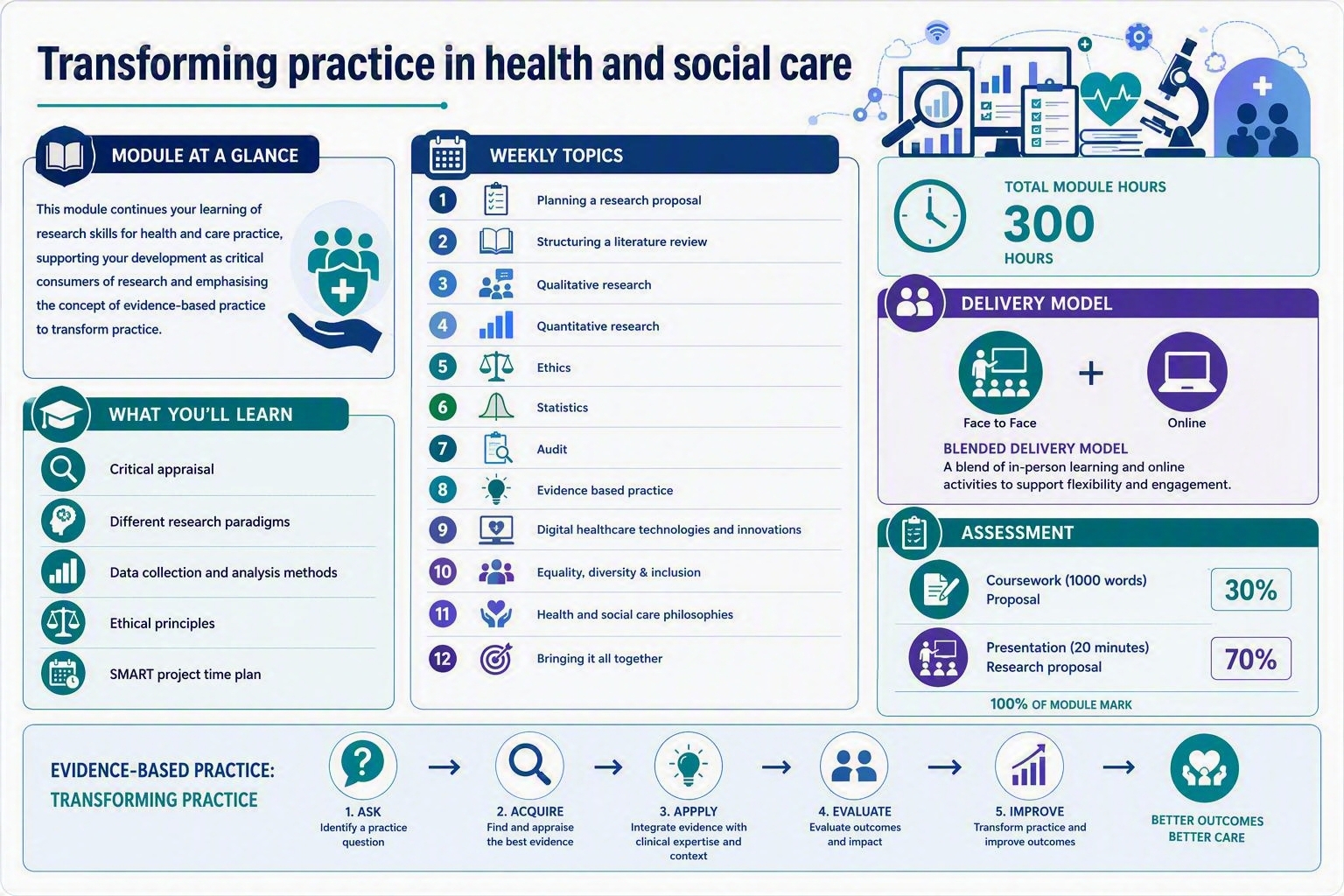 This module continues students learning of research skills for health care practice, supporting their development as critical consumers of research and emphasising the concept of evidence-based practice to transform practice. Students will develop their critical appraisal skills of quantitative, qualitative, and mixed methods, research design, research ethics and data analysis in the context of person-centred care. Students will enhance their skills in literature searching and synthesising primary and secondary research to derive meaning and application to practice. The importance of evidence-based practice to guide assessment and treatment will continue alongside the value of data analysis to review effectiveness of practice and services provided. Students will explore further the contributions of interprofessional perspectives to holistic care in the health and social care settings and consider the value of collaboration in healthcare research. From their learning in this module and a critical review of the evidence, students will plan a scoping review in an area of their choice to be completed in year 3/level 6.
Digital healthcare will continue to be examined in terms of the opportunities and challenges for practice, including the ethical and effective use of AI as a tool to support their research practice. Life-long learning and continuing professional development continue to be emphasised as vital for a graduate professional. In the third year of their courses, students will apply the knowledge and skills developed in this module in the undertaking of a research project/capstone project, inclusive of the opportunity for a scoping review. The research skills and scholarly thinking developed in this module will also be utilised in all other modules and practice-based learning.
This module continues students learning of research skills for health care practice, supporting their development as critical consumers of research and emphasising the concept of evidence-based practice to transform practice. Students will develop their critical appraisal skills of quantitative, qualitative, and mixed methods, research design, research ethics and data analysis in the context of person-centred care. Students will enhance their skills in literature searching and synthesising primary and secondary research to derive meaning and application to practice. The importance of evidence-based practice to guide assessment and treatment will continue alongside the value of data analysis to review effectiveness of practice and services provided. Students will explore further the contributions of interprofessional perspectives to holistic care in the health and social care settings and consider the value of collaboration in healthcare research. From their learning in this module and a critical review of the evidence, students will plan a scoping review in an area of their choice to be completed in year 3/level 6.
Digital healthcare will continue to be examined in terms of the opportunities and challenges for practice, including the ethical and effective use of AI as a tool to support their research practice. Life-long learning and continuing professional development continue to be emphasised as vital for a graduate professional. In the third year of their courses, students will apply the knowledge and skills developed in this module in the undertaking of a research project/capstone project, inclusive of the opportunity for a scoping review. The research skills and scholarly thinking developed in this module will also be utilised in all other modules and practice-based learning.
Autumn 2026 Practice Based Learning 2 (OTH-P205-0)
Autumn 2026
Academic Year: Support and Other Sites
This module expands on the learning from Practice Based Learning 1 and develops the concept of practice learning which students will undertake through a placement in year 2 of the programme. The module focuses on the development of the professional values, knowledge and skills needed to deliver safe, effective, compassionate and evidence-based person-centred care. This placement is part-time (three days a week, 270 hours total) so that theory practice links can be enhanced, with Action Learning Sets for students to learn with and from each other when they attend the university for one day each week.
In practice based learning 2, there is continued focus on the themes of the 4 pillars of the RCOT’s Career Development Framework (‘Skills for Practice’ and ‘Evidence Based Practice’). There is particular preparation prior to this placement to ensure students have sufficiently debriefed from their previous placement and identified any learning needs to take into this placement. In addition, it is important for them to understand what is expected of them on a level 5 placement, and that they have met all the requirements for any additional mandatory training required for year 2. Students will undertake learning in the Clinical Simulation Centre to practice and develop their clinical skills. This will also help to integrate theory and practice. The focus of practice learning will be on developing skills for working within a variety of practice settings in order to ensure they fully understand the role of the occupational therapist. All students will undertake a placement pathway relevant to their field(s) of practice. Students will also address the RCOT and HCPC requirements (where relevant) with regards to placement learning experiences.
Autumn 2026 Cells, Disease and Therapy (HEP-L081-0)
Autumn 2026
Academic Year: Academic Year 2026-2027
This module provides students with a deep overview of current knowledge and technology used in research of therapeutics against cancer, auto-immune disorders, infectious disease and neuro-degeneration. Students will be introduced to key aspects of experimental methods and principles of gene therapy, stem cells, cellular interactions, biomarkers and anti-infective therapies targeting host-pathogen interactions. The clinical translation of basic science into therapies will also be considered.
Autumn 2026 Fundamentals of Clinical Practice (CNR-C124-0)
Autumn 2026
Academic Year: Academic Year 2026-2027
This module introduces you to nursing practice by blending real-world placements with expert-led simulation-based education (SBE). This integrated approach helps you develop the knowledge, skills, and professional behaviours needed to deliver safe, effective, compassionate, and evidence-based person-centred care, in line with the Standards of Proficiency for Nursing Associates (2018).
You will be prepared for clinical placements through taught content that includes clinical skills and simulation. You will undertake learning in the Clinical Simulation Centre, where you can practice and develop your clinical skills. This gives you the opportunity to integrate theory with practice and build confidence in a safe, supportive environment before attending your clinical placements.
Through simulation-based education, you will experience scenarios that reflect the realities of modern healthcare. You will engage with a range of modalities, which may include low- and high-fidelity immersive simulation, virtual reality scenarios via Oxford Medical Simulation, and Forum Theatre with professional SimActors. These authentic, service-user-informed experiences are followed by facilitated debriefs, encouraging you to reflect both in and on action, and to apply the NMC Code (2018) to your current and future practice.
Employability is embedded throughout the module, ensuring that you develop the knowledge, skills, and professional behaviours required for safe and effective nursing practice.
As part of the module, you will undertake a series of external supernumerary clinical placements that meet the NMC requirements for experiencing the full range of care environments and fields of practice. These placements will include in-hospital settings, diagnostic and outpatient services, as well as community services, primary care, and social care.
Autumn 2026 Research Methods for Healthcare Practice (PTH-L004-0)
Autumn 2026
Academic Year: Support and Other Sites
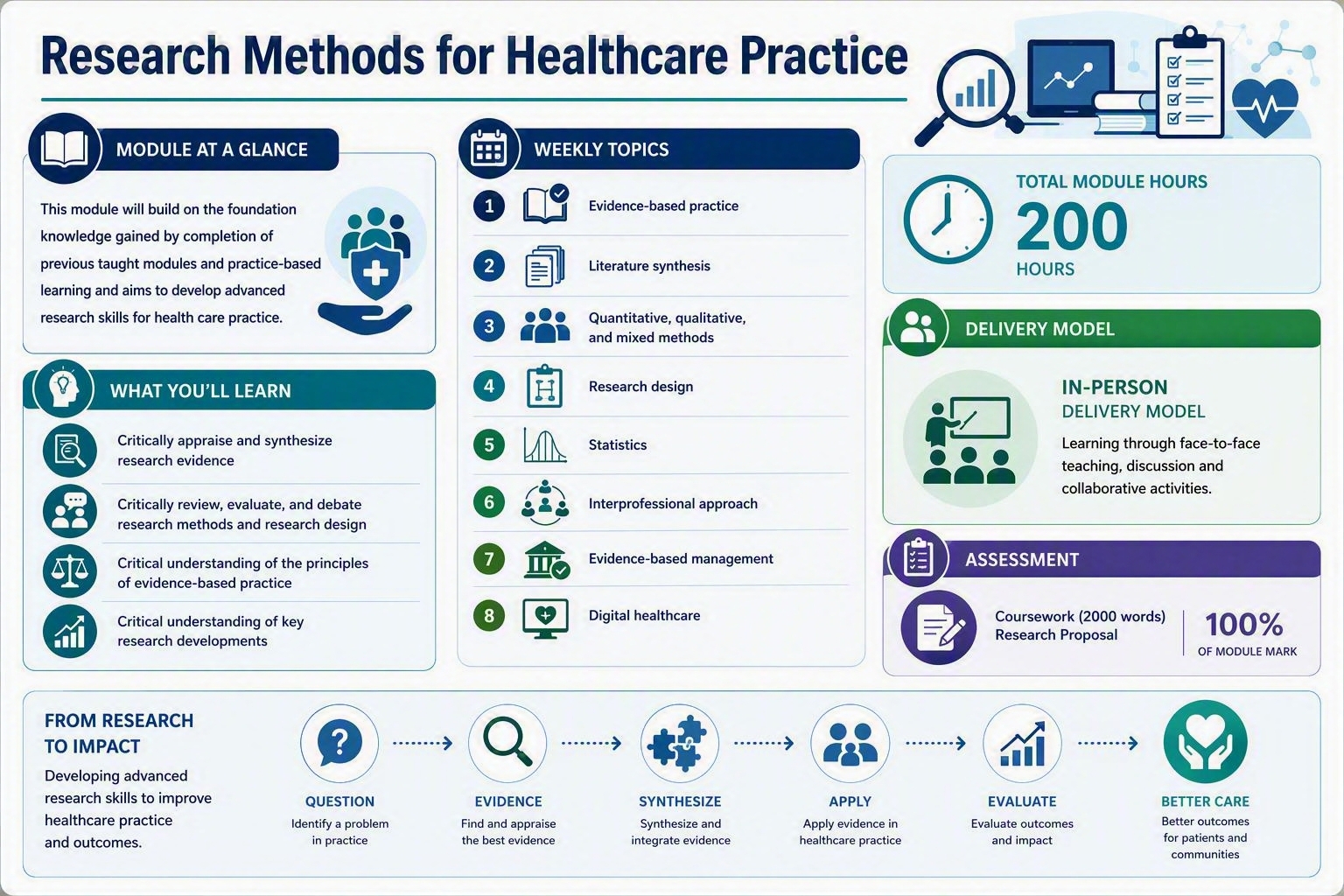
Autumn 2026 Nutrition Support (HEP-L036-0)
Autumn 2026
Academic Year: Academic Year 2026-2027
The Nutrition Support module is designed to facilitate an advanced understanding of the processes, which inform methods of nutrition support and to gain a critical awareness of the quality of evidence behind the interventions in various settings and disease states. As the field of clinical nutrition continues to be changing and developing at a rapid pace the key skills to access, interpret and critically evaluate current literature are integral to this module. This module is designed to assist students in career progression and incorporating research into future roles. The Nutrition Support module provides key content for the Association for Nutrition accreditation of the programme.
Autumn 2026 Medical Microbiology (BSS-N226-0)
Autumn 2026
Academic Year: Support and Other Sites
Medical Microbiology is a core component of Biomedical Science, underpinning your understanding of infectious diseases that remain a major cause of global morbidity and mortality. As antimicrobial resistance rises and novel pathogens emerge, it is increasingly important for biomedical and healthcare professionals to be well-versed in diagnostic microbiology, infection control, and epidemiology. This module provides an in-depth understanding of medical microbiology and its relevance to human health and disease. It examines the diversity, physiology, and pathogenic mechanisms of clinically significant microorganisms, including bacteria, viruses, fungi, and parasites, and explores how these organisms interact with the human host to cause disease.
This module builds on foundational microbiology and cell biology covered at Level 4 and provides essential background for advanced modules in clinical pathology, immunology, and molecular diagnostics. It aligns with IBMS professional accreditation requirements and supports the development of competencies needed in clinical laboratories, public health, research, and pharmaceutical industries.
You will study microbial immune evasion strategies, host immune responses, the pharmacology of antimicrobial agents, and resistance mechanisms. The module emphasises the global challenge of antimicrobial resistance and the impact of emerging and re-emerging infectious diseases.
You will consider the concept of One Health and the roles of normal microbial flora in health, disease, and the control of infectious microorganisms.
The teaching integrates interactive lectures, problem-solving workshops, seminars, and practical sessions, promoting critical thinking, teamwork, and professional communication skills. Laboratory sessions will enable you to develop core microbiological competencies, including clinical sample collection, aseptic technique, culture and identification of microorganisms using microscopy and other investigations, to carry out antimicrobial susceptibility testing and utilise molecular diagnostic methods. You will gain experience in interpreting clinical data and writing laboratory reports and learn how concepts of Quality Management apply in Medical Microbiology diagnostic laboratories.
The module supports the UN Sustainable Development Goals, particularly Goal 3: Good Health and Well-being through its focus on infectious disease management and prevention, and Goal 4: Quality Education by delivering inclusive, applied biomedical education.
You will acquire knowledge and skills needed for careers in biomedical science, medical microbiology, diagnostics, and public health.
Autumn 2026 Practice Learning 1 (CNR-C120-0)
Autumn 2026
Academic Year: Academic Year 2026-2027
Practice Learning 1 offers you an exciting introduction to nursing practice, blending real-world placements with expert-led simulation-based education (SBE). This integrated approach develops the knowledge, skills, and professional values outlined in the Nursing & Midwifery Council (NMC, 2024) Standards of Proficiency for Registered Nurses. From the very start of your journey with us, you will gain hands-on experience in diverse care settings, working alongside service users, carers, families, and communities.
During your placement, you will hold supernumerary status, meaning you are not counted as part of the workforce and can focus entirely on your learning. You will be supported throughout by a team of academic assessors, practice supervisors, and practice assessors who guide your development. Before starting your placement, you will receive comprehensive preparation through online learning, interactive workshops that encourage critical thinking and collaboration, and clinical skills training in the university’s specialist simulation centres, where you will practice real-world scenarios in a safe, supportive environment. This preparation ensures you gain confidence and competence in the NMC (2024) proficiencies outlined in Annexes A and B, covering essential clinical and communication skills.
Our interprofessional faculty and simulation-based education approach provide you with experiences that mirror the realities of modern healthcare. You will engage with a range of modalities, including low- and high-fidelity immersive simulation, virtual reality scenarios through Oxford Medical Simulation, and Forum Theatre with professional SimActors and service users/carers. These authentic, service-user-informed experiences are followed by facilitated debriefs, encouraging reflection both in and on action, and supporting your real-time application of the NMC Code (2018) to current and future practice.
The module’s themes are mapped directly to the NMC (2024) platforms and include communication, teamwork, patient safety, raising concerns, person-centred care, preserving dignity, patient assessment, common presentations, pathophysiology, and care planning. Both your practice placement hours and simulated practice hours contribute to the total practice hours required for NMC registration.
Autumn 2026 Independent Study in Life and Health Sciences (HEP-L011-0)
Autumn 2026
Academic Year: Academic Year 2026-2027
This module will allow you to develop specialist knowledge in an individually or group negotiated subject area relevant to Biodiversity and Conservation, or Cell and Molecular Medicine or Sport and Exercise Sciences. The specialized knowledge developed will then be applied to a selected case study in the subject area, with the support of a tutor. You have the opportunity to pursue an in-depth study of an emerging topic, consistent with the coherence of your overall programme study.
The module is delivered to you, whether you are a home or international student, primarily through face-to-face sessions. These sessions will vary dependent on the pathway and project. You may be required to attend lectures, seminars and workshops on other taught modules. You may also be requested to engage in supporting ongoing staff research projects, participating in consultancy work, or tackling real-life problem-solving activities. There are limited options for distance or work-based learning, which depend on negotiating a learning contract with your supervisor. This contract will outline the specific arrangements and expectations for your learning experience.
Throughout the module, you will have access to various resources to support your research and learning. Additionally, you will benefit from personalised guidance and feedback from your assigned tutor, helping you refine your skills and deepen your understanding of the subject matter.
Autumn 2026 Practice Learning 1 (NRS-C120-0)
Autumn 2026
Academic Year: Academic Year 2026-2027
Practice Learning 1 offers you an exciting introduction to nursing practice, blending real-world placements with expert-led simulation-based education (SBE). This integrated approach develops the knowledge, skills, and professional values outlined in the Nursing & Midwifery Council (NMC, 2024) Standards of Proficiency for Registered Nurses. From the very start of your journey with us, you will gain hands-on experience in diverse care settings, working alongside service users, carers, families, and communities.
During your placement, you will hold supernumerary status, meaning you are not counted as part of the workforce and can focus entirely on your learning. You will be supported throughout by a team of academic assessors, practice supervisors, and practice assessors who guide your development. Before starting your placement, you will receive comprehensive preparation through online learning, interactive workshops that encourage critical thinking and collaboration, and clinical skills training in the university’s specialist simulation centres, where you will practice real-world scenarios in a safe, supportive environment. This preparation ensures you gain confidence and competence in the NMC (2024) proficiencies outlined in Annexes A and B, covering essential clinical and communication skills.
Our interprofessional faculty and simulation-based education approach provide you with experiences that mirror the realities of modern healthcare. You will engage with a range of modalities, including low- and high-fidelity immersive simulation, virtual reality scenarios through Oxford Medical Simulation, and Forum Theatre with professional SimActors and service users/carers. These authentic, service-user-informed experiences are followed by facilitated debriefs, encouraging reflection both in and on action, and supporting your real-time application of the NMC Code (2018) to current and future practice.
The module’s themes are mapped directly to the NMC (2024) platforms and include communication, teamwork, patient safety, raising concerns, person-centred care, preserving dignity, patient assessment, common presentations, pathophysiology, and care planning. Both your practice placement hours and simulated practice hours contribute to the total practice hours required for NMC registration.
Autumn 2026 Fieldwork in the Biological Sciences (BSS-N230-0)
Autumn 2026
Academic Year: Support and Other Sites
Fieldwork is the opportunity for biological scientists to engage themselves directly with the natural world. This unique module offers you an immersive, hands-on introduction to ecological and zoological fieldwork across a range of natural environments. It begins with a five-day residential field trip (e.g. to rural Wales) that explores marine intertidal zones, saltmarshes, and freshwater rivers. Following this, you will engage in local field trips and laboratory sessions focused on habitat mapping, eutrophication, biodiversity assessment, and invasive species, complemented by laboratory and computer practicals using Geographic Information Systems (GIS) and other analytical software.
Throughout the module, you will develop a diverse skillset that combines traditional ecological survey methods with modern technological approaches, such as eDNA sampling, camera traps, bioacoustic analysis, and machine learning. This blend of practical and digital tools enhances your ability to monitor environmental change and understand ecosystem dynamics at both local and global scales. The module also encourages collaborative learning and communication skills through group presentations, fostering confidence in sharing scientific findings.
By ensuring all students have equal opportunity to participate in field experiences, the course supports inclusivity and broadens access to natural habitats, regardless of background. The practical focus not only equips you with transferable technical skills valued in professional biological sciences and environmental careers, but also nurtures an appreciation of sustainable environmental practices. Ultimately, the module prepares you to engage meaningfully with the challenges of ecological research and conservation, applying your learning in diverse contexts.
Autumn 2026 Foundations of Adult and Mental Health Nursing (NRS-C122-0)
Autumn 2026
Academic Year: Academic Year 2026-2027
This year-long module is designed to empower you as you transition into studying in Higher Education. It will also lay the foundational knowledge you need to begin your career as an Adult and Mental Health Nurse, focusing on platforms 1, 3, and 4 of the Future Nurse: Standards of Proficiencies for Registered Nurses (NMC, 2024). You will receive support in developing both your academic and nursing skills.
The module will focus on the skills you need to successfully demonstrate your learning and understanding as you progress through the programme. You will develop your academic writing, literature searching, and referencing skills, while also honing your digital literacy so you can confidently navigate digital technologies such as generative AI.
The content will help you build the underpinning theoretical knowledge needed to become a safe, efficient, reflective, and accountable professional. You will explore core nursing theory such as effective professional relationships, the nursing process, assessment tools, and person-centred care. You will also be introduced to key nursing policies that govern how nurses conduct themselves as professionals in a diversified and ever-changing healthcare landscape.
To demonstrate your learning, you will complete assessments based on real-world case studies and show your ability to use reflective tools such as reflective models and a SLOT analysis.
You will take part in varied learning activities, with a strong focus on small-group teaching through seminars and workshops. You will also engage in digital learning activities that run asynchronously within the module.
Throughout, you will be supported by the nursing faculty and members of the service users and carers group.
By the end of the module, you will not only be prepared to succeed in your academic studies, but you will also begin to think critically, act compassionately, and move forward with integrity as a future professional.
Autumn 2026 Clinical Neuroscience Practical (HEP-L029-0)
Autumn 2026
Academic Year: Academic Year 2026-2027
This module reflects the research strengths within the Centre for Integrated Research in Life and Health Sciences and School of Life and Health Sciences. The aims of this module are that upon completion the students will be better able to: - understand the background of an empirical study. - apply evidence-based arguments to generate a hypothesis upon which the study is based. - apply and follow experimental protocols to generate robust scientific data. - critically evaluate and interpret the data generated; identify potential experimental issues and perform efficient troubleshooting. - identify and critically evaluate the relevant scientific literature, in the form of an annotated bibliography. - create an individual written report demonstrating originality; giving the study background, clear experimental hypothesis and appropriate experimental design and methodology, appropriate analysis and presentation of the data generated, and critical discussion of the results within the context of the wider scientific literature. - as part of a group, create and perform a clear and concise oral presentation on the study, answering follow-up questions.
Autumn 2026 Public Health Interventions (HEP-L006-0)
Autumn 2026
Academic Year: Academic Year 2026-2027
This module will address public health project development, implementation and evaluation. It will look at the social determinant of health and its intersectionality’s including equality/ equity in public health. Interventions will be discussed from the small scale and narrow (for example, improving school meals in a school) to much broader interventions (such as national-level health education and lifestyle literacy programmes).
The UK Public Health Register (UKPHR) competencies are identified in line with the current UKPHR Practitioner Standard, and this module is built around meeting those competencies.
You will investigate what societal constructs and forces should be considered when identifying and implementing public health projects. You will consider marginalized groups, who they are and why it is important that they are recognized rather than stereotyped (UKPHR 1.3, 1.4, 1., 5.1 and 5.2).
You will examine evidence based public health care interventions on a local, national and international level. (UKPHR 5.2, 5.3). You will be introduced to project management which will lead to you developing the varied abilities required to develop public health projects in your field (UKPHR 6.1, 6.2 and 7.2).
Autumn 2026 Practice Based Learning 1 (OTH-P105-0)
Autumn 2026
Academic Year: Support and Other Sites
This module introduces the learner to the concept of practice learning which students will undertake through clinical placements throughout the programme. The module focuses on the development of the professional values, knowledge and skills needed to deliver safe, effective, compassionate and evidence-based person-centred care. The module will prepare students for each placement to ensure learning is maximised. The learning outcome for this placement are mapped to the first pillar of the RCOT’s Career Development Framework, ‘Foundations for Practice’. There is also particular preparation prior to the first placement to ensure students understand what is expected of them and that they have met all the requirements for mandatory training. Students will undertake learning in the Clinical Simulation Centre to practice and develop their clinical skills. This will also help to integrate theory and practice. The focus of practice learning will be on developing skills for working within a variety of practice settings in order to ensure they fully understand the role of the occupational therapist. All students will undertake a placement pathway relevant to their field(s) of practice. Students will also address the RCOT and HCPC requirements (where relevant) with regards to placement learning experiences.
Autumn 2026 The Brain from a Clinical Perspective (HEP-L026-0)
Autumn 2026
Academic Year: Academic Year 2026-2027
This module provides an advanced insight into the present day clinical brain research and gives a core of knowledge about brain disorders and their investigations. It is designed to discuss the topical issues of clinical neuroscience, such as neurodegeneration and its clinical implications, neuroprotection and its possible applications in neurology, or the recent theories of neuroinflammation. The emphasis is placed on the mechanisms of brain disorders, which is possible with the foundations gained from the "Principles of Clinical Neuroscience" (HEP020L024A). The module includes sessions that will help to understand the potential and see applications of the modern techniques of visualising the living human brain, such as magnetic resonance imaging (MRI) and positron emission tomography (PET). Issues related to neuroethics will be discussed. The module is designed to introduce students to a wide spectrum of research within clinical neuroscience such that they can define their own areas of interest to study in greater depth. In some sessions of the module a more applied clinical perspective to the treatment of patients is adopted, which is possible thanks to the contribution of the neurologists who are our visiting lecturers. Although there will be a core of direct tuition, initiative on the part of the student will be sought, particularly in the completion of a review essay.
Autumn 2026 Research Project (HEP-L005-0)
Autumn 2026
Academic Year: Academic Year 2026-2027
This module is compulsory for all students following the MRes Cell Biomedicine and MRes, MRes Nutrition and Metabolic Disorders, because it provides students with in depth practice of research project design, planning and execution. It accounts for two thirds of the total MRes programme credits. Carrying out first-hand original research with data collection provides a valuable opportunity for the students to apply and develop the knowledge gained in the rest of the programme, in particular the research methods module and the programme specific theory module 'Cells, Disease and Therapy' or 'Obesity and Metabolism' . This module is designed such that students learn how to use available bibliographic resources and academic publications to design an original research project. Students are individually supervised in their specific projects and learn how to acquire and interpret experimental data while becoming competent in relevant current laboratory techniques used in basic and applied research.
Autumn 2026 Research Project 2 (EEB-L003-0)
Autumn 2026
Academic Year: Academic Year 2026-2027
The research project involves students learning about a specific topic within the fields of ecology, evolution or behaviour by conducting a substantial research project on this topic. This project can be field, laboratory or computer based, or involve an original synthesis and analysis of existing data sets. The module requires students to gain a deeper understanding of their chosen project topic and combine these with the skills learnt on the Research Methods in Biology module to produce an original piece of research. The research project is central to the Master by Research programme and so this module accounts for 120 credits (out of a programme total of 180). Students develop and conduct their research project across the entire duration of the course with the support of primary and secondary academic supervisors. This module encompasses students conducting their research project in the second year of the Master by Research for students taking the programme on a part-time basis (project development and planning is carried out in the Research Project 1 module in year 1). Students will have usually been in touch with their primary supervisor to identify a project topic as part of the programme application process. The primary supervisor’s role is to assist the student in (i) refining the specific hypotheses and predictions they will test, (ii) developing their data collection and analysis methods and (iii) completing the module assessments by providing formative feedback on drafts. Students should meet supervisors on a regular basis (at mutually arranged times, estimated 22 hours in total) and agree on dates for the completion of stages in the project's development and the completion of assessment drafts. Secondary supervisors will be assigned to students at the start of the programme (i.e. at the start of Research Project 1). These secondary supervisors will have expertise in the broad topic of the student's research project. They will act as a second point of contact for students, providing additional independent support and advice, as well as cover should the primary supervisor be unavailable (e.g. on leave or away at a conference). The timing of data collection will be project specific but usually will be completed by the end of March in year 2. The project is written up in two parts: (i) a scientific research paper presented in the appropriate style for submission to a named peer-reviewed journal, (ii) a press release summarising the project and its findings for a popular science audience. Where necessary, e.g. students with marks on the boundary of two degree classes, a viva voce examination may be conducted.
Autumn 2026 Foundations of Mental Health Nursing (CNR-C118-0)
Autumn 2026
Academic Year: Academic Year 2026-2027
This year-long module is designed to empower you as you transition into studying in Higher Education. It will also lay the foundational knowledge you need to begin your career as a Mental Health Nurse, focusing on platforms 1, 3, and 4 of the Future Nurse: Standards of Proficiencies for Registered Nurses (NMC, 2024). You will receive support in developing both your academic and nursing skills.
The module will focus on the skills you need to successfully demonstrate your learning and understanding as you progress through the programme. You will develop your academic writing, literature searching, and referencing skills, while also honing your digital literacy so you can confidently navigate digital technologies such as generative AI.
The content will help you build the underpinning theoretical knowledge needed to become a safe, efficient, reflective, and accountable professional. You will explore core nursing theory such as effective professional relationships, the nursing process, assessment tools, and person-centred care. You will also be introduced to key nursing policies that govern how nurses conduct themselves as professionals in a diversified and ever-changing healthcare landscape.
To demonstrate your learning, you will complete assessments based on real-world case studies and show your ability to use reflective tools such as reflective models and a SLOT analysis.
You will take part in varied learning activities, with a strong focus on small-group teaching through seminars and workshops. You will also engage in digital learning activities that run asynchronously within the module.
Throughout, you will be supported by the nursing faculty and members of the service users and carers group.
By the end of the module, you will not only be prepared to succeed in your academic studies, but you will also begin to think critically, act compassionately, and move forward with integrity as a future professional.
Autumn 2026 Foundations of Mental Health Nursing (NRS-C118-0)
Autumn 2026
Academic Year: Academic Year 2026-2027
This year-long module is designed to empower you as you transition into studying in Higher Education. It will also lay the foundational knowledge you need to begin your career as a Mental Health Nurse, focusing on platforms 1, 3, and 4 of the Future Nurse: Standards of Proficiencies for Registered Nurses (NMC, 2024). You will receive support in developing both your academic and nursing skills.
The module will focus on the skills you need to successfully demonstrate your learning and understanding as you progress through the programme. You will develop your academic writing, literature searching, and referencing skills, while also honing your digital literacy so you can confidently navigate digital technologies such as generative AI.
The content will help you build the underpinning theoretical knowledge needed to become a safe, efficient, reflective, and accountable professional. You will explore core nursing theory such as effective professional relationships, the nursing process, assessment tools, and person-centred care. You will also be introduced to key nursing policies that govern how nurses conduct themselves as professionals in a diversified and ever-changing healthcare landscape.
To demonstrate your learning, you will complete assessments based on real-world case studies and show your ability to use reflective tools such as reflective models and a SLOT analysis.
You will take part in varied learning activities, with a strong focus on small-group teaching through seminars and workshops. You will also engage in digital learning activities that run asynchronously within the module.
Throughout, you will be supported by the nursing faculty and members of the service users and carers group.
By the end of the module, you will not only be prepared to succeed in your academic studies, but you will also begin to think critically, act compassionately, and move forward with integrity as a future professional.
Autumn 2026 Foundations of Adult Nursing (CNR-C117-0)
Autumn 2026
Academic Year: Academic Year 2026-2027
This year-long module is designed to empower you as you transition into studying in Higher Education. It will also lay the foundational knowledge you need to begin your career as an Adult Nurse, focusing on platforms 1, 3, and 4 of the Future Nurse: Standards of Proficiencies for Registered Nurses (NMC, 2024). You will receive support in developing both your academic and nursing skills.
The module will focus on the skills you need to successfully demonstrate your learning and understanding as you progress through the programme. You will develop your academic writing, literature searching, and referencing skills, while also honing your digital literacy so you can confidently navigate digital technologies such as generative AI.
The content will help you build the underpinning theoretical knowledge needed to become a safe, efficient, reflective, and accountable professional. You will explore core nursing theory such as effective professional relationships, the nursing process, assessment tools, and person-centred care. You will also be introduced to key nursing policies that govern how nurses conduct themselves as professionals in a diversified and ever-changing healthcare landscape.
To demonstrate your learning, you will complete assessments based on real-world case studies and show your ability to use reflective tools such as reflective models and a SLOT analysis.
You will take part in varied learning activities, with a strong focus on small-group teaching through seminars and workshops. You will also engage in digital learning activities that run asynchronously within the module.
Throughout, you will be supported by the nursing faculty and members of the service users and carers group.
By the end of the module, you will not only be prepared to succeed in your academic studies, but you will also begin to think critically, act compassionately, and move forward with integrity as a future professional.
Autumn 2026 Introduction to Biomedical Concepts (BSS-C149-0)
Autumn 2026
Academic Year: Academic Year 2026-2027
In this module, you will be introduced to an understanding of the chemical, cell and tissue organization of the human body and of disease-causing organisms, as a foundation of modern diagnostics and biomedicine. You will gain practical experience in various laboratory techniques for the rigorous and effective analysis of various diagnostic specimens. Laboratory investigations of human diseases are grounded in basic sciences that may be familiar from school: chemistry, physics, cell biology, and mathematics. This module will (re-)introduce you to these foundational concepts and illustrate, with reference to specific disease examples, how they can be applied to understand and diagnose disease processes in the human body.
You will learn how to perform quantitative and qualitative diagnostic lab investigations and evaluate their precision, accuracy and other aspects of data quality, using spreadsheets for data analysis, evaluation and graphing. You will learn how to take effective lab notes, record data accurately, find related scientific literature, draw diagnostic conclusions, and write a concise lab report. You will learn how to perform laboratory work with due regard for your own health and safety, that of your colleagues and of the environment and understand the importance of quality control and quality assurance processes.
You will build a foundation of basic knowledge and understanding and develop laboratory and transferrable skills that are directly applicable to good health and wellbeing (UN Sustainable Development Goal 3) and help to make you employable in many biomedical settings, including laboratory-based research and development and in medical diagnostics. The module contributes to meets professional accreditation criteria of Biomedical Science courses relating to biochemistry, cell biology, immunology and microbiology. It also touches upon selected aspects of cross-cutting themes critical to Biomedical Science, such as Quality Control and Quality Management, near-patient testing, and pharmacology, and encourages the use of public biomedical databases where appropriate.
Autumn 2026 Infectious Diseases and Applied Immunology (HEP-L022-0)
Autumn 2026
Academic Year: Academic Year 2026-2027
Infectious diseases continue to pose major challenges to global health, demanding innovative approaches to diagnosis, treatment, and prevention. Understanding how pathogens interact with the human body, and how the immune system responds, is essential for advancing biomedical science and improving health outcomes. This module offers you an in-depth exploration of how pathogens cause disease and how your immune system responds to infection. You will develop a critical understanding of current diagnostic and therapeutic approaches while deepening your knowledge of the molecular and cellular basis of host–pathogen interactions.
You will explore key topics such as emerging infectious diseases, antimicrobial resistance, and novel immunological technologies. Through both practical and theoretical learning, you will gain essential skills for advanced practice and research in biomedical science. You will critically assess current diagnostic techniques, therapeutic strategies, and public health interventions that shape infectious disease control.
By connecting scientific theory with real-world biomedical applications, this module prepares you for a career at the forefront of global health, clinical diagnostics, and infectious disease research.
Autumn 2026 Fundamentals of Life Sciences (CNR-C100-0)
Autumn 2026
Academic Year: Academic Year 2026-2027
The aim of this interprofessional module is to introduce you to the key concepts and core foundations for the scientific study of life. A strong interprofessional ethos is built by bringing you and other students together and creating the opportunity to interact with and learn alongside students from a breadth of professional programmes. Subsequent modules will build on and integrate the strong foundations gained through this module to support the development of required profession specific knowledge and skills. You will develop a solid understanding of the structure and function of living organisms through the study of anatomy and physiological systems relevant to their programme of study. You will explore core physiological principles across the lifespan and, where appropriate, examine deviations from normal function, including aspects of pathophysiology.
Autumn 2026 Data Analysis for Zoologists and Bioscientists (BSS-X308-0)
Autumn 2026
Academic Year: Academic Year 2026-2027
New technologies have changed the way we collect and analyse zoological and ecological data: small loggers attached to the body of wild and domestic animals give us information about their movements and their physiology. Images, videos, and sound recordings can be used to monitor individual organisms and their communities.
In this module, you will learn how we analyse and make sense of such big data. In the many practical sessions of the module, you will yourself analyse different types of data, and you will answer questions such as, how far or fast do different animals move? How can we measure the size and morphology of objects directly from images? Can we detect the age or the welfare of an animal from its vocalizations?
The techniques that you learn are essential for the zoologists of the 21st century and will be valuable portable skills also in case in future you decide to steer towards a different profession.
Autumn 2026 Fundamentals of Life Sciences (LHS-C103-0)
Autumn 2026
Academic Year: Support and Other Sites
The aim of this interprofessional module is to introduce you to the key concepts and core foundations for the scientific study of life. A strong interprofessional ethos is built by bringing you and other students together and creating the opportunity to interact with and learn alongside students from a breadth of professional programmes. Subsequent modules will build on and integrate the strong foundations gained through this module to support the development of required profession specific knowledge and skills. You will develop a solid understanding of the structure and function of living organisms through the study of anatomy and physiological systems relevant to their programme of study. You will explore core physiological principles across the lifespan and, where appropriate, examine deviations from normal function, including aspects of pathophysiology.
Autumn 2026 Anthropology Independent Study (ANT-X192-0)
Autumn 2026
Academic Year: Academic Year 2026-2027
This module provides an opportunity for students to explore a topic of their own choosing in depth by means of in-depth library-based research. The subject matter is of the student's own choosing. Independent Study titles are approved by the member of staff nominally responsible for the module. The module encourages the student to apply their growing critical judgement and powers of analysis. Students develop research skills in a competent and scholarly manner. They use skills in project management, critical discrimination and a sense of proportion in evaluating data and anthropological evidence for a substantial project. They draw upon abilities learned elsewhere in the module; this includes an awareness of potential ethical issues.
Autumn 2026 Evolution and Diversity of Life (BSS-C151-0)
Autumn 2026
Academic Year: Support and Other Sites
Evolution is the foundational theory of the biological sciences, as and such this module provides a foundation that the rest of your bioscience learning will build on. Whether you go on to specialise in biomedical science, ecology, genetics, conservation, or education, understanding evolution is essential to thinking like a biologist. The knowledge and analytical skills you develop here will not only deepen your appreciation of life’s complexity but also prepare you for more advanced modules in areas such as genetics, molecular biology, ecology physiology, comparative anatomy and behaviour.
In this first-year core module, you will explore the fundamental evolutionary processes such as natural selection, genetic drift, and sexual selection, that shape the living world. You will learn how speciation occurs, how genes influence populations, and how both adaptation and non-adaptive mechanisms drive biodiversity. Along the way, you’ll travel through deep evolutionary time and across the tree of life, investigating everything from protists and fungi to plants, invertebrates, and vertebrates.
You will also explore how scientists reconstruct evolutionary history using fossils, molecular clocks, and phylogenetic tools, and examine the ecological interactions that influence how species evolve. Teaching is vibrant and hands-on: lectures introduce key concepts each week, while interactive seminars, practical lab sessions, and fieldwork give you space to apply what you’ve learned.
During Career Development Week, you will gain practical skills in evolution and ecology that are directly relevant to scientific and environmental careers.
Autumn 2026 Professional Skills and Advanced Laboratory Techniques in Biomedical Science (HEP-L021-0)
Autumn 2026
Academic Year: Academic Year 2026-2027
Modern biomedical science requires not only advanced technical expertise but also a strong foundation of professional and transferable skills. This module equips you with the knowledge, practical capabilities, and professional mindset needed to operate effectively in diverse biomedical contexts.
The Professional Skills and Advanced Laboratory Techniques in Biomedical Science module is designed to cultivate both the technical expertise and professional competencies essential for success in contemporary biomedical practice. Through immersive, hands-on training in advanced analytical methods, experimental design, and quality assurance, you will refine your laboratory proficiency while developing key transferable skills such as scientific communication, critical thinking, ethics, and teamwork.
This module bridges practical application with professional development, empowering you to contribute confidently and competently within clinical, research, and regulatory environments. Emphasis is placed on research integrity, clinical governance, and reflective practice, preparing you for professional roles and leadership positions within clinical and research laboratory settings.
Autumn 2026 Physiology and Metabolism (BSS-N237-0)
Autumn 2026
Academic Year: Academic Year 2026-2027
This module develops an understanding of the homeostatic processes involved in the maintenance of metabolic functions and physiologic systems. It reviews major organ systems and explains their function in health and their dysfunctions in selected diseases, using examples drawn from human and general mammalian physiology. Physiological systems, such as the blood, immune system, cardiovascular, gastrointestinal and renal system, are discussed and their adaptation to environmental conditions explained. By exploring the basic control mechanisms of energy metabolism and the relationships between metabolic pathways and health and disease, this module illustrates situations which disturb homeostasis. Topics covered include mechanisms of nutrition and the aetiology of diseases such as diabetes, obesity, and cardiopulmonary diseases.
Within HE5, the module builds on the foundation developed at HE4 by the module Biometrics: Physiology, Statistics and Maths (BSS020C129A). It also builds on the molecular foundations of living systems taught in Chemistry of Life (BSS020C128A) and Cell Biology (BSS020C141S). In turn, Physiology and Metabolism provides the basis for further study at HE6 in Medical Microbiology (BSS020X324A) and Human Epidemiology and Pathophysiology (BSS020X359A).
Autumn 2026 Anthropology Dissertation (ANT-X190-0)
Autumn 2026
Academic Year: Academic Year 2026-2027
Note: this module has the following prerequisites: ANT020N177, SOC020N224 or ANT010N924. The dissertation provides an opportunity for students to explore a topic of their own choosing in depth by means of independent research. The subject matter is of the student's own choosing. Dissertation titles are approved by the member of staff nominally responsible for the module. The module encourages the student to apply their growing critical judgement and powers of analysis. Students develop research skills in a competent and scholarly manner. They use skills in project management, critical discrimination and a sense of pro-portion in evaluating data and anthropological evidence for a substantial project. They draw upon abilities learned elsewhere in the course; this includes an awareness of potential ethical issues and an assessment of potential risks.
Autumn 2026 Culture, "Madness" and Medicalization (ANT-X188-0)
Autumn 2026
Academic Year: Academic Year 2026-2027
This module provides a critical introduction to today's dominant psychological/clinical practices such as psychoanalysis, bio-psychiatry, psychotherapy, counselling and clinical psychology. Drawing upon classic and more recent anthropological texts we question, for example, the extent to which mental disorders are culturally constructed artifacts rather than scientifically discovered biological entities; whether antidepressants are efficacious more for cultural than biological reasons; whether the Globalisation of Western mental health is having indigenous effects that are efficacious; whether psychoanalysis and anthropology can still fruitfully inform each other theoretically and methodologically; and whether the medicalization of Western emotional lives has fundamentally altered how we currently understand, manage and experience emotional suffering. In short, this module brings into sharp relief how anthropology can effectively deconstruct and inform Western psychological therapies in ways still unconsidered by many mental health professionals. We thus illustrate the usefulness of anthropology in illuminating how psychological/clinical practices are dramatically shaping contemporary subjectivities and wider socio/cultural life.
Autumn 2026 Research Project for Healthcare Practice (LHS-L051-0)
Autumn 2026
Academic Year: Academic Year 2026-2027
This is a module shared between post-graduate healthcare programmes in life and health Sciences. It is intended to support you through your research project with a combination of teaching and supervision.
This module provides you with the opportunity to complete a research or service evaluation project of your choice. The default is a scoping review. However, in discussion with the programme leader, prior to the start of year two, a range of other data gathering projects or an in-depth systematic review with meta-analysis can be completed. Research projects will take various forms. In some cases, multiple students can collaborate on projects but complete independent analyses and background research etc. You may also complete a solo project. This will be decided by the needs of the programme and projects available. This will also support you if you have access to existing, large workplace research/service evaluation projects (usually in healthcare employment) and joint supervision of students may be available on agreement with the programme lead. Please note, this may require the completion of ethical approval.
Autumn 2026 Biosciences Research Methods (BSS-N231-0)
Autumn 2026
Academic Year: Academic Year 2026-2027
This module develops people to become scientists, to develop and apply skills in analysis and design. Two major themes are interleaved in the syllabus:
The first theme involves lecture- and computer practical-based teaching of statistics, building on the Level 4 module Biometrics, Statistics and Maths, and enabling skills in handling complex data. This brings transferrable numeracy skills using industry-standard software to improve future employability.
The second theme involves enhancing research skills through the development of a student proposal, with individual support by an academic supervisor. This supports programme aims of independent learning and thinking, ethical and scientific standards.
The two strands are integrated by requiring students to consider the design, evaluation and statistical analysis of their proposed study. The proposal development process is often a substantial step in the academic and personal development of students.
Completion of this module equips students with the transferrable skills needed to undertake independent literature reviews or research dissertations at level 6.
Autumn 2026 Anthropology Directed Reading (ANT-N174-0)
Autumn 2026
Academic Year: Academic Year 2026-2027
This module provides the opportunity to examine a particular subject in Anthropology in detail, without the necessity of collecting and/or analysing original data. It is designed to allow an in-depth, library-based research.
Autumn 2026 Innovations and Emerging Practice (OTH-L009-0)
Autumn 2026
Academic Year: Academic Year 2026-2027
The aim of this module is to enhance your knowledge and skills in current occupational therapy practice while also enabling you to explore emerging and global practices. This module deepens your understanding of occupational therapy interventions through critical exploration of the profession’s philosophies and practice in complex health and social care settings, as well as in a range of diverse and developing contexts.
You will continue using a case-based approach to evaluate the human experience of occupation and theoretical concepts from occupational science. Models of occupational therapy and the occupational therapy process will continue to inform your professional reasoning when selecting appropriate interventions. Case studies may include topics such as frailty, neuromuscular conditions, forensic mental health, spinal cord injury, personality disorders, addictions, homelessness, and traumatic brain injury. Case studies in emerging areas of practice will be confirmed later to ensure relevance, but may include (at the time of writing): public health, social prescribing/social enterprise, forced migration, telehealth, emergency services, the Recovery College, case management in private practice, sustainability, neonatal services, Complex Emotional Needs (CEN), and primary care services.
Links from other modules:
You will draw on learning from the Foundations of Occupational Therapy Practice and Enabling Occupational Participation modules in Year 1 to understand how the biological, psychological, and social aspects of human science impact occupational participation. You will use evidence-based practice to inform your intervention decisions and support your professional reasoning. Additionally, your Year 2 placements will allow you to apply theory to practice in real-world settings.
Autumn 2026 Comparative Zoology (BSS-N221-0)
Autumn 2026
Academic Year: Academic Year 2026-2027
The module is designed to provide further insight into the diversity of invertebrates and vertebrates, their evolutionary history, physiology and behaviour. Building on Diversity of Life and Introduction to Evolution modules, this module focuses on phylogeny, key features (morphological, structural and physiological) and the diversity and adaptive radiation of selected groups. The module will consider the history and development of ideas in the field of comparative zoology. In this module the focus is the main vertebrate classes, thus providing a more complete and well-rounded understanding of animal biology.
Autumn 2026 Enabling Occupational Participation (OTH-L007-0)
Autumn 2026
Academic Year: Academic Year 2026-2027
The aim of this module is to develop your knowledge of how the biological, psychological, and social aspects of human science impact occupational performance and participation. The module introduces you to the Person–Environment–Occupation (PEO) model as a fundamental philosophy of occupational therapy, emphasising the factors that contribute to and influence human function, dysfunction, occupational participation, and engagement. You will explore both environmental and personal determinants of human performance across the lifespan, drawing on theories and approaches from psychology and sociology to develop an in-depth understanding of human occupation.
You will examine your understanding of human function and dysfunction by linking the PEO model to the International Classification of Functioning, Disability and Health (ICF).
This module is made up of four key elements: Anatomy, Physiology, Psychology, and Sociology.
Links to other modules:
This module runs concurrently with two other modules to support the integration of learning for occupational therapy practice:
Foundations of Occupational Therapy Practice – to help you apply your science learning to case studies and understand how this informs occupational therapy practice;
Research Methods – to develop your ability to be a consumer of research that informs professional practice;
Placement 1.
Autumn 2026 Comparative Zoology (BSS-N207-0)
Autumn 2026
Academic Year: Academic Year 2026-2027
The module is designed to provide further insight into the diversity of invertebrates and vertebrates, their evolutionary history, physiology and behaviour. Building on the module Diversity of Life in year 1 and Ecology and Evolution in year 2, this course focuses on phylogeny, key features (morphological, structural and physiological), the diversity and adaptive radiation of selected groups, and the processes that produce them. The course will consider the history and development of these ideas in the field of comparative biology. Implications for broader understanding of the tempo and mode of evolution will be considered. In this module the focus is the main vertebrate classes, thus providing a more complete and well-rounded understanding of comparative zoology.
Autumn 2026 Foundations of Occupational Therapy (OTH-L006-0)
Autumn 2026
Academic Year: Academic Year 2026-2027
The aim of this module is to introduce you to the key concepts and core foundations of occupational therapy in current contexts across the human lifespan. Subsequent occupational therapy modules will build on and integrate the knowledge and skills you develop here and will lead you to explore emerging and global practice. Through a case-based learning approach, you will explore the human experience of occupation and key theoretical concepts from occupational science. Models of occupational therapy practice will guide your exploration through the OT process and support your professional reasoning when making occupational therapy intervention choices.
Links to other modules:
This module runs concurrently with Enabling Occupational Participation in the first semester, enabling you to understand how the biological, psychological, and social aspects of human science impact occupational performance (function). It also runs alongside Research Methods to help you integrate evidence to inform professional practice prior to commencing Placement 1.
Autumn 2026 Core Skills in Biological Science (BSS-C145-0)
Autumn 2026
Academic Year: Academic Year 2026-2027
Biologists apply the scientific method to investigation, problem solving, and research. This module introduces students to key facets of the scientific method; concepts that you will encounter repeatedly throughout your degree. For example, you will learn about the power of reasoning and logic when considering and debating contentious issues, and the many complexities of taking measurements when collecting data for an empirical study. Thus through this module you will develop 'scientific literacy' - the capacity to use scientific knowledge - to identify questions and draw on evidence-based conclusions in order to understand and help make decisions about the natural world. During your degree, you will need to learn efficiently and effectively in order to maximise your development, and in turn your employment prospects. This module tutors you in learning how to learn both from your lecturers, from your peers and from yourself. In turn, this module prepares you for the workplace by encouraging you to reflect on the transferable skills you are developing as a student of science.
Autumn 2026 Professional Skills (LHS-C105-0)
Autumn 2026
Academic Year: Academic Year 2026-2027
This interprofessional module introduces you to the foundational academic, professional, and personal skills needed to succeed in university in your chosen field of study. Through learning with and from peers across disciplines, you will explore what it means to be a professional within ethical, legal, and regulatory frameworks relevant to your programme.
You will develop key transferable skills such as communication, teamwork, empathy, resilience, digital literacy, and the ethical use of AI, all essential for academic success and professional development. They will reflect on their beliefs, values, and experiences to build self-awareness and begin shaping their professional identity.
The module supports the transition to university by addressing common challenges such as time management, academic writing, research appraisal, and assessment anxiety. You will also develop basic mathematical and statistical skills appropriate to your programme of study, supporting your ability to interpret data, understand research, and apply evidence-based practice in both national and global contexts.
You will be introduced to essential skills for locating, appraising, and synthesising research, with opportunities to explore the value of interprofessional collaboration in research and practice, particularly in areas such as population and planetary health.
With a strong emphasis on lifelong learning, you will be encouraged to set SMART goals and align your academic development with future career aspirations. The knowledge and skills gained will be applied in future modules and practice-based learning, including planning research or in dissertation / capstone projects in later years.
Autumn 2026 Biometrics: Physiology, Statistics and Maths (BSS-C129-0)
Autumn 2026
Academic Year: Academic Year 2026-2027
Biometry (literally: biological measurement) is about quantifying the biological world by measuring it and then describing and investigating those measurements to enhance our understanding. This process often involves manipulation and scrutiny of the collected data, which requires numerical and basic mathematical skills followed by statistical analyses. Biometry is therefore fundamental to biological research, developing both knowledge about the human body and a host of empirical skills vital for professions in the life sciences in the 21st century.
Autumn 2026 Biomechanics of Human Movement (SES-C148-0)
Autumn 2026
Academic Year: Academic Year 2026-2027
In this module you will be introduced to the study of human biomechanics - the application of mechanical principles to understand how people move. Why can some people jump higher than others? How can sports scientists 'see' the strengths and weaknesses of different movements? In this module you will learn how to analyse human movement using cutting edge technology to answer questions like these. The module will draw upon contemporary knowledge, research, and innovation as well as align with industry needs and demands (specifically relating to CASES requirements).
In this practically driven module, you will be introduced to the study of human functional anatomy and the application of mechanical principles to the study of how people move. The laws of physics will be introduced with respect to the principles of movement analysis and you will develop an understanding of how the biomechanical principles of kinetics and kinematics relate to the underlying structures and subsequent movements of the human body. You will develop an ability to undertake a systematic analysis of movement tasks, and the skilled movements to be analysed will be carefully selected to ensure engagement and provide exposure to a wide range of movements and biomechanical application. Typical skills to be assessed will be jumping, running, kicking and throwing.
The module will provide you with a base knowledge of functional anatomy and biomechanical applications with respect to human movement. It will form the foundation for progression through the application of biomechanical principles. The ability to successfully complete a qualitative analysis is necessary before progressing to the analysis at level 5 and level 6. The cognitive and transferable skills learned in this module are fundamental to successful progress in biomechanics. The module makes use of research expertise and the specialist facilities within the department e.g., isokinetic dynamometer, 3D motion analysis, force platforms to ensure that up-to-date research-led teaching is delivered throughout.
Autumn 2026 Integrated Care and Leadership in Practice (NRS-N230-0)
Autumn 2026
Academic Year: Academic Year 2026-2027
Autumn 2026 Improving Practice through Evidence (CNR-N229-0)
Autumn 2026
Academic Year: Academic Year 2026-2027
This module will explore the principles of evidence-based practice and continuous quality improvement, equipping you to critically evaluate clinical research and guidelines. The ability to identify opportunities for enhancing patient safety, care delivery, and team learning will be developed. Personal accountability and the importance of fostering a culture of growth, where shared knowledge and reflective practice help shape safer, smarter care for all will be emphasised.
You will learn where to find and how to evaluate research and policy guidance to influence clinical practice and patient care. This will include the use of search engines, websites and AI as relevant.
Teaching will include a number of opportunities to undertake groupwork and share learning through presentations in preparation for assessment. The first summative assessment will be a review a guideline or piece of research of your choice. You will then explore this area in more detail produce a poster and presentation relating to quality improvement.
Autumn 2026 Chemistry of Life (BSS-C128-0)
Autumn 2026
Academic Year: Academic Year 2026-2027
In this module, students study the structure, evolution and simple biochemistry of the cell. This module is also designed to equip students with the specific knowledge and skills in chemistry, which underpins other modules in several programmes, including Biomedical Science. The main objective is to develop subject specific knowledge of the biochemical sciences and practical skills as well as a range of transferable skills such as applying laboratory techniques like analytical analysis, building/consolidating numeracy skills, plan, conduct and evaluate experiments, and research and interpret scientific literature.
Standard laboratory practice in terms of handling equipment, recording results and the writing up of experimental procedures is also a pre-requisite for a scientific discipline and is taught in this module. The module provides students with a strong foundation in the chemical principles that underpin biological processes, which is essential for understanding and advancing in the biosciences field. Thus, Chemistry of Life lays the foundation for other L4 and L5/L6 level modules on Cell Biology (L4), Biometrics (HE4), Molecular Biology (L5), Pharmacology and Toxicology (L5), and Immunology (L5), Physiology and Metabolism (L5), The Brain in Health and Disease (L5), Human Epidemiology, Pathophysiology (L6), Medical Microbiology (L6), Regenerative Medicine (L6).
Students who successfully complete the Chemistry of Life module will have a solid understanding of the chemistry of life, the structure and function of cells, and the importance of macromolecular assemblies in biology. They will also have gained practical laboratory skills and developed transferable skills that are highly valued by employers, such as working effectively both in a team and independently, effective communication skills, time management skills, and self-awareness. These skills will be useful not only for further study in the biosciences but also for a wide range of professions in the science and technology sectors.
Autumn 2026 Promoting Holistic Health across the Lifespan (CNR-N228-0)
Autumn 2026
Academic Year: Academic Year 2026-2027
With the UK Government’s NHS 10-Year Plan and Life Sciences Sector Plan announced in July 2025, a new model of care is emerging—one that prioritises science, technology, patient empowerment, and proactive prevention. To realise this vision, nursing associates must be equipped to deliver personalised, effective care across a range of health and social care settings.
The module will consider the complexities of both physical and mental health needs across the lifespan, exploring factors influencing recovery and wellbeing. You will examine evidence-based pharmacological and non-pharmacological management, service structures, and the role of the multidisciplinary team in delivering person-centred care. Emphasis is placed on supporting healthy lifestyle choices, promoting independence, and enabling self-management.
This module is a yearlong module, delivered alongside placements giving the opportunity for you to apply new knowledge and critically reflect on this experience. You will be expected to discuss and explore experiences from your clinical placements to support contextualisation of the module content. Through the module you will have sessions supported by members of the service user and carer forum to ensure the user of services perspective is captured. The ‘All our Health’ programme will be used to supplement learning within the class.
You will be required to draw on experience from your placements and the relevant theoretical underpinning knowledge and research to produce 4 case studies demonstrating your knowledge, understanding and application to practice of care needs across the four fields of practice.
Autumn 2026 Promoting Holistic Health Across the Lifespan (NRS-N228-0)
Autumn 2026
Academic Year: Academic Year 2026-2027
Autumn 2026 Developing Clinical Practice (CNR-N227-0)
Autumn 2026
Academic Year: Academic Year 2026-2027
This module encompasses the skills, knowledge and professional behaviours needed to deliver safe, effective, compassionate and evidence-based person-centred care, in order to meet the Standards of Proficiency for Nursing Associates (2018). You will be able to elevate your delivery of holistic care by refining existing skills and mastering new ones, preparing you for the complexities of real-world healthcare.
You will be prepared for clinical placements through the taught content which will include clinical skills and simulation. You will undertake learning in the Clinical Simulation Centre to practice and develop your clinical skills. You will have the opportunity to integrate theory with practice and to practice your clinical skills within the varied clinical environments in the Clinical Simulation Centre prior to attending clinical placement.
You will have the opportunity to engage in simulation-based education, providing experiences that mirror the realities of modern healthcare. You will engage with a range of modalities which may include low- and high-fidelity immersive simulation, virtual reality scenarios through Oxford Medical Simulation, and Forum Theatre with professional SimActors. These authentic, service-user-informed experiences are followed by facilitated debriefs, encouraging reflection both in and on action, and supporting the real-time application of the NMC Code (2018) to current and future practice.
Employability is embedded as an underpinning principle within the module, ensuring you develop the knowledge, skills and professional behaviours required for safe and effective nursing practice.
You will undertake a series of external supernumerary clinical placements that will address the NMC requirements with regards to experiencing the full range of care environments and fields of practice. External placements will include in-hospital settings, diagnostic and outpatient services, as well as community services, primary care and social care.
Autumn 2026 Nursing Care in Long Term Conditions: Mental Health (CNR-N225-0)
Autumn 2026
Academic Year: Academic Year 2026-2027
With the UK Government announcing two transformative strategies (the NHS 10-Year Plan and the Life Sciences Sector Plan) in July 2025, care is being reimagined around science, technology, patient empowerment, and a shift from reactive treatment to proactive prevention. It has never been more important for you, as a future nurse, to develop the knowledge and skills to deliver this vision—providing care closer to home and ensuring personalised, effective treatment where patients are informed and empowered.
This module builds on the knowledge and skills you gained in Nursing Care of the Acutely Ill Person and through practice experience. You will explore the complexities, progression, and impact of living with a long-term mental health condition (LTMHC) and evaluate the biopsychosocial and systemic factors that shape recovery and wellbeing.
You will develop your understanding of evidence-based pharmacological and non-pharmacological management of LTMHCs, the structure and availability of health services, and specialist care. You will also learn to work in partnership with the multidisciplinary team, service users, families, and carers to plan person-centred care. Throughout the module, you will be encouraged to consider the ongoing impact of lifestyle choices and social circumstances, and how you can support people to make healthy choices, maintain independence, and self-manage their condition.
By exploring the ongoing needs arising from common LTMHCs, multiple co-morbidities, and the provision of trauma-informed care, you will examine the lived experience of LTMHCs through interaction, collaboration, and engagement with service users and carers.
The module is delivered through a combination of on-campus workshops, lectures, and seminars, alongside distance and online learning. In face-to-face sessions, you will engage in lectures, group discussions, case studies, role play, flipped classroom activities, VR/OMS, independent and group research, and presentations. Your learning will be assessed through a case study analysis.
Autumn 2026 Nursing Care in Long Term Conditions: Mental Health (NRS-N225-0)
Autumn 2026
Academic Year: Academic Year 2026-2027
With the UK Government announcing two transformative strategies (the NHS 10-Year Plan and the Life Sciences Sector Plan) in July 2025, care is being reimagined around science, technology, patient empowerment, and a shift from reactive treatment to proactive prevention. It has never been more important for you, as a future nurse, to develop the knowledge and skills to deliver this vision—providing care closer to home and ensuring personalised, effective treatment where patients are informed and empowered.
This module builds on the knowledge and skills you gained in Nursing Care of the Acutely Ill Person and through practice experience. You will explore the complexities, progression, and impact of living with a long-term mental health condition (LTMHC) and evaluate the biopsychosocial and systemic factors that shape recovery and wellbeing.
You will develop your understanding of evidence-based pharmacological and non-pharmacological management of LTMHCs, the structure and availability of health services, and specialist care. You will also learn to work in partnership with the multidisciplinary team, service users, families, and carers to plan person-centred care. Throughout the module, you will be encouraged to consider the ongoing impact of lifestyle choices and social circumstances, and how you can support people to make healthy choices, maintain independence, and self-manage their condition.
By exploring the ongoing needs arising from common LTMHCs, multiple co-morbidities, and the provision of trauma-informed care, you will examine the lived experience of LTMHCs through interaction, collaboration, and engagement with service users and carers.
The module is delivered through a combination of on-campus workshops, lectures, and seminars, alongside distance and online learning. In face-to-face sessions, you will engage in lectures, group discussions, case studies, role play, flipped classroom activities, VR/OMS, independent and group research, and presentations. Your learning will be assessed through a case study analysis.
Autumn 2026 Dissertation (HEA-X350-0)
Autumn 2026
Academic Year: Support and Other Sites
Students will undertake a research project, during the final year for full time students. The module is compulsory since it integrates the different subject areas within the programmes. The project may take the form of an original laboratory or field based investigation or alternatively may comprise an original synthesis of existing data. It will follow preparatory work in Research Methods where students will have become familiar with the current literature and will have presented a research proposal. The research project may be based on this proposal or an alternative research proposal may be submitted for approval. The research may be based in any of the disciplines within the Health Sciences programme, but the project must have an interdisciplinary aspect.
Autumn 2026 Nursing Care of the Acutely Ill Person: Child (CNR-N223-0)
Autumn 2026
Academic Year: Academic Year 2026-2027
This module equips you, as a child nursing student, with the essential knowledge and skills to care for children and young people with complex and critical health needs in both hospital and community settings. Building on your prior learning, you will focus on a range of complex conditions—including, but not limited to, sepsis, cardiac failure, dehydration, respiratory failure, metabolic and neurological emergencies, poly-trauma, and burns—and their age-specific impacts. You will explore pathology, epidemiology, treatment, and family-centred care, using a systematic approach to assess and manage physical deterioration. You will also gain insight into adolescent mental health issues such as eating disorders, self-harm, depression, and anxiety, and how to manage these effectively.
The module integrates all seven platforms of the NMC (2024) Standards of Proficiency and Annexes A and B, ensuring you develop competence in communication, assessment, care coordination, and clinical procedures.
You will learn through lectures and consolidate your knowledge in weekly workshops, where theory is linked directly to practice. Simulation manikins will be used to support your clinical decision making in a safe, patient-centred environment.
Your assessment will be a practical OSCE exam, where you will problem-solve, demonstrate your knowledge, and propose further management of the unwell child. Service users will inform the clinical scenarios used for assessment to ensure authenticity, and the OSCE will build on the simulation manikin practice from your workshops.
By completing this module, you will strengthen your confidence in communicating and escalating the care of the unwell child, enhancing patient safety in both practice placements and your future professional role.
Autumn 2026 Nursing Care of the Acutely Ill Person: Mental Health (CNR-N222-0)
Autumn 2026
Academic Year: Academic Year 2026-2027
This module provides you, as a mental health nursing student, with the knowledge and skills to manage serious mental illness (SMI). You will increase your awareness and understanding of complex presentations, with a focus on delivering biopsychosocial care across the lifespan. The module will strengthen your ability to support people with complex needs across diverse care settings, in line with the parity of esteem agenda.
Building on your prior learning and practice experience, you will focus on the pathology, epidemiology, and treatment of enduring mental health conditions such as schizophrenia, mood and personality disorders, and mania. You will examine patient journeys and the services supporting acute and crisis care, while exploring the integration of mental and physical health services through multidisciplinary collaboration, integrated care, and complex risk management.
You will enhance your care planning abilities and engage with evidence-based guidelines underpinning specialist services, including Child and Adolescent Mental Health Services (CAMHS), Learning Disabilities, Perinatal Mental Health, and eating disorders. You will also explore relevant legislative frameworks and critically analyse contemporary mental health policy. Alongside this, you will consider the significance of ethics when making complex, collaborative decisions with service users.
The module integrates all seven platforms of the NMC (2024) Standards of Proficiency and Annexes A and B, ensuring you develop competence in communication, assessment, care coordination, and clinical procedures.
You will learn through lectures and consolidate your knowledge in weekly workshops, where theory is applied to practice. Simulation will be used to support your clinical decision making in a safe, person-centred environment.
Your assessment will be a practical OSCE exam, where you will problem-solve, demonstrate your knowledge, and propose further management of the unwell person in mental health. Service users will inform the clinical scenarios used for assessment to ensure authenticity.
By completing this module, you will build your confidence in communicating and escalating the care of the unwell person, enhancing patient safety in both practice placements and your future professional role.
Autumn 2026 Nursing Care of the Acutely Ill Person: Mental Health (NRS-N222-0)
Autumn 2026
Academic Year: Academic Year 2026-2027
This module provides you, as a mental health nursing student, with the knowledge and skills to manage serious mental illness (SMI). You will increase your awareness and understanding of complex presentations, with a focus on delivering biopsychosocial care across the lifespan. The module will strengthen your ability to support people with complex needs across diverse care settings, in line with the parity of esteem agenda.
Building on your prior learning and practice experience, you will focus on the pathology, epidemiology, and treatment of enduring mental health conditions such as schizophrenia, mood and personality disorders, and mania. You will examine patient journeys and the services supporting acute and crisis care, while exploring the integration of mental and physical health services through multidisciplinary collaboration, integrated care, and complex risk management.
You will enhance your care planning abilities and engage with evidence-based guidelines underpinning specialist services, including Child and Adolescent Mental Health Services (CAMHS), Learning Disabilities, Perinatal Mental Health, and eating disorders. You will also explore relevant legislative frameworks and critically analyse contemporary mental health policy. Alongside this, you will consider the significance of ethics when making complex, collaborative decisions with service users.
The module integrates all seven platforms of the NMC (2024) Standards of Proficiency and Annexes A and B, ensuring you develop competence in communication, assessment, care coordination, and clinical procedures.
You will learn through lectures and consolidate your knowledge in weekly workshops, where theory is applied to practice. Simulation will be used to support your clinical decision making in a safe, person-centred environment.
Your assessment will be a practical OSCE exam, where you will problem-solve, demonstrate your knowledge, and propose further management of the unwell person in mental health. Service users will inform the clinical scenarios used for assessment to ensure authenticity.
By completing this module, you will build your confidence in communicating and escalating the care of the unwell person, enhancing patient safety in both practice placements and your future professional role.
Autumn 2026 Nursing Care of the Acutely Ill Person: Adult (CNR-N221-0)
Autumn 2026
Academic Year: Academic Year 2026-2027
This module introduces you, as an adult field nursing student, to the recognition and management of acute deterioration in both physical and mental health. Building on your year one learning, you will develop and apply core knowledge of anatomy, physiology, pathophysiology, and pharmacology to the assessment and management of acute deterioration in the adult population. A systematic approach underpins the A to E assessment, enabling you to prioritise and manage physical deterioration while strengthening your communication pathways to enhance practice.
You will explore a range of life-threatening emergencies, including airway obstruction, respiratory failure, circulatory shock (such as sepsis and acute coronary syndromes), stroke, diabetic emergencies, and acute mental health deterioration. The module also addresses acute exacerbations of chronic conditions, pre- and post-operative care, and evidence-based interventions such as oxygen therapy, intravenous fluids, emergency medications, and escalation of care. You will also examine decision making around CPR, advance care planning, organ donation, and evaluate safety considerations for patient transfers.
The module integrates all seven platforms of the NMC (2024) Standards of Proficiency and Annexes A and B, ensuring you develop competence in communication, assessment, care coordination, and clinical procedures. You will learn through key lectures and consolidate your knowledge in weekly workshops, where theory is applied to clinical context. Simulation manikins will be used to support your clinical decision making in a safe, person-centred environment.
Your assessment will be through a practical OSCE exam, where you will problem-solve, demonstrate your knowledge, and propose further management of the unwell adult. Service users will inform the clinical scenarios to ensure authenticity, and the OSCE will build on the simulation manikin practice from your workshops. By completing this module, you will strengthen your confidence in recognising, communicating, and escalating the care of the unwell adult, enhancing patient safety in both practice placements and your future professional role.
Autumn 2026 Nursing Care of the Acutely Ill Person: Adult (NRS-N221-0)
Autumn 2026
Academic Year: Academic Year 2026-2027
This module introduces you, as an adult field nursing student, to the recognition and management of acute deterioration in both physical and mental health. Building on your year one learning, you will develop and apply core knowledge of anatomy, physiology, pathophysiology, and pharmacology to the assessment and management of acute deterioration in the adult population. A systematic approach underpins the A to E assessment, enabling you to prioritise and manage physical deterioration while strengthening your communication pathways to enhance practice.
You will explore a range of life-threatening emergencies, including airway obstruction, respiratory failure, circulatory shock (such as sepsis and acute coronary syndromes), stroke, diabetic emergencies, and acute mental health deterioration. The module also addresses acute exacerbations of chronic conditions, pre- and post-operative care, and evidence-based interventions such as oxygen therapy, intravenous fluids, emergency medications, and escalation of care. You will also examine decision making around CPR, advance care planning, organ donation, and evaluate safety considerations for patient transfers.
The module integrates all seven platforms of the NMC (2024) Standards of Proficiency and Annexes A and B, ensuring you develop competence in communication, assessment, care coordination, and clinical procedures. You will learn through key lectures and consolidate your knowledge in weekly workshops, where theory is applied to clinical context. Simulation manikins will be used to support your clinical decision making in a safe, person-centred environment.
Your assessment will be through a practical OSCE exam, where you will problem-solve, demonstrate your knowledge, and propose further management of the unwell adult. Service users will inform the clinical scenarios to ensure authenticity, and the OSCE will build on the simulation manikin practice from your workshops. By completing this module, you will strengthen your confidence in recognising, communicating, and escalating the care of the unwell adult, enhancing patient safety in both practice placements and your future professional role.
Autumn 2026 Biomedical Science: Clinical Methods (BSS-X361-0)
Autumn 2026
Academic Year: Support and Other Sites
This module aims to enhance students’ basic knowledge and laboratory skills with respect to specific diagnostic techniques used in medical pathology laboratories, covering practical aspects of histopathology, medical haematology, clinical biochemistry, and medical microbiology.
The module builds on laboratory skills developed in BSS020C143S Biomedical Science: Practical Methods, Chemistry of Life and other modules, and on subject knowledge across Biomedical Science modules at Levels 4 and 5.
Specifically, this module covers:
Histopathology: structure/function relation of cells and tissues in health and diseased conditions and the possible association of changes in structure with clinical symptoms.
Medical Haematology: identification of blood disorders and association of changes with clinical symptoms.
Medical Microbiology: Identification of unknown clinical isolate from samples.
Clinical Chemistry: performing creatinine clearance.
Autumn 2026 Practice Learning 2 (CNR-N220-0)
Autumn 2026
Academic Year: Academic Year 2026-2027
Practice Learning 2 builds on the foundations of Practice Learning 1, combining real-world placements with expert-led simulation-based education (SBE) to further develop the knowledge, skills, and values outlined in the Nursing & Midwifery Council (NMC, 2024) Standards of Proficiency for Registered Nurses. Students revisit core skills with greater complexity, applying them to increasingly challenging patient scenarios.
Preparation for placement includes online learning, interactive workshops, and hands-on clinical skills training which includes physical assessment, diagnostics, care planning, and medicines management. This preparation ensures students gain confidence and competence in the Nursing and Midwifery Council (NMC, 2024) proficiencies outlined in Annexes A and B, which cover essential clinical and communication skills and the seven platforms.
You will engage with a range of simulation modalities, from low- and high-fidelity immersive simulation to virtual reality via Oxford Medical Simulation, and Forum Theatre with professional SimActors and service users/carers. Scenarios and patient case studies introduced in Practice Learning 1 are revisited with added complexity, exploring themes such as human factors, delegation, de-escalation of challenging behaviour, suicide and self-harm, mental health assessment, end-of-life care, recognising deterioration, play therapy, and responding to emergencies.
Autumn 2026 Practice Learning 2 (NRS-N220-0)
Autumn 2026
Academic Year: Academic Year 2026-2027
Practice Learning 2 builds on the foundations of Practice Learning 1, combining real-world placements with expert-led simulation-based education (SBE) to further develop the knowledge, skills, and values outlined in the Nursing & Midwifery Council (NMC, 2024) Standards of Proficiency for Registered Nurses. Students revisit core skills with greater complexity, applying them to increasingly challenging patient scenarios.
Preparation for placement includes online learning, interactive workshops, and hands-on clinical skills training which includes physical assessment, diagnostics, care planning, and medicines management. This preparation ensures students gain confidence and competence in the Nursing and Midwifery Council (NMC, 2024) proficiencies outlined in Annexes A and B, which cover essential clinical and communication skills and the seven platforms.
You will engage with a range of simulation modalities, from low- and high-fidelity immersive simulation to virtual reality via Oxford Medical Simulation, and Forum Theatre with professional SimActors and service users/carers. Scenarios and patient case studies introduced in Practice Learning 1 are revisited with added complexity, exploring themes such as human factors, delegation, de-escalation of challenging behaviour, suicide and self-harm, mental health assessment, end-of-life care, recognising deterioration, play therapy, and responding to emergencies.
Autumn 2026 Anatomy and Physiology Fundamentals (LHS-C104-0)
Autumn 2026
Academic Year: Academic Year 2026-2027
The aim of this interprofessional module is to introduce learners to the key concepts and core foundations of physiology and anatomy. A strong interprofessional ethos is built by bringing learners together and creating the opportunity to interact with and learn alongside learners from a breadth of professional programmes. Subsequent modules will build on and integrate the strong foundations gained through this module to support the development of required profession specific knowledge and skills. Learners will form a solid understanding of the structure and function of the human body by studying human anatomy, the physiology of key body systems including cardiovascular, neurological and respiratory systems and appreciating how these interact to maintain homeostasis in health across the lifespan. Learners will also explore the pathophysiology of common diseases and conditions treated by healthcare professionals to contextualise the topics.
Autumn 2026 Food Science and Sustainability (HEA-N224-0)
Autumn 2026
Academic Year: Academic Year 2026-2027
This module will provide you with a comprehensive understanding of food composition and analysis, while offering high-quality practical experience in food science and microbiological techniques. A strong emphasis is placed on the scientific foundations of food safety, nutrition, and the health-promoting properties of both nutrients and non-nutrient components, including anti-nutrients, toxicants, additives, and pharmacologically active agents.
You will explore the growing fields of nutraceuticals, functional foods, and the specific bioactive constituents of foods. The module also critically examines methods of food production, preparation, and preservation, alongside the legislative and regulatory frameworks designed to safeguard public health. A central theme of the module is sustainability in the food system. From farm to fork, you will evaluate how sustainable practices can be integrated into every stage of the food chain - from production and processing to distribution and consumption. Environmental, ethical, and economic aspects of sustainable food systems will be examined, equipping students to consider the long-term impacts of food choices and technologies.
This module builds upon the foundational nutrition knowledge developed at HE4 and introduces advanced practical and analytical skills essential for further study and professional practice in nutrition and food science. Thus, also covers many key competencies required for registration with the Association for Nutrition as an Associate Nutritionist.
Autumn 2026 Food and Nutrition (HEA-C119-0)
Autumn 2026
Academic Year: Academic Year 2026-2027
This module provides a comprehensive introduction to the science of food and nutrition, focusing on the role of nutrients and non-nutrient components in supporting health and physiological function. You will explore the processes of digestion, absorption, transport, metabolism, and storage of nutrients, and examine how these processes interact to meet the body’s nutritional demands.
You will study the structure, function, and metabolism of macronutrients (carbohydrates, proteins, fats, and alcohol) and micronutrients (vitamins and minerals), understand the dietary reference values (DRVs), as well as consider nutrient bioavailability, interactions, antioxidant action, and the consequences of nutrient deficiency or excess. Core metabolic pathways such as the Krebs cycle and electron transport chain will be introduced in relation to digestion, energy balance, thermogenesis, and nutrient utilisation.
Food composition, dietary assessment, and nutritional analysis are key practical components of the module. You will gain experience in calculating the nutritional content of foods and diets using specialist software, and in assessing dietary intake using validated methods. You will develop your ability to interpret dietary data and apply it to plan, assess, and modify meals or menus, considering food groups, portion sizes, labelling, food-based dietary guidelines, and sustainability.
You will also explore the impact of food preparation, cooking methods, processing, and storage on nutrient quality. Catering systems and food service provision are introduced, with a focus on food literacy and sustainability, including the role of plant-based diets and novel foods.
Regulatory frameworks governing nutrition and health claims, food labelling, and ethical communication are addressed, along with the importance of scientific evidence and professionalism in all aspects of practice. The module emphasises communication skills and the ability to translate nutrition science to different audiences using appropriate formats and media.
This module runs in the first semester of the programme to provide you with an introduction to the subject of nutrition, but also covers many key competencies required for registration with the Association for Nutrition as an Associate Nutritionist.
Autumn 2026 Practice Placement 2 (SLT-N205-0)
Autumn 2026
Academic Year: Academic Year 2026-2027
This module is in the second year of the Speech and Language Therapy programme and will build on the learner’s introduction to practice learning across different settings which took place in the first year. This year long module will combine teaching and preparation in a University setting, simulation environments and practice placement in local NHS, local authority education or charitable, private and voluntary settings building on the experiences that they had previously during observation, block placement and longitudinal relationship building placement.
The University based learning elements will introduce learners to some of the key professional skills for practice including those necessary for this level including assessment skills and using assessment materials. Communication skills will be developed including feeding back to service users, carers and other professionals what has been observed in assessment. Communication learning outcomes need to evidenced via written or oral means, and needs to use language and terminology which is appropriate to the person listening, repeating and rephrasing where needed. Professional skills, observation skills and emerging skills around typical development will be built on from modules including ‘Person-centered assessment and practice’, ‘Developmental communication disorders across the lifespan’ and ‘Acquired communication disorders across the lifespan’ and ‘Assessment and management of dysphagia and voice disorders’.
The focus of this module will be to develop learners within practice learning, highlighting the link between theory and practice and giving learners an opportunity to become more confident and competent to use their emerging skills and knowledge and skills needed for safe and effective person-centered care.
The Royal College of Speech and Language Therapists (RCSLT) Curriculum Guidance (2021) outline that the expectations for practice placement learning include mandatory placements are required for all learners over the duration of the programme, ensuring that there is a period of clinical practice close to the end of the programme, so that students have recent experience of clinical work when graduating.
• All learners must achieve the mandatory 150 sessions of practice education across the duration of the pre-registration training. A session is equivalent to 3.75 hours.
• 100 sessions must be overseen by an SLT, but the SLT does not need to be present with the student at all times.
• 50 sessions can be completed through clinically related activities.
• Of the 100 sessions over seen by an SLT, 30 should be in adult settings, 30 in child settings and the remainder should reflect local service delivery needs.
• Within these practice hours, there are additional RCSLT requirements for learners to have a total of 60 hours experience across the range of aspects of EDS required. At least 30 hours must be direct, SLT-supervised, adult patient facing contact. At least 10 hours must be direct, SLT-supervised paediatric patient-facing contact.
These requirements by the RCSLT mean that each student needs to have 563 hours of practice placement across the programme. The aim for the University of Roehampton Speech and Language Therapy course is to aim for 600 hours (160 sessions) of practice placement, to support learning in a range of practice settings and to allow for some flexibility, ensuring that the requirements are achieved for each student. Placements have been included at all years of the programme and support the emerging practice skills of graduates alongside theoretical knowledge development.
Simulated placements are an appropriate way to support students to develop some of the professional skills needed for practice and to support the Eating and Drinking Swallowing competencies needed. There are opportunities for interprofessional learning during university simulated placement weeks.
This is a non-credit bearing practice placement which needs to be passed before completing the year.
The total requirement for placement hours for this module is:
Longitudinal placement (Time for Autism and Time for Dementia) = 37.5 hours
Simulated placement = 37.5 hours
Block clinical placement = 157.5 hours
Total for year 2= 232.5 hours
Autumn 2026 Developmental Communication Disorders across the Lifespan (SLT-N202-0)
Autumn 2026
Academic Year: Academic Year 2026-2027
This module is delivered in Year 2 in the autumn term and core content within the module covering a range of developmental speech and language disorders. The module content gives learners a detailed understanding of core aspects of communication disorders that can occur in childhood, and will prepare learners for practice placement learning opportunities.
This module will introduce learners to a wide range of developmental communication disorders. Clinical features and diagnostic assessments will be described as well as introductions to general approaches to manage these conditions, seeing the person in a holistic manner and not separating out assessment and management in artificial constructs. This module will build on the concepts and areas covered on previous modules such as ‘Communication process and building blocks’ in year 1 which explore typical development and the building blocks of communication with aphonetics, linguistics, hearing and sociolinguistics. Extended Speech sounds of the IPA and diacritics will be taught and experiential workshops will build on the transcription skills built in year one, to have experience of the less commonly seen speech sounds which can be aspects of disordered speech. ‘Foundations of Professional Practice for Speech and Language Therapy’, ‘Working in Partnership 1’ and ‘Person-centered Assessment and Practice’ are supporting modules and form part of the underpinning spiral curriculum which is built on during this module. Knowledge and skills around working with service users and carers and systems will be developed throughout the year within ‘Practice Placement 2’ and in year 3 modules.
Although conditions will be grouped into developmental conditions, a lifespan approach is adopted, appreciating that developmental disorders can continue and have impact in adulthood.
Developmental conditions explored in more detail will include Developmental Language Disorder (DLD), phonological delay, phonological disorder, childhood apraxia of speech, speech disorder , literacy and the impact on communication, sensory impact on communication including visual and auditory impairment, fluency disorders.
Autumn 2026 Person-centered Assessment and Practice (SLT-N201-0)
Autumn 2026
Academic Year: Academic Year 2026-2027
This module sits in the second year of the programme and supports the learners to develop skills in assessment and working with people. This module builds on the introductory concepts of holistic practice and person-centered care which learners have completed in year 1 ‘Working in Partnership’ and develops this as part of a spiral curriculum, with a focus on assessment skills which is applied to Communication and swallowing conditions in people who have complex presentations and a need for a holistic and person-centered individualized approach.
Holistic practice and social models of disability and rehabilitation will be outlined and concepts such as unconditional positive regard will be applied to practice with a range of clinical areas. The social determinants of health, health inequalities, social justice and the impact on communication and eating, drinking and swallowing will be explored using case examples. Within this module issues around neurodiversity and disability will be explored and the concepts of ‘normal/typical’ and ‘difference’.
The importance of community access, inclusion and visibility will be applied to client groups and individuals, with exploration of the role that Speech and Language Therapy as a profession has in advocacy and supporting rarely heard voices. Groups and communities with specific vulnerabilities will be discussed within case study workshops including service users with learning disability and those with profound and multiple learning disabilities who are amongst the most vulnerable in society. Palliative and end of life care, those with mental health long term conditions and multiple co-morbidities, people whose primary language is not English, will feature in case study examples and action planning. This will include issues around working with others to deliver support and intervention, examples include bilingual co-workers, interpreters and translation services. The need for early intervention, referral and support will be discussed within the contact and landscape of NHS and Statutory services including working with waiting lists, gaps in service and prioritisation criteria.
These concepts will be built on to consider the need for differential diagnosis, professional uncertainty and solution focused and functional skills approaches to practice.
Autumn 2026 Communication Process and Building Blocks (SLT-C102-0)
Autumn 2026
Academic Year: Academic Year 2026-2027
This module introduces some core elements of Speech and Language Therapy practice and the programme is designed to build on these foundational elements as part of the spiral curriculum approach.
This module has been designed to support learners to have clear detailed understanding of the communication process as a whole, and the constituent parts, which are the building blocks. Typical development of Speech and Language skills will be taught with milestones across the lifespan, discussing different theories of language acquisition and highlighting the importance of considering development as a whole.
Linguistics and phonetics will be taught and practical workshop sessions will allow students to develop foundational skills in phonetic transcription and linguistic analysis, with English sounds.
Material around sound, audiology, hearing and deaf society and culture will be explored in theoretical and practical workshop sessions.
Anatomy and physiology will be taught with detailed application to speech and language development in infancy and childhood.
Autumn 2026 Practice Placement 1 (SLT-C105-0)
Autumn 2026
Academic Year: Academic Year 2026-2027
This module is in the first year of the Speech and Language Therapy programme and is the learner’s first introduction to practice learning across different settings. This year long module will combine teaching and preparation in a University setting, simulation environments and practice placement in local NHS, local authority education or charitable, private and voluntary settings.
The University based learning elements will introduce learners to some of the key professional skills for practice including preparation of self, understanding of expectations. Communication skills such as introducing self, role and what service users should expect will be taught and practiced. Professional skills, observation skills and emerging skills around typical development will be built on from modules including ‘Foundations of professional practice’, ‘Communication process and building blocks’, ‘Development of eating and drinking a swallowing across the lifespan’ and ‘Working in partnership 1’.
The focus of this module will be to introduce learners to practice learning and the knowledge and skills needed for safe and effective person-centered care.
The Royal College of Speech and Language Therapists (RCSLT) Curriculum Guidance (2021) outline that the expectations for practice placement learning include mandatory placements are required for all learners over the duration of the programme, ensuring that there is a period of clinical practice close to the end of the programme, so that students have recent experience of clinical work when graduating.
• All learners must achieve the mandatory 150 sessions of practice education across the duration of the pre-registration training. A session is equivalent to 3.75 hours.
• 100 sessions must be overseen by an SLT, but the SLT does not need to be present with the student at all times.
• 50 sessions can be completed through clinically related activities.
• Of the 100 sessions over seen by an SLT, 30 should be in adult settings, 30 in child settings and the remainder should reflect local service delivery needs.
• Within these practice hours, there are additional RCSLT requirements for learners to have a total of 60 hours experience across the range of aspects of EDS required. At least 30 hours must be direct, SLT-supervised, adult patient facing contact. At least 10 hours must be direct, SLT-supervised paediatric patient-facing contact.
These requirements by the RCSLT mean that each student needs to have 563 hours of practice placement across the programme. The aim for the University of Roehampton Speech and Language Therapy course is to aim for 600 hours of practice placement, to support learning in a range of practice settings and to allow for some flexibility, ensuring that the requirements are achieved for each student. Placements have been included at all years of the programme and support the emerging practice skills of graduates alongside theoretical knowledge development.
Simulated placements are an appropriate way to support students to develop some of the professional skills needed for practice and to support the Eating and Drinking Swallowing competencies needed. There are opportunities for interprofessional learning during university simulated placement weeks.
This is a non-credit bearing practice placement module which needs to be passed before completing the year.
1 session is equal to 3.75 hours which is half a working day.
A working day of 8 hours (7.5 hours placement and 30 minutes lunch) is equal to 2 sessions.
The total requirement for placement hours for this module is:
Observation placement 4 placement days = 30 hours
Longitudinal placement (Time for Autism) = 15 hours
Simulated placement = 37.5 hours
Block clinical placement = 90 hours
Total for year 1= 172.5 hours
Autumn 2026 Foundations of Professional Practice for Speech and Language Therapy (SLT-C101-0)
Autumn 2026
Academic Year: Academic Year 2026-2027
This module is an introductory module on the Speech and Language Therapy programme and allows learners an opportunity to understand the professional and regulatory aspects of the role of a Speech and Language Therapist. This module has been designed with underpinning principles of professionalism and working in collaboration as a foundational aspect of the programme. There is an opportunity to apply the theoretical knowledge and use newly acquired reflective frameworks to consider their own skills and functioning in this area. These skills will support their practice placement learning and support the development of their own professional identity as the programme develops.
This module introduces learners to the role and professional responsibilities of a Speech and Language Therapist, as well as the attitudes and behaviours which form part of the Health Care Professions Council (HCPC) requirements for practice. HCPC Standards of proficiency will be explored and aspects relevant to professional skills and professional identity. Issues around safeguarding, risk management and raising and escalating concerns will be introduced.
The module will introduce learners to professional practice, with issues such as confidentiality and data protection being taught and applied and as well as ethical issues are social media use. The importance of clinical governance, case note writing, documentation, data quality, accessible information will be discussed in detail with case examples used.
Learners will be supported to develop knowledge and skills around introductory clinical skills including observation skills and recording, managing time and priorities. These will be introduced and further developed in future modules. Fundamental concepts around person-centered care and holistic care will be introduced and returned to in further modules across the programme.
Learners will have an introduction to the importance of working with others in a multi and interdisciplinary team. Team roles will be explored and case examples demonstrating practice will be used to support learning. Reflective opportunities will be used to support understanding the importance of professional interaction and communication when working with others including written communication, verbal interaction and underpinning professional behaviour and conduct.
Support will be given to explore the leaner’s own communication style and approach, using reflective models and skills. This will be further applied in looking at the learner’s own development needs. Appreciating that reflecting on the learner’s own communication and learning, may highlight areas that were previously unknown to the individual, signposting and support to access support systems at the University will be done in a sensitive manner, modelling professional approaches to supporting difference and inclusion.
Autumn 2026 Leadership and Collaborative Working (NRS-N214-0)
Autumn 2026
Academic Year: Academic Year 2026-2027
Within the module students will explore the principles of effective leadership, management, group and organisational dynamics and culture as relevant for the nursing associate role and apply these to team working and decision-making. Students will be supported to reflect on their role as a leader within a variety of health and social care teams. They will reflect on their ability to lead and manage their own workload and responsibilities including time management, prioritisation and delegation. The roles, responsibilities and scope of practice of key members of the nursing and interdisciplinary team will be explored, including how to make best use of the contributions of others involved in providing care. Students will apply the principles of human factors and environmental factors approaches when working in teams. Students will explore how to utilise constructive feedback and examine their own leadership potential and ability to guide, support and motivate individuals and interact confidently within the interdisciplinary team. They will consider how to challenge and provide constructive feedback about care delivered by others in the team and explore their emerging role as a supervisor of students in the delivery of nursing care, promoting reflection and providing constructive feedback.
Autumn 2026 Delivering Quality Care through Evidence Based Practice (NRS-N213-0)
Autumn 2026
Academic Year: Academic Year 2026-2027
This module will help students build on their knowledge of evidence-based practice in healthcare from their Part 1 modules and their critical thinking skills. The relevance and application of evidence-based practice in varied health and social care environments/services will be discussed. Students will be introduced to a range of methodologies when considering how the safety and quality of care is enhanced using evidence-based practice. The module will build on their literature searching skills and provide a more thorough and robust approach to search strategies. Students will use critical thinking, evidence-based practice frameworks and hierarchies of evidence to support their analysis of the quality and reliability of published research when reviewing evidence and literature. Students will also be introduced to change management theory and consider its application within the process of enhancing the quality of care by implementing evidence-based practice and service improvement. Students will be supported to develop their digital skills in undertaking literature searches and their literacy skills, such as constructing a coherent argument.
Autumn 2026 Nursing Practice Part 2 (NRS-N205-0)
Autumn 2026
Academic Year: Academic Year 2026-2027
This module will develop students further through practice learning in placements and simulated learning. The module focuses on the continuing development of professional values, knowledge and skills needed to deliver safe, effective, compassionate and evidence-based person-centred care. The module will prepare students for each placement to ensure learning is maximised. There is particular preparation prior to the first placement to ensure students understand what is expected of them as a Year 2 student and that they have met the continuing requirements for mandatory training. Students will also undertake further learning in the Clinical Simulation Centre to practice and develop more technical clinical skills. This will further integrate theory and practice. The focus of practice learning will be on further developing skills for working within community and primary care settings. All students will undertake a placement pathway relevant to their field(s) of practice. Students will also address the NMC and EU requirements (where relevant) with regards to experiencing the full range of care environments.
In addition to demonstrating achievement of the Professional Values and fulfilling all mandatory Part-specific requirements, students must complete the requisite number of practice and simulation learning hours associated with the Part in order to be eligible for progression to the next Part and to meet NMC registration requirements at the end of the final Part for the programme. Where a student has a shortfall exceeding 80hours of practice learning for the Part, the Nursing Practice module will be deemed incomplete, and the student will be unable to progress to the subsequent Part. For a student in their final Part of the programme, the total number of practice learning hours for the programme must be achieved for their degree to be awarded and recommendation for NMC registration*.
NB *NMC registration requirements at the end of the programme is minimum 2300 hours for the BSc Nursing programmes and 3200 hours for the MSci Nursing dual registration programme.
Autumn 2026 Malnutrition and Advances in Nutritional Care (HEP-L017-0)
Autumn 2026
Academic Year: Academic Year 2026-2027
Professionally focused education and evidenced-based practice are embedded throughout the learning. Content is informed by research, international guidelines and clinical practice; taught by expert academics and practicing clinicians. Content includes, but not limited to, an in depth understanding of malnutrition and a critical evaluation of recent advances in nutritional therapies for clinical conditions with reference to national and international guidelines. You will be required to consider professional standards of ethics, conduct and performance, to your nutrition communication and practice.
The module includes clinical experts who provide real-world application of knowledge in complex clinical scenarios. You will value the additional benefit of speakers providing insight to their career journey as well as the skills and attributes that have contributed to their successful career.
Case studies reflect the multicultural student population and the globalised world we live in; by increasing awareness we challenge the biases and non-inclusive practices in health research and clinical practice. Throughout the module you are encouraged to contribute to discussions regarding current topics in clinical nutrition, inclusive of digital health technologies, environmental sustainability and global influences. You are encouraged to share your prior knowledge and experiences enriching the learning environment and promoting a deeper understanding of different viewpoints. The module will assess your ability to apply knowledge, and critical awareness to clinical case studies to offer evidence-based, person-centered nutritional care.
The module aims to enable you to:
- Develop an advanced, critical, evidenced-based understanding of clinical nutrition within the context of malnutrition that can be practically applied in person-centred nutrition practice.
- Engage in, and contribute to, current debates and controversies within clinical nutrition using evidence-based information.
Autumn 2026 Spinal Assessment and Supporting the Injured Athlete (SPT-N207-0)
Autumn 2026
Academic Year: Academic Year 2026-2027
This module aims to further develop your ability to provide a comprehensive subjective history and develop your examination and assessment skills further whilst exploring conditions and injuries of the spine. You will examine the multifactorial aetiology of more chronic and complex presentations and further develop your clinical reasoning through analysis and interpretation of subjective and objective examination and in providing clinical rationale for chosen mobilisations and broader management strategies. To help prevent injury and/or effectively rehabilitate the injured athlete, it is important to have a good knowledge of the multifactorial issues in sport science that are risk factors for, and/or may potentially affect recovery from injury. Factors such as how the athlete moves, their psychological state, their nutritional demands, and the environmental conditions, may all influence injury or recovery, and so are important considerations for Sports Therapist. Furthermore, having knowledge of these factors, will improve a therapist’s ability to work in multidisciplinary teams of sport science experts.
Topics covered will include subjective history considering mechanism and source of symptoms, SIN level, contributing factors, red and yellow flags, and contraindications, and examination and assessment of the spinal regions to include neurological testing. You will continue to develop your understanding of equality and diversity and overall patient welfare, to tailor treatment to maintain the individual’s comfort and dignity. This module will broadly explore the multidisciplinary factors that Sports therapists should be considering to best support the injured athlete. Relevant topics in physiology, biomechanics, and psychology will be covered. Some of the physiological factors covered include issues associated with weight management and nutrition, as well as the environmental factors (such as weather and travel) that affect performance and injury risk. From a biomechanical perspective, you will be introduced to the biomechanics of injury and rehabilitation. From a psychological perspective, you will be introduced to topics such as the psychosocial risk factors of injury, and psychosocial interventions to support injured athletes.
This module centres around professionally focused education, utilising foundation skills developed at Level 4 during ‘Acute Injury First Aid and Soft Tissue Therapy’ and ‘Peripheral Clinical Assessment’, and expanding on the key skills, knowledge and expertise that are applicable to the industry, and will continue to be revisited and developed upon throughout your studies. You will develop a multicultural and inclusive approach, by improving your understanding of equality, diversity, and overall patient welfare, to tailor treatment to maintain everyone's comfort and dignity. This will include but not limited to religious considerations such as level of undress and diverse backgrounds posing barriers to treatment. This module will allow learners to continue to explore critical thinking and the idea of collaborative working within a multidisciplinary team (MDT) to create a sustainable working environment that promotes good health and wellbeing. For this module, this will not only be from a clinical perspective, but also involving other expertise such as Sports Psychology, Biomechanics and Exercise Physiology. You will also develop an appreciation for the use of technology in patient assessment, such as through video analysis software and inclinometer smartphone applications. Students will also explore the safe and ethical use of AI to enhance Patient Communication & Education, improve Documentation & Research, and assist with Patient Evaluation and Clinical Decision Making, especially for mock case studies and assessment preparation.
Weekly lectures will be used to consolidate key themes of subjective and objective examination, injuries and conditions, and approaches to management of the spinal region. You will be predominantly taught in whole-class scenarios; however, embedded in those classes will be breakout discussion groups and other interactive activities (e.g., quizzes) to maintain engagement and active learning. Prior to each class, you will be set activities to complete (e.g., read a paper or book chapter, watch a video, etc.) that are relevant to the upcoming class, and to learning on the module. There will also be practical sessions built into the module on measuring metabolic activity and biomechanically assessing physical readiness in rehabilitation. Weekly practical sessions will apply theory into practice, enabling you to further enhance your practical, interpersonal communication skills. Seminars will provide critical discussion and problem solving through a range of clinical scenarios. This experiential learning is designed to compound the learning from the whole group classes and develop valuable skills for working in multidisciplinary teams in the future, as a Sport Therapist.
Autumn 2026 Acute Injury and First Aid (SPT-N202-0)
Autumn 2026
Academic Year: Academic Year 2026-2027
Sport and exercise psychology is the scientific study of people and their behaviours in sport and exercise contexts and the practical application of that knowledge. As a result, this module aims to introduce you to key topics within sport and exercise psychology and enable you to appreciate how theory, research, and practice relate to one another. A broad spectrum of both well-established (e.g., personality, motivation, stress and coping, anxiety, and concentration) and more contemporary topics (e.g., resilience, grit) will be covered, providing you with the necessary knowledge base of theory, application, and learning. These topics will be introduced within lectures, further examined within practical sessions, and supplemented with additional online study material (e.g., weekly reading, podcasts, online quizzes). In doing so, this module will help you start to develop the specific knowledge and transferable skills (e.g., verbal communication, data analysis, problem solving) needed for graduate jobs.
Autumn 2026 Limitations to Performance and Training (SES-X334-0)
Autumn 2026
Academic Year: Academic Year 2026-2027
To improve sports performance it is important to first understand the physiological and biomechanical factors that limit performance, and then design appropriate training programmes to target these limitations. This module will first critically analyse the scientific evidence for and against the physiological and biomechanical factors (primarily physiological) underpinning performance, and examines some of the measurement techniques used to assess these factors, predict performance and inform training. The module will then consider how different training methods can be employed to adapt the physiological and biomechanical limitations to performance, and thus enhance the athlete’s ability. This will be achieved via a detailed examination of the principles of training and periodization, and a critical analysis of the scientific theory underpinning these principles.
Autumn 2026 Work Place Learning (SES-X308-0)
Autumn 2026
Academic Year: Academic Year 2026-2027
This module provides students with the opportunity to gain valuable vocational experience as part of their academic studies, to develop a better understanding of the complex nature of the sport industry and the links between theory and practice. Furthermore, it requires this experience to be conducted within a climate of critical self-reflection and appreciation of the theoretical underpinnings of such practice. Students are required to cover a minimum of 50 hours at the work place. It is envisaged that this module may help the student in determining a later career path through its provision of experiential 'Learning from Work'. Finally, this module will provide an opportunity for students to put into practice some of the theory that they have encountered so far in their degree and to do so in a self-reflective manner.
Autumn 2026 Dissertation by Practice (SES-X307-0)
Autumn 2026
Academic Year: Academic Year 2026-2027
Note: this module has a level 5 prerequisite SES020N223. The Dissertation by Practice module offers an alternative to the Dissertation by Research route and involves the interaction with a client (or clients) where sport science support is required. This module represents the culmination of research methods and applied sport and exercise science modules at level 5. The specific nature of the Dissertation by Practice will vary depending on the area (or areas as this module lends itself nicely to interdisciplinary work). The aims of this module are to allow the students the opportunity to develop and demonstrate their practical and literary skills through the in-depth analysis and critique of the literature to inform their test selection (demonstrated through the in-depth needs analysis and measurement protocol), practical skill assessment (observed client assessments) and their dissemination skills (client feedback). This module will allow the student to demonstrate their ability to relate theory to practice and will assess them using a broad range of assessment techniques.
Autumn 2026 Dissertation by Research (SES-X306-0)
Autumn 2026
Academic Year: Academic Year 2026-2027
Note: this module as a level 5 prerequisite SES020N254. This module represents the culmination of the research methods and practical modules at levels 4 & 5. The dissertation is a learning process that gives the opportunity to bring together, and further, concepts, skills, and techniques developed in previous modules. It will involve the design and implementation of primary research and will culminate in the production of a formally presented academic dissertation. The nature of the dissertation will vary depending on the area and purpose of the study, however, it aims to allow the students the opportunity to develop and demonstrate their research and literary skills through the in-depth investigation of an area of personal academic interest.
Autumn 2026 Research Methods for Sport, Exercise, and Health (SES-N257-0)
Autumn 2026
Academic Year: Academic Year 2026-2027
Autumn 2026 Thriving in Sport and Exercise Sciences (SES-C109-0)
Autumn 2026
Academic Year: Academic Year 2026-2027
This module aims to provide student with the fundamental skills required to succeed in their programme of study. As well as developing subject specific skills, it will develop transferable ones (beneficial to the student from a course and wider-world perspective) and give the students opportunities to work collaboratively and independently.
This module will provide an opportunity for the students to develop skills required across the programme. It will cover many of the basic, fundamental knowledge, freeing up time in other modules to focus more on the module-specific content.
This module provides a scaffolded learning experience to help the students develop into graduate-level independent learners who are employable.
Phase 1: Students will be provided with the key information in lectures, small groups discussions, academic guidance tutor sessions, and sign-posted Moodle materials.
Phase 2: Students will be given time to actively practice these skills individually and collaboratively on the fieldtrip, in AGT sessions, and in the practical time-tabled session so that they consolidate the learning. Collaborative learning will be assessed in the presentation.
Phase 3: Students’ individual knowledge will be assessed in the in-class test. In this test, students will be required to build upon and apply the knowledge developed during the previous stages and to provide solutions to the tasks set alone.
Students who complete this module will be equipped with the subject-specific and transferable skills fundamental to success on the course and elsewhere e.g., in the workplace.
Autumn 2026 Fundamentals of Exercise Physiology (SES-C106-0)
Autumn 2026
Academic Year: Academic Year 2026-2027
This module introduces the student to a number of fundamental physiological systems important to the study of exercise physiology, and develops an understanding of the interdependent nature of these systems. The module aims to provide a theoretical underpinning through consideration of the organisation, regulation, adjustment and integration of the physiological systems and their interaction to exercise. A well-structured laboratory focus is adopted throughout the module to help students understand the theory, whilst enabling them to develop essential laboratory skills.
Autumn 2026 Practice Placement 2 (PP2) (OTH-P012-0)
Autumn 2026
Academic Year: Academic Year 2026-2027
This module expands on your learning from PP1 and further develops the concept of practice learning, which you will undertake through clinical placements during Year 2 of the programme. The module focuses on developing the professional values, knowledge, and skills you need to deliver safe, effective, compassionate, and evidence-based person-centred care. It will prepare you for each placement to ensure your learning is maximised.
In PP2, you will focus particularly on the themes within the second and third pillars of the RCOT’s Career Development Framework: Skills for Practice and Evidence-Based Practice. Before beginning this placement, you will receive dedicated preparation to help you debrief from PP1, identify your learning needs, and understand what is expected of you on a Level 5 placement. You must also ensure that you have completed any additional mandatory training required for Year 2.
You will undertake learning in the Clinical Simulation Centre to practise and develop your clinical skills, which will support your ability to integrate theory and practice. The focus of practice learning will be on developing skills for working in a variety of settings so that you continue to deepen your understanding of the occupational therapy role. You will complete a placement pathway relevant to your field(s) of practice and meet RCOT and HCPC requirements (where applicable) related to placement learning experiences.
Please refer to the South London Occupational Therapy (SLOT) paperwork for further details, especially regarding how this placement maps to the RCOT’s Career Development Framework (2019).
Links to other modules:
This module runs in the autumn term of your second academic year, following an initial month of more advanced theory and knowledge-based modules, to support the integration of your learning for occupational therapy practice:
Enhancing and Emerging Communities of Practice – enables you to expand your understanding of the role of occupation, the OT process, and core OT assessment and intervention skills in more advanced, specialised, and complex practice areas;
Application of Evidence-Based Practice in Occupational Therapy – prepares you to apply the research methods skills you acquired in Year 1 as you develop your critical literature review.
In PP2, you will focus particularly on the themes within the second and third pillars of the RCOT’s Career Development Framework: Skills for Practice and Evidence-Based Practice. Before beginning this placement, you will receive dedicated preparation to help you debrief from PP1, identify your learning needs, and understand what is expected of you on a Level 5 placement. You must also ensure that you have completed any additional mandatory training required for Year 2.
You will undertake learning in the Clinical Simulation Centre to practise and develop your clinical skills, which will support your ability to integrate theory and practice. The focus of practice learning will be on developing skills for working in a variety of settings so that you continue to deepen your understanding of the occupational therapy role. You will complete a placement pathway relevant to your field(s) of practice and meet RCOT and HCPC requirements (where applicable) related to placement learning experiences.
Please refer to the South London Occupational Therapy (SLOT) paperwork for further details, especially regarding how this placement maps to the RCOT’s Career Development Framework (2019).
Links to other modules:
This module runs in the autumn term of your second academic year, following an initial month of more advanced theory and knowledge-based modules, to support the integration of your learning for occupational therapy practice:
Enhancing and Emerging Communities of Practice – enables you to expand your understanding of the role of occupation, the OT process, and core OT assessment and intervention skills in more advanced, specialised, and complex practice areas;
Application of Evidence-Based Practice in Occupational Therapy – prepares you to apply the research methods skills you acquired in Year 1 as you develop your critical literature review.
Autumn 2026 Application of Evidence-based Practice in Occupational Therapy (OTH-L005-0)
Autumn 2026
Academic Year: Academic Year 2026-2027
This module will build on previous knowledge in the Year 1 Research Methods module, as well as practical experience on placement, and aims to develop advanced critical research skills for health and social care practice. Students will have an opportunity to undertake a scoping review to complete an in-depth investigation of a topic that contributes to relevant professional practice.
In completing their scoping review, students must demonstrate depth in their critical analysis and synthesis of the research used. Students will develop their skills required for locating, critically appraising and synthesising primary and secondary research to derive meaning and application to practice. The importance of evidence-based practice to guide assessment and treatment will be emphasised alongside the value of data analysis to review effectiveness of practice and services provided. Students will be given opportunities to explore the contributions of interprofessional perspectives to holistic care in the health and social care settings and consider the value of collaboration in wider health and social care research.
Autumn 2026 Enhancing and Emerging Communities of Practice (OTH-L004-0)
Autumn 2026
Academic Year: Academic Year 2026-2027
The aim of this module is to enhance learners’ knowledge and critical skills in current practices and explore emerging and global practices. This module deepens the learners’ understanding of occupational therapy interventions through critical exploration of the profession’s philosophies and practice in complex health and social care settings and in a range of diverse and developing contexts. Students will continue their case-based approach to evaluate the human experience of occupation and theoretical concepts from occupational science. Models of occupational therapy and the occupational therapy process will continue to inform their professional reasoning of occupational therapy intervention choices. Case studies could include Frailty, Neuromuscular conditions, Forensic Mental Health, Spinal Cord injury, Personality Disorders, Addictions, Homelessness and Traumatic brain injury. Case studies around emerging areas of practice will be determined later to ensure they are contemporary but could include (at time of document writing): Public health, social prescribing/social enterprise, forced migration, telehealth, emergency services, the Recovery college, case management in private practice, sustainability, neonatal service, Complex Emotional Needs (CEN), and primary care services.
Links from other modules: Students will use learning from their completed Foundations of Occupational Therapy and Enabling Occupational Participation modules in year 1 to understand how the biological, psychological, and social aspects of human science impact on occupational participation. They will use evidence-based practice to inform their intervention decisions, and support for their professional reasoning. Furthermore, placements in year two support the application of theory to practice.
Links from other modules: Students will use learning from their completed Foundations of Occupational Therapy and Enabling Occupational Participation modules in year 1 to understand how the biological, psychological, and social aspects of human science impact on occupational participation. They will use evidence-based practice to inform their intervention decisions, and support for their professional reasoning. Furthermore, placements in year two support the application of theory to practice.
Autumn 2026 Nursing Practice Part 3a (NRS-X307-0)
Autumn 2026
Academic Year: Academic Year 2026-2027
This module is for MSci students only and will allow them to undertake Part 3 Practice over two academic years. The module will further develop students through practice learning in mental health placements and simulated learning. The focus is on the development of confidence when leading and coordinating safe, effective, compassionate and evidence-based person-centred care. For MSci students, this first phase of Part 3 practice will allow students to start directing their development towards parity of esteem leadership roles. Students will be encouraged to negotiate some of their placement time shadowing senior and/or specialist individuals and teams. Examples include consultant nurses, advanced practitioners, specialist practitioners, education leads, clinical leads, project leads and researchers. The module will prepare MSci students for each placement to ensure learning is maximised through setting appropriate goals. Students will also need to update any mandatory training required. Students will also undertake further learning in the Clinical Simulation Centre to develop some final technical clinical skills, but mainly to focus on leadership, management and coordination skills. Students will also practice skills for supervising other students. This will further integrate theory and practice.
In addition to demonstrating achievement of the Professional Values and fulfilling all mandatory Part-specific requirements, students must complete the requisite number of practice and simulation learning hours associated with the Part in order to be eligible for progression to the next Part and to meet NMC registration requirements at the end of the final Part for the programme. Where a student has a shortfall exceeding 80hours of practice learning for the Part, the Nursing Practice module will be deemed incomplete, and the student will be unable to progress to the subsequent Part. For a student in their final Part of the programme, the total number of practice learning hours for the programme must be achieved for their degree to be awarded and recommendation for NMC registration*.
NB *NMC registration requirements at the end of the programme is minimum 2300 hours for the BSc Nursing programmes and 3200 hours for the MSci Nursing dual registration programme.
In addition to demonstrating achievement of the Professional Values and fulfilling all mandatory Part-specific requirements, students must complete the requisite number of practice and simulation learning hours associated with the Part in order to be eligible for progression to the next Part and to meet NMC registration requirements at the end of the final Part for the programme. Where a student has a shortfall exceeding 80hours of practice learning for the Part, the Nursing Practice module will be deemed incomplete, and the student will be unable to progress to the subsequent Part. For a student in their final Part of the programme, the total number of practice learning hours for the programme must be achieved for their degree to be awarded and recommendation for NMC registration*.
NB *NMC registration requirements at the end of the programme is minimum 2300 hours for the BSc Nursing programmes and 3200 hours for the MSci Nursing dual registration programme.
Autumn 2026 Principles of Mental Health Care (NRS-X305-0)
Autumn 2026
Academic Year: Academic Year 2026-2027
This module will introduce students to core concepts of theory and practice utilised when working with people experiencing common mental health problems, such as depression and anxiety disorders. Students will also further explore the parity of esteem between physical and mental health. Prevention of illness and health promotion for both physical and mental wellbeing will feature heavily throughout the module. Students will be supported to develop succinct collaborative interventions to address these needs in individuals from diverse populations. Evidence has shown there is a higher prevalence of nutritional, cardiovascular, viral and respiratory disease for individuals suffering with poor mental health. Students will revisit core anatomy, physiology and pathophysiology to underpin holistic assessment of both physical health and mental health and the interactions between these systems. Theory and application of mental health law, including the Mental Health Act (1983) and Mental Capacity Act (2005) are also covered. Students will explore how these legislative frameworks can be applied within both physical and mental health settings whilst ensuring practice is conducted with the least restrictive and most collaborative, person-centred approach. To support this, students will be taught the process of conducting mental state examinations and mental capacity assessments, with opportunities to practice these in the Clinical Simulation Centre.
Autumn 2026 Nursing Practice Part 3 (NRS-X304-0)
Autumn 2026
Academic Year: Academic Year 2026-2027
This module will further develop students through practice learning in their final placements and simulated learning for working within a range of settings. The focus is on the consolidation of practice and the development of confidence when leading and coordinating safe, effective, compassionate and evidence-based person-centred care. The module will prepare students for each placement to ensure learning is maximised. There is particular preparation prior to the final placement to ensure students understand what is expected of them as a final placement student. Students will also need to update any mandatory training required. Students will undertake further learning in the Clinical Simulation Centre to develop some final technical clinical skills, but mainly to focus on leadership, management and coordination skills. Students will also practice skills for supervising other students. This will further integrate theory and practice.
In addition to demonstrating achievement of the Professional Values and fulfilling all mandatory Part-specific requirements, students must complete the requisite number of practice and simulation learning hours associated with the Part in order to be eligible for progression to the next Part and to meet NMC registration requirements at the end of the final Part for the programme. Where a student has a shortfall exceeding 80hours of practice learning for the Part, the Nursing Practice module will be deemed incomplete, and the student will be unable to progress to the subsequent Part. For a student in their final Part of the programme, the total number of practice learning hours for the programme must be achieved for their degree to be awarded and recommendation for NMC registration*.
NB *NMC registration requirements at the end of the programme is minimum 2300 hours for the BSc Nursing programmes and 3200 hours for the MSci Nursing dual registration programme.
In addition to demonstrating achievement of the Professional Values and fulfilling all mandatory Part-specific requirements, students must complete the requisite number of practice and simulation learning hours associated with the Part in order to be eligible for progression to the next Part and to meet NMC registration requirements at the end of the final Part for the programme. Where a student has a shortfall exceeding 80hours of practice learning for the Part, the Nursing Practice module will be deemed incomplete, and the student will be unable to progress to the subsequent Part. For a student in their final Part of the programme, the total number of practice learning hours for the programme must be achieved for their degree to be awarded and recommendation for NMC registration*.
NB *NMC registration requirements at the end of the programme is minimum 2300 hours for the BSc Nursing programmes and 3200 hours for the MSci Nursing dual registration programme.
Autumn 2026 Enhancing the Safety and Quality of Care (NRS-X303-0)
Autumn 2026
Academic Year: Academic Year 2026-2027
In this module, students will undertake a service improvement project applied to an area of practice of their choice. They will demonstrate independent learning supported by a member of academic staff. Students will critically explore the safety and quality of care and apply the principles of continuous improvement to propose changes in practice. Students will revisit concepts of safety, risk assessment, quality evaluation, improvement methodologies and service enhancement explored throughout the programme. Links will also be made to concurrent Year 3 modules focused on developing self and others and leading and coordinating care (where relevant). Health and social care policy will also be revisited for students to apply to their projects. The module will reinforce and provide further learning on evidence-based practice, the research process, literature searching and review, research methods, audit and other sources of data introduced in the evidence-based practice module in Year 2. Students will also learn the principles of writing basic policies, procedures, protocols and business cases. Clinical leaders involved in service improvement will share their expertise with students to illustrate the process. The module will help prepare students for their role in monitoring safety and quality as a registered nurse. It will also help prepare them for potential roles as leaders and managers responsible for service improvement.
Autumn 2026 Development of Self and Others for Nursing Practice (NRS-X301-0)
Autumn 2026
Academic Year: Academic Year 2026-2027
This module will require students to reflect on their role as a leader and manager within health and care teams. The focus will be upon being effective within the complexities of community and primary care settings. Students will explore the principles of effective leadership, management, group and organisational dynamics and culture and apply these to team working and decision-making. Students will reflect on their ability to lead and manage their own workload and responsibilities including time management, prioritisation and delegation. Students will also explore how to receive and utilise constructive feedback. Students will examine their own leadership potential and ability to guide, support and motivate individuals and interact confidently within the interdisciplinary team. They will also examine themselves as an effective role model to others. The roles, responsibilities and scope of practice of all members of the nursing and interdisciplinary team will be explored, including how to make best use of the contributions of others involved in providing care. Students will apply the principles of human factors, environmental factors and strength-based approaches when working in teams. The module will cover the principles of performance management and how to monitor and evaluate the quality of care delivered by others in the team, including carers. Students will explore their emerging role as a supervisor of students in the delivery of nursing care, promoting reflection and providing constructive feedback, and evaluating and documenting performance in the Practice Assessment Document. Students will practice how to challenge and provide constructive feedback about care delivered by others in the team, and support them to identify and agree individual learning needs. The module will also examine team reflection activities to promote service improvement and how this contributes to organisational change. Students will also develop their skills for lifelong learning and start to plan their early career development.
Autumn 2026 Nursing Practice Part 3b (NRS-L404-0)
Autumn 2026
Academic Year: Academic Year 2026-2027
This is the second module for MSci students to complete Part 3 Practice over two academic years. The module will further develop students through practice learning in their final adult and mental health placements and simulated learning. The focus is on the consolidation of practice and the development of confidence when leading and coordinating safe, effective, compassionate and evidence-based person-centred care. The second phase of Part 3 practice will allow students to further direct their development towards parity of esteem leadership roles. Students will be able to negotiate some of their placement time being supervised by senior and/or specialist individuals and teams. Examples include consultant nurses, advanced practitioners, specialist practitioners, education leads, clinical leads, project leads and researchers. This practice learning will complement and support the concurrent MSci theory modules, further integrating theory and practice. The module will prepare MSci students for each placement to ensure learning is maximised through setting appropriate goals. Students will also need to update any mandatory training required. Students will also undertake further learning in the Clinical Simulation Centre to focus on leadership, management and coordination skills. Students will also further develop skills for supervising other students.
In addition to demonstrating achievement of the Professional Values and fulfilling all mandatory Part-specific requirements, students must complete the requisite number of practice and simulation learning hours associated with the Part in order to be eligible for progression to the next Part and to meet NMC registration requirements at the end of the final Part for the programme. Where a student has a shortfall exceeding 80hours of practice learning for the Part, the Nursing Practice module will be deemed incomplete, and the student will be unable to progress to the subsequent Part. For a student in their final Part of the programme, the total number of practice learning hours for the programme must be achieved for their degree to be awarded and recommendation for NMC registration*.
NB *NMC registration requirements at the end of the programme is minimum 2300 hours for the BSc Nursing programmes and 3200 hours for the MSci Nursing dual registration programme.
Autumn 2026 Research and Innovation in Parity of Esteem - (NRS-L403-0)
Autumn 2026
Academic Year: Academic Year 2026-2027
All students who are enrolled onto the following Moodle sites should have access to this site via meta link enrolment.
Course meta link (Autumn 2026 Research and Innovation in Parity of Esteem (NRS-L403-0))
Autumn 2026 Research and Innovation in Parity of Esteem (NRS-L403-0)
Autumn 2026
Academic Year: Academic Year 2026-2027
This capstone module will enable MSci students to consolidate their learning across the four years and demonstrate what they are capable of achieving within a parity of esteem leadership role. The module will demand a high degree of independent learning, a systematic approach to enquiry and advanced critical thinking skills. Students will complete a research-based project in which they will critically evaluate the existing evidence-base, select and apply research and improvement methodologies, collect and critically analyse appropriate data and develop an innovation which has the potential to improve sustainable measurable outcomes or impact within the field of parity of esteem. Students will need to underpin the rationale for their innovation with contemporary health and social care policy and address the ethical implications of their project. They will need to develop a comprehensive evaluation plan for measuring the impact of their innovation and its potential sustainability. Students will also need to explicitly address the leadership and negotiation skills needed to successfully implement and embed their innovation. Examples of projects include new health technologies, new care models, new specialist and advanced roles, new integrated services and pathways, innovative approaches to the management of specific groups, implementation of new and existing standards or guidelines, new funding models, new workforce development strategies and new public health or preventative initiatives. Students are expected to work closely with an appropriate practice partner and may choose a project that is already identified as a need. Students may undertake a collaborative project with practice, but they will need to demonstrate that their submitted work is original and of an appropriate scope. The MSci extended project must be substantially different from the Year 3 project, although it may lead on from it and build on previous ideas. Students will have the opportunity to present their work to other students, practice partners and service users. They will also be encouraged to disseminate their innovation through conference presentations and academic papers.
Autumn 2026 Development of Self and Others for Nursing Practice (NRS-L401-0)
Autumn 2026
Academic Year: Academic Year 2026-2027
This module will require students to reflect on their role as a leader and manager within health and care teams. The focus will be upon being effective within the complexities of integrated settings. Students will explore the principles of effective leadership, management, group and organisational dynamics and culture and apply these to team working and decision-making. Students will reflect on their ability to lead and manage their own workload and responsibilities including time management, prioritisation and delegation. Students will also explore how to receive and utilise constructive feedback. Students will examine their own leadership potential and ability to guide, support and motivate individuals and interact confidently within the interdisciplinary team. They will also examine themselves as an effective role model to others. The roles, responsibilities and scope of practice of all members of the nursing and interdisciplinary team will be explored, including how to make best use of the contributions of others involved in providing care. Students will apply the principles of human factors, environmental factors and strength-based approaches when working in teams. The module will cover the principles of performance management and how to monitor and evaluate the quality of care delivered by others in the team, including carers. Students will explore their emerging role as a supervisor of students in the delivery of nursing care, promoting reflection and providing constructive feedback, and evaluating and documenting performance in the Practice Assessment Document. Students will practice how to challenge and provide constructive feedback about care delivered by others in the team, and support them to identify and agree individual learning needs. The module will also examine team reflection activities to promote service improvement and how this contributes to organisational change. Students will also develop their skills for lifelong learning and start to plan their early career development.
Autumn 2026 Research Methods for the Life Scientist (LHS-N203-0)
Autumn 2026
Academic Year: Academic Year 2026-2027
Information and data can sometimes be limited, sometimes overwhelming, but your ability to interpret and analyse them is an essential skill as a scientist. In this module, you will develop the critical awareness and practical skills needed to evaluate data and understand research study design. You will explore both quantitative and qualitative approaches, learn how to analyse and present data, and engage critically with scientific and non-scientific literature. These skills will support your success in Level 5 and give you a strong foundation for Level 6.
You will take an international perspective on research methods and share your own experiences and insights with peers and staff. To support your learning, inclusive materials will be available on Moodle at least 48 hours before lectures. You will also engage with digital resources such as podcasts and videos, alongside interactive tools like Mentimeter, Moodle Quizzes, and Padlet.
Throughout the module, you will gain practical experience with statistical software, ethics, and risk assessment, as well as transferable skills such as digital literacy and data analysis. You will also explore sustainability and global perspectives, recognising research as a worldwide endeavour. By the end of the module, you will be able to analyse, interpret, and present scientific data confidently and demonstrate these valuable research skills to future employers .
Autumn 2026 Extended Research Project (LHS-L055-0)
Autumn 2026
Academic Year: Academic Year 2026-2027
This module is compulsory if you are on the MRes Applied Science programme. The module provides you with in-depth practice of research project design, planning and execution. Carrying out first-hand original research with data collection provides a valuable opportunity for you to apply and develop the knowledge gained in the rest of the programme. This module is designed such that you learn how to use available bibliographic resources and academic publications to design an original research project. You are individually supervised in your specific project and learn how to acquire and interpret experimental data while becoming competent in relevant current laboratory techniques used in basic and applied research in the areas aligned with the different paths:
1. Examples of research topics for the Cell and Molecular Medicine pathway: cellular and molecular mechanisms of cancer; microbial resistance to antibiotics; immune mechanisms of disease; stem cell research and molecular modelling in cell biomedicine.
2. Examples of research topics for the Nutrition and Metabolic disorders pathway: endocrine regulation of appetite; polycystic ovary syndrome; diet, nutrition and the microbiota, beta cell function and survival; the effects of diet and meal timing on obesity and metabolic rate; polyphenols and cardiovascular disease.
3. Examples of research topics for the Sport and Exercise Science pathway: Optimization human performance and/or health in the heat using acute (e.g., cooling) and chronic (e.g., acclimation) strategies; understanding the metabolic demands during exercise under different environmental conditions.
4. Examples of research topics for the Conservation and Biodiversity pathway: Ecological monitoring of urban river restoration, Impacts of microplastics on freshwater invertebrates.
It is envisaged that the research findings of MRes projects will be of publishable quality. They will be disseminated through scientific conferences and academic journals as well as contribute to the impact of research conducted at the University. Frequently, the MRes research project is the first building block in the research portfolio for a scientific research career.
Autumn 2026 Professional Skills for Success (LHS-C102-0)
Autumn 2026
Academic Year: Academic Year 2026-2027
This interprofessional module will provide you with the opportunity to learn from, about and with students from other professional programmes while developing important study skills. You will explore what it means to be a professional within the context of ethical, legal, and regulatory frameworks as applied to your professional discipline.
You will be given the opportunity to reflect and develop self-awareness to foster an understanding of your own beliefs, attitudes, values, knowledge, attributes, and skills and explore how others may see the world differently to build and develop your professional identity. There will be content that focuses on equity, diversity, and inclusion (EDI) in all areas of practice and education. There will be a strong focus on personal and professional development, where students will be encouraged to critically reflect on previous experiences, set Specific Measurable Achievable Relevant Time-bound (SMART) goals and demonstrate commitment to lifelong learning of self. Transferable skills that are meaningful to practice in both life sciences and health and social care such as communication skills, empathy, teamwork, resilience, self-awareness, and digital literacy, including meaningful use of AI, will be explored, and developed.
This module is designed to empower you to excel both academically and professionally, equipping you with the tools and strategies needed to thrive during the university journey and beyond. This module will help you to smoothly transition to university life by addressing common challenges such as time management, and assessment anxiety. You will learn how to leverage the vast resources and support systems available to them as learners, ensuring they stay on track and focused. Along the way, you will develop essential skills tailored to your course, including professional reasoning, research appraisal, creativity, communication, digital literacy, and the increasingly important skill of prompt engineering for AI.
You will also gain valuable insights into your chosen discipline of study and learn how to align your developing professional and academic skills with future career goals.
You will have an introduction to the core research skills needed to get your undergraduate degrees off to a successful start. Topics will focus on understanding evidence-based practice within national and international contexts, referencing and how to effectively use AI to support your research skills, among others. You will develop the skills required for locating, appraising, and synthesising primary and secondary research to derive meaning and application to assignments and future practice alike. You will be given opportunities to explore the contributions of interprofessional perspectives and consider the value of collaboration in your respective disciplines’ population and planetary health research.
Digital healthcare will also be explored in terms of the opportunities and challenges it brings. This module will support the theme of life-long learning and continuing professional development. For example, for students on any of the healthcare programmes, in the second year of your courses, you will apply the knowledge and skills developed in this module in the planning of a research or capstone project, to be completed in year three. The skills and scholarly thinking developed in this module will also be utilised in all other modules and practice-based learning throughout your degree.
Autumn 2026 Fundamentals of Human Physiology and Anatomy (LHS-C101-0)
Autumn 2026
Academic Year: Academic Year 2026-2027
The aim of this interprofessional module is to introduce you to the key concepts and core foundations of physiology and anatomy. A strong interprofessional ethos is built by bringing students together and creating the opportunity to interact with and learn alongside students from a breadth of professional programmes. Subsequent modules will build on and integrate the strong foundations gained through this module to support the development of required profession specific knowledge and skills. You will form a solid understanding of the structure and function of the human body by studying human anatomy, the physiology of key body systems including cardiovascular, neurological, and respiratory systems and appreciating how these interact to maintain homeostasis in health across the lifespan. You will also explore the pathophysiology of common diseases and conditions treated by healthcare professionals to contextualise the topics.
Autumn 2026 Body Composition Practical (HEP-L035-0)
Autumn 2026
Academic Year: Academic Year 2026-2027
Research in the health sciences devotes much attention to overweight and obesity and, consequently, to body composition. In recent years, traditional body measures have been questioned as efficient variables in health sciences due to the fact that they cannot give information about body fat mass. Our aim is to teach how to analyze body composition through anthropometry and bioelectrical impedance analysis. This practical will provide students with an appreciation of the practical issues surrounding methods used for measuring body composition and dietary intake which are fundamental in many areas of nutrition, obesity and diabetes practice or research. The skills and knowledge gained from this module will be invaluable when understanding published literature in this field. The methods used are also employed in the workplace or as an investigative tool for research (for example MSc dissertation). The practical also enables you to gain an appreciation of the practicalities and nuances of study design, data collection and presentation of results. This module introduces you to the collection and analysis of a data-set via anthropometric measurements and dietary intake reporting. It is intended to give you the skills and confidence necessary to carry out research in healthcare settings.
Autumn 2026 Principles of Nutrition (HEP-L034-0)
Autumn 2026
Academic Year: Academic Year 2026-2027
An understanding of the molecular basis of human metabolism and physiology is an essential prerequisite for the study of human nutrition. Without this foundation it is difficult to understand the pathophysiology of disease and how it may be beneficially altered by nutritional intervention and treatment. The module is therefore designed to provide a detailed overview of carbohydrate, lipid and protein metabolism in fed and fasted states. The integral role of vitamins and minerals in nutrient metabolism is discussed as is the influence of diet and nutrient metabolism in chronic disorders such as obesity, metabolic syndrome, cardiovascular disease and diabetes. In this way knowledge attainment of key fundamental biochemical and physiological principles is facilitated within a nutritional context and with reference to genetic influences. The module thus provides an essential learning block for other programme modules as well as research projects within the field of human nutrition.
Autumn 2026 Fundamentals of Nutrition and Sustainable Diets (HEP-L016-0)
Autumn 2026
Academic Year: Academic Year 2026-2027
This module provides an in-depth understanding of key nutrients and non-nutrients, their digestion, absorption, and roles in human physiology. You will examine the integration of nutrients in metabolism and how metabolic pathways adapt to different nutritional states and physiological demands. The module also covers the variation in nutritional needs across lifestyle, life stages, and population groups and consider the consequences of nutrient deficiency.
You will assess the impact of food processing and cooking on nutrient content and gain practical experience with nutritional analysis techniques including relevant digital tools and online platforms. The course further explores the importance of sustainable diets and novel foods in the context of global health, environmental, and socio-political factors.
By the end of the module, you will have developed a well-rounded, evidence-based approach to nutrition, blending theoretical knowledge with practical skills that can be applied in research and clinical settings.
Autumn 2026 Principles of Public Health (HEP-L012-0)
Autumn 2026
Academic Year: Academic Year 2026-2027
This is a core module for the Public Health programme and introduces you to the principles of public health. It deals with major concepts and issues within contemporary theory and professional practice. It will provide you with a critical theoretical and empirical basis for understanding health and health promotion in the public arena. It will examine the importance of public health and health promotion initiatives with their social, political and practical implications, drawing on both UK and global examples.
It will critically examine lifestyle and the prevention of chronic disease, specifically diabetes and cancer planning, and evaluating public health initiatives, for example promoting health through exercise, aging and health promotion etc. The module will be taught using a variety of real-world examples, approaches to public health, risk identification and control.
As part of ensuring this a professionally focused education, the curriculum is built around the UK Public Health Register (UKPHR) competencies. These are identified in line with the current UKPHR Practitioner Standard, and this module is designed to deliver UKPHR competencies 1.3, 1.4, 1.5, 2.1, 4.1, 4.2, 5.1 and 5.2. In addition to those identified bellow under the SAIL structure.
Autumn 2026 Independent Study in Life and Health Sciences (HEP-L011-0)
Autumn 2026
Academic Year: Academic Year 2026-2027
This module will allow you to develop specialist knowledge in an individually or group negotiated subject area relevant to Biodiversity and Conservation, or Cell and Molecular Medicine or Sport and Exercise Sciences. The specialized knowledge developed will then be applied to a selected case study in the subject area, with the support of a tutor. You have the opportunity to pursue an in-depth study of an emerging topic, consistent with the coherence of your overall programme study.
The module is delivered to you, whether you are a home or international student, primarily through face-to-face sessions. These sessions will vary dependent on the pathway and project. You may be required to attend lectures, seminars and workshops on other taught modules. You may also be requested to engage in supporting ongoing staff research projects, participating in consultancy work, or tackling real-life problem-solving activities. There are limited options for distance or work-based learning, which depend on negotiating a learning contract with your supervisor. This contract will outline the specific arrangements and expectations for your learning experience.
Throughout the module, you will have access to various resources to support your research and learning. Additionally, you will benefit from personalised guidance and feedback from your assigned tutor, helping you refine your skills and deepen your understanding of the subject matter.
Autumn 2026 Principles of Clinical Neuroscience (HEP-L008-0)
Autumn 2026
Academic Year: Academic Year 2026-2027
This module is designed to introduce you to the foundations of modern clinical neuroscience. Its syllabus addresses a wide range of issues from the mechanisms of neurotransmission and the associated molecular events at the level of genes, to the new theories of integrated brain functions, such as those of plasticity, aiming at discussing the translational science context. This module provides the foundation for the Clinical Neuroscience programme using a variety of real-world examples, current theories and policies. This module gives you molecular biology, genetics, pharmacology and medical sciences.
This module will specifically address 3, 4, 5 and 10 of the UN Sustainable Development Goals. It will also integrate social responsibility, environmental and economic sustainability into its approach. It offers you the opportunity to become aware of and engage with environmental, social, and economic issues and how they are likely to develop during their career. The World Health Organisation's 2021 Global Burden of Disease analysis highlights the health burden posed by neurological and psychiatric disorders. Over 3 billion people worldwide (i.e., over 1 in 3 people) were identified as living with a neurological condition, and this figure is expected to rise dramatically over the next few decades. In this module you will consider these global issues and the global burden of neurological diseases and discusses priorities for future research to potentially improve the lives of people at risk of or living with neurological disorders. You will also consider contemporary issues in ethics and medical research, including the recent (2024) revisions to the Declaration of Helsinki. Using a variety of open access resources and digital technologies, you will be provided with opportunities to engage with the topics on an international scale. The module content covers foundational aspects of clinical neuroscience using a research-led approach and therefore aligns with the level of knowledge expected by potential industry employers. Furthermore, the assessment methods have been designed to help you articulate this knowledge in both oral and written formats. The assessment methods (presentation and use of generative AI) are designed to reflect real-world transferable skills.
Autumn 2026 Dissertation (HEP-L004-0)
Autumn 2026
Academic Year: Academic Year 2026-2027
This module is compulsory for all students following the MSc Clinical Neuroscience and Clinical Nutrition programmes. The independent, empirical study of an issue of health, disease or healthcare utilising appropriate research tools is central to the programme and consequently accounts for one third of the total assessment. This module provides an opportunity for the students to apply the knowledge and skills gained in the rest of the programme, in particular the research methods modules and the practical modules. Therefore, students are required to choose a dissertation topic that relates clearly to their programme specialisation. The opportunity to learn about the research process by carrying out research within a supportive framework is frequently the main reason given by candidates for wishing to read for an MSc. Students will either perform a research project or in depth systematic review with or without meta-analysis. Meta- analyses and systematic review are becoming increasingly important within health related research. They influence the direction of future research and are considered in health related policy. Performing a robust systematic review and/ or meta-analysis requires time and effort equal to a traditional dissertation project, and use advanced data analysis techniques, which will be considered an asset by many employers. The more traditional research projects may take several forms. The overarching project idea may come from the student with a supervisor agreeing to help the student develop the research idea into a suitable project. Alternatively, in many cases project areas will be suggested by a supervisor as students will work on, ongoing research themes within the university. In either case student input will be encourage and acknowledged by the supervisor when considering marks awarded for effort and engagement (see below). It is possible more than one student will work on a larger research project. However, all student’s analysis and background research will be performed independently, and where possible each student will focus on a different aspect of the project and analyse separate data. Dissertation project areas will be chosen and allocated during the Autumn semester. By the start of the Spring semester students will have completed the Ethics Application submission, inclusive for those undertaking a systematic review/ meta-analysis as it is important to consider the data collection method and ethical side of the research area they are studying. The main data collection and analysis part of the dissertation will normally start in late Spring/ Summer semester, once all ethical and health and safety approval through the procedures of the University of Roehampton is in place. The project will be written up as a scientific paper (4000 words). Supervisors will read a draft of each section of the paper and a full draft of the paper and provide formative feedback. Student engagement, judged by the supervisor will be considered in the marking. The press release (500 words) develops the skill of being able to communicate complex scientific information to the lay public in a very concise format, considered a very relevant skill when entering many workplace environments. In addition to the project the Dissertation module will be used as a vehicle to start students looking at their careers following completion of their MSc. There will be a careers session to make students aware of possible career options and signpost the support available to students from department, university and outside bodies. The session will include short talks from staff with different experiences and where possible, ex-students and experts from different industries.
Autumn 2026 Psychological Disorders and Health (HEA-X342-0)
Autumn 2026
Academic Year: Academic Year 2026-2027
This module develops an understanding of the issues in psychology appropriate for nutritionists. Specifically, it considers disorders of behaviour that affect health and wellbeing. The module explains the theory and practice of modern psychiatric diagnoses and deals with a range of disorders of relevance to nutrition and health such as mood disorders, eating disorders, anxiety and personality disorders. The module also discusses the role of judgement in areas of professionalism and raises issues such as risk assessment and the need for referral in the professional context. It also deals with the conceptual and practical issues around mental health in a wider health context. This module will provide further in depth knowledge of areas of psychology of importance to nutrition and health and will help students appreciate medical, moral and ethical issues in psychology that are relevant to nutrition.
Autumn 2026 Critical Review in Nutrition (HEA-X340-0)
Autumn 2026
Academic Year: Academic Year 2026-2027
This module provides students with the opportunity to acquire detailed and specialist knowledge of a chosen topic related to Nutrition and Health. The student will carry out a rigorous search of the literature in order to produce an up-to-date critical review of their chosen subject area, (in some cases this may be a topic that would not be appropriate for a dissertation). Topics suitable for this module need to be agreed with the supervising tutor. This module will allow the student to display progression in their use of primary resources and scholarly reviews but also in their written skills and communication as well as show independence. This module utilises skills taught throughout the Nutrition and Health in order to produce a final written piece of work.
Autumn 2026 Clinical Nutrition (HEA-X326-0)
Autumn 2026
Academic Year: Academic Year 2026-2027
The Clinical Nutrition module provides students with an insight into the nutritional issues encountered within a clinical setting. Dietary management, including dietary adequacy, in chronic conditions, (such as malnutrition, obesity, inflammatory bowel disease, food allergies, cancer, diabetes and cardiovascular disease) will be explored in depth. The module will examine energy requirements in disease alongside assessing nutritional status, malnutrition screening, methods of nutrition support and their ethical considerations. This content will support the programme aim to provide a broad-based and contemporary education in nutrition. Embedded within the module is helping students to develop as critical thinkers and critically evaluate information from a wide variety of sources, including peer reviewed journal articles and the media. This links in with the programme aim to encourage students to inquire, analyse and have critical evidence based approach to the study of nutrition. The module also has a focus on 'after graduating', highlighting a range of graduate employment opportunities and postgraduate study. Key to this is helping the students to develop a thorough understanding of the Association of Nutrition (AfN) Standards of Ethics, Conduct and Performance and providing guidance on practicing as an associate nutritionist, this includes the legal context of nutrition practice, responsibilities and accountability to relevant policies and guidelines. This links in with the programme aim to provide a sound foundation in a scientific discipline as a basis for further study, research, professional employment and accreditation registration. This module offers the students a broader awareness of how nutrition impacts health, illness, and employment/ postgraduate study opportunities. It helps students develop their critical thinking and understanding of the AfN Standards of Ethics, Conduct and Performance crucial to the graduating associate registered nutritionists. The module provides essential content for the AfN accreditation of the programme and considers employability skills suitable for associate registered nutritionists.
Autumn 2026 Nutrition of Population Groups (HEA-N228-0)
Autumn 2026
Academic Year: Academic Year 2026-2027
This module is essential for students studying nutrition and health. It aims to develop the nutritional issues developed in the module Principles of Human Nutrition in relation to the maintenance of good health at different stages of the life cycle and in different population groups. At any stage of the lifespan there will be varying influences on the nutritional status and food habits or constraints on dietary intake such as income, religion, vegetarianism, age, gender and lifestyle. The physiology of growth and ageing and the effects of these on nutritional requirements are studied in this module, alongside the particular requirements of some population groups and how nutritional status is assessed. The application of this knowledge into the provision of advice for the promotion of nutrition for different groups in the population is emphasized in this module in relation to the Association for Nutrition Standards of Ethics, Conduct and Performance.
Autumn 2026 Public Health and Health Promotion (HEA-N213-0)
Autumn 2026
Academic Year: Academic Year 2026-2027
This module aims to provide students with a critical theoretical and empirical basis for understanding health and health promotion in the public arena. This module will examine the importance of public health and health promotion initiatives with their social, political and practical implications, drawing on both UK and global examples. The module will debate the relationship between food, nutrition, lifestyle factors, and their connections with population health and wellbeing. The students will engage with the module content through guided activities, individual reflection and group work. This module builds on themes introduced in the modules Principles of Human Nutrition and Psychology and Sociology for Nutrition and in particular develops understanding of methodologies and ethical considerations in nutrition and health and as well as developing scientific communication skills.
Autumn 2026 Principles of Human Nutrition (HEA-C113-0)
Autumn 2026
Academic Year: Academic Year 2026-2027
The module introduces the key principles of human nutrition. This includes the concept of energy balance and presents the macronutrients carbohydrate, protein, fat and alcohol and the vitamins and minerals. The module covers the roles of food and drinks (staples and sources of key nutrients), and nutrients in maintaining health, dietary requirements and dietary reference values (DRVs), the physiology of digestion and the physiological effects of deficiency and toxicity and appropriateness / inappropriateness of supplements. Students will also be introduced to basic molecular and cell biology to enhance their understanding of nutrition. Students will also have the opportunity to use a dietary analysis computer package and look at their own diets, and diets in the UK using survey data as they find out about the nutritional value of foods and understand what makes up a balanced diet.
Autumn 2026 Professional and Academic Practice for Nutritionists (HEA-C117-0)
Autumn 2026
Academic Year: Academic Year 2026-2027
This module enables students to become empowered to take control of their learning to ensure that they can succeed at university - to be active learners who can reflect on their academic and personal development. This module facilitates the development of effective study practices along with personal and professional development i.e. what it is to be a Registered Associate Nutritionist. This will also develop students' career aspirations and highlight the concept of what it is to be a graduate. The module aims to develop scientific literacy and develops skills such as the ability to use online and library based resources and databases to scientifically inform students' work; to use general software packages such as the MS Office Suite as well as specialist software packages; to be able to articulate an argument in the style appropriate to the scientific discipline; to be numerate and to be able to present data in an appropriate manner; to be able to interpret feedback to ensure developmental learning. This module also seeks to prepare students for the workplace by encouraging them to reflect on transferrable skills and qualifications that they already have, and to identify those that they should enhance whilst at University.
Autumn 2026 Nursing Practice Part 3 (CNR-X304-0)
Autumn 2026
Academic Year: Academic Year 2026-2027
This module will further develop students through practice learning in their final placements and simulated learning for working within a range of settings. The focus is on the consolidation of practice and the development of confidence when leading and coordinating safe, effective, compassionate and evidence-based person-centred care. The module will prepare students for each placement to ensure learning is maximised. There is particular preparation prior to the final placement to ensure students understand what is expected of them as a final placement student. Students will also need to update any mandatory training required. Students will undertake further learning in the Clinical Simulation Centre to develop some final technical clinical skills, but mainly to focus on leadership, management and coordination skills. Students will also practice skills for supervising other students. This will further integrate theory and practice.
In addition to demonstrating achievement of the Professional Values and fulfilling all mandatory Part-specific requirements, students must complete the requisite number of practice and simulation learning hours associated with the Part in order to be eligible for progression to the next Part and to meet NMC registration requirements at the end of the final Part for the programme. Where a student has a shortfall exceeding 80hours of practice learning for the Part, the Nursing Practice module will be deemed incomplete, and the student will be unable to progress to the subsequent Part. For a student in their final Part of the programme, the total number of practice learning hours for the programme must be achieved for their degree to be awarded and recommendation for NMC registration*.
NB *NMC registration requirements at the end of the programme is minimum 2300 hours for the BSc Nursing programmes and 3200 hours for the MSci Nursing dual registration programme.
In addition to demonstrating achievement of the Professional Values and fulfilling all mandatory Part-specific requirements, students must complete the requisite number of practice and simulation learning hours associated with the Part in order to be eligible for progression to the next Part and to meet NMC registration requirements at the end of the final Part for the programme. Where a student has a shortfall exceeding 80hours of practice learning for the Part, the Nursing Practice module will be deemed incomplete, and the student will be unable to progress to the subsequent Part. For a student in their final Part of the programme, the total number of practice learning hours for the programme must be achieved for their degree to be awarded and recommendation for NMC registration*.
NB *NMC registration requirements at the end of the programme is minimum 2300 hours for the BSc Nursing programmes and 3200 hours for the MSci Nursing dual registration programme.
Autumn 2026 Enhancing the Safety and Quality of Care (CNR-X303-0)
Autumn 2026
Academic Year: Academic Year 2026-2027
In this module, students will undertake a service improvement project applied to an area of practice of their choice. They will demonstrate independent learning supported by a member of academic staff. Students will critically explore the safety and quality of care and apply the principles of continuous improvement to propose changes in practice. Students will revisit concepts of safety, risk assessment, quality evaluation, improvement methodologies and service enhancement explored throughout the programme. Links will also be made to concurrent Year 3 modules focused on developing self and others and leading and coordinating care (where relevant). Health and social care policy will also be revisited for students to apply to their projects. The module will reinforce and provide further learning on evidence-based practice, the research process, literature searching and review, research methods, audit and other sources of data introduced in the evidence-based practice module in Year 2. Students will also learn the principles of writing basic policies, procedures, protocols and business cases. Clinical leaders involved in service improvement will share their expertise with students to illustrate the process. The module will help prepare students for their role in monitoring safety and quality as a registered nurse. It will also help prepare them for potential roles as leaders and managers responsible for service improvement.
Autumn 2026 Development of Self and Others for Nursing Practice (CNR-X301-0)
Autumn 2026
Academic Year: Academic Year 2026-2027
This module will require students to reflect on their role as a leader and manager within health and care teams. The focus will be upon being effective within the complexities of community and primary care settings. Students will explore the principles of effective leadership, management, group and organisational dynamics and culture and apply these to team working and decision-making. Students will reflect on their ability to lead and manage their own workload and responsibilities including time management, prioritisation and delegation. Students will also explore how to receive and utilise constructive feedback. Students will examine their own leadership potential and ability to guide, support and motivate individuals and interact confidently within the interdisciplinary team. They will also examine themselves as an effective role model to others. The roles, responsibilities and scope of practice of all members of the nursing and interdisciplinary team will be explored, including how to make best use of the contributions of others involved in providing care. Students will apply the principles of human factors, environmental factors and strength-based approaches when working in teams. The module will cover the principles of performance management and how to monitor and evaluate the quality of care delivered by others in the team, including carers. Students will explore their emerging role as a supervisor of students in the delivery of nursing care, promoting reflection and providing constructive feedback, and evaluating and documenting performance in the Practice Assessment Document. Students will practice how to challenge and provide constructive feedback about care delivered by others in the team, and support them to identify and agree individual learning needs. The module will also examine team reflection activities to promote service improvement and how this contributes to organisational change. Students will also develop their skills for lifelong learning and start to plan their early career development.
Autumn 2026 Conservation, People and Wildlife: South African Field Course (BSS-X357-0)
Autumn 2026
Academic Year: Academic Year 2026-2027
In this module students will be able to experience African fieldwork, learn directly from people living and working in conservation and related fields in South Africa and directly observe South African wildlife. This will give students unique insight into conservation in Africa and a valuable experience of another culture and country. As such, it will provide an important opportunity for students to look at conservation issued from a range of perspectives - both biological and social. We will emphasise the inter-disciplinary nature of work conservation but have learning outcomes that will allow students to focus on areas of interest.
The course will run for 14 days (12 days in the field), normally in June/July. It will be available to all qualified students going into their final year of study. Students will pay for the course themselves- The total cost (including flights) ranges between £2500-£3000.. The module will be run by an educational tour company ‘African Insight’ together with academic staff (one per 10 students) who will accompany the students.
The course will run for 14 days (12 days in the field), normally in June/July. It will be available to all qualified students going into their final year of study. Students will pay for the course themselves- The total cost (including flights) ranges between £2500-£3000.. The module will be run by an educational tour company ‘African Insight’ together with academic staff (one per 10 students) who will accompany the students.
Autumn 2026 Conservation Ecology (BSS-X353-0)
Autumn 2026
Academic Year: Academic Year 2026-2027
This module combines two aspects of conservation to give students a deep insight into the management of biodiversity. Firstly, they collect and map habitat data from a designated local field site: currently we envisage using Wimbledon common. This experience is built on by each student undertaking an independent habitat monitoring exercise, creating habitat maps de novo, which is then presented as a short talk to the whole module. The aim is to give them a new experience of data collection / analysis (GPS habitat mapping), giving them an opportunity to demonstrate their ability to work independently and resourcefully, e.g. mapping local urban, managed rural or fully rural sites. This independent survey runs in parallel with an academic component based on lectures and assessed by an unseen examination. Secondly, The lectures set out interactions between biodiversity and human society, and to achieve good results in this module, students need to show an ability to explain how wild fauna and flora are impacted by human society and place their findings into a wider conservation framework.
This module is included especially for students who aspire to advise on the management of habitats for biodiversity, or work in zoos/the conservation world.
This module is included especially for students who aspire to advise on the management of habitats for biodiversity, or work in zoos/the conservation world.
Autumn 2026 Biomedical Research Project (BSS-X317-0)
Autumn 2026
Academic Year: Academic Year 2026-2027
This module provides students with the opportunity to acquire coherent and detailed understanding of a specialist biomedical topic, often in an emerging area of research. Students carry out a sustained and rigorous research project in which they must deploy rigorously scientific techniques of investigation and quantitative analysis. Suitable topics for the research project are agreed with a personal supervising tutor and students are expected to carry out the project. The research project is designed to allow students to demonstrate their advanced practical investigative and written skills. Support is provided via tutorial sessions, feed forward and feedback comments on investigative progress and the different assessed outputs and, where applicable, supervision of laboratory work. Students build on and develop their ability to drive their own project, search and utilise information from the literature and are expected to devise and sustain arguments in their chosen area. The research process also fosters close engagement with the ethical and regulatory compliance requirements of biomedical research, including laboratory Health and Safety.
Permissible approaches for data collection include laboratory investigations, bioinformatics (including structural modelling) and quantitative surveys. Due to budgetary constraints, some laboratory projects may be offered in a small-group setting or involve the use of shared reagents to explore variations on a theme shared by several students. Supervisors are selected based on the biomedical relevance of their research expertise.
Permissible approaches for data collection include laboratory investigations, bioinformatics (including structural modelling) and quantitative surveys. Due to budgetary constraints, some laboratory projects may be offered in a small-group setting or involve the use of shared reagents to explore variations on a theme shared by several students. Supervisors are selected based on the biomedical relevance of their research expertise.
Autumn 2026 Biosciences Independent Study (BSS-X316-0)
Autumn 2026
Academic Year: Academic Year 2026-2027
This module provides the opportunity to examine a particular subject in the biosciences in detail, without the necessity of collecting and/or analysing original data. Students build on and develop their ability to search and utilise information from the literature and are expected to devise and sustain arguments in their chosen area. It is the compulsory alternative for students who choose not to register for the Biosciences Research Project.
Autumn 2026 Molecular Biology: Theory and Practice (BSS-N234-0)
Autumn 2026
Academic Year: Academic Year 2026-2027
This module consists of a theoretical component, interspersed with a series of laboratory and computer-based classes, which introduce the student to a range of concepts and techniques in the field of molecular biology.
The module sits in between Cell biology (level 4) and Advanced Molecular Biology and Biotechnology (level 6). Students are equipped in Cell Biology with a theoretical knowledge of DNA, RNA and proteins and their role in fundamental aspects of cellular biology. In Molecular Biology, students revisit these concepts and learn to compare and contrast DNA replication, transcription and translation in eukaryotes and prokaryotes and the research that has underpinned these discoveries. A fundamental aspect of this module is to understand how and when these molecules represent pathogenetic biomarkers and the techniques used to investigate them in the context of research and diagnostics. The theoretical knowledge is developed through interactive lectures that prepare the students to its application and to consolidate their learning in the lab practicals (4 independent lab practicals) and computer-based workshops. Data analysis-based lectures at the end of the term provide the students with an opportunity to troubleshoot their experiments and learn problem-solving.
Content specifically covered in this module:
- Genetics, genomics and human variation: the structure and function of genes, the principles of their inheritance, genetic disorders with particular biomedical significance, evolution and population biology
- molecular biology: the structure and function of biologically important molecules, including DNA, RNA and proteins and the molecular events that govern cell function; molecular biology overlaps with biochemistry, genetics and cell biology
- bioinformatics and systems biology: the analysis of high volumes of biological data, including use of appropriate computational tools and algorithms; appreciation and modelling of the properties of a network of interacting components in a system, as well as the properties of the components themselves.
The module sits in between Cell biology (level 4) and Advanced Molecular Biology and Biotechnology (level 6). Students are equipped in Cell Biology with a theoretical knowledge of DNA, RNA and proteins and their role in fundamental aspects of cellular biology. In Molecular Biology, students revisit these concepts and learn to compare and contrast DNA replication, transcription and translation in eukaryotes and prokaryotes and the research that has underpinned these discoveries. A fundamental aspect of this module is to understand how and when these molecules represent pathogenetic biomarkers and the techniques used to investigate them in the context of research and diagnostics. The theoretical knowledge is developed through interactive lectures that prepare the students to its application and to consolidate their learning in the lab practicals (4 independent lab practicals) and computer-based workshops. Data analysis-based lectures at the end of the term provide the students with an opportunity to troubleshoot their experiments and learn problem-solving.
Content specifically covered in this module:
- Genetics, genomics and human variation: the structure and function of genes, the principles of their inheritance, genetic disorders with particular biomedical significance, evolution and population biology
- molecular biology: the structure and function of biologically important molecules, including DNA, RNA and proteins and the molecular events that govern cell function; molecular biology overlaps with biochemistry, genetics and cell biology
- bioinformatics and systems biology: the analysis of high volumes of biological data, including use of appropriate computational tools and algorithms; appreciation and modelling of the properties of a network of interacting components in a system, as well as the properties of the components themselves.
Autumn 2026 Immunology (BSS-N232-0)
Autumn 2026
Academic Year: Academic Year 2026-2027
This module is designed to develop an understanding of how the body recognizes and responds to foreign agents, infectious organisms and malignancy as well as to self. The module gives a comprehensive account of the individual components of the immune system and how they interact, and the discussion of mechanisms involved in the aetiology and treatment of disease states in clinical immunology. Malfunctioning of the immune system will be introduced with examples of some of the main disease states in autoimmunity, allergies and inherited and acquired immunodeficiency.
Autumn 2026 Biosciences Field Course (BSS-N203-0)
Autumn 2026
Academic Year: Academic Year 2026-2027
This module develops field-based skills in ecology, animal behaviour and animal physiology, supported by laboratory observation and experimentation, during a residential field course based in rural Wales. These field skills include habitat surveying, sample collecting and recording, biochemical analysis and animal observations. Each day of the field trip centres on visiting a different field site or sites representing exemplars of different UK habitats including river ecosystems, salt marshes, woodlands and rocky shores. Students are assessed on a selection of this work. One group presentation is developed and presented on the field trip, and two written reports are completed.
Autumn 2026 Introduction to Evolution (BSS-C159-0)
Autumn 2026
Academic Year: Academic Year 2026-2027
In this first-year module, you will explore the fascinating field of evolutionary biology, which seeks to explain how species change and adapt over time. You will learn about the principles and mechanisms of evolution, from the molecular level to the entire organism within its environment. You will discover how organisms evolve through natural selection and how evolutionary theory can be applied to a wide range of biological phenomena. Through lectures, readings, and hands-on activities, you will gain a deep understanding of the development of evolutionary theory, its impact on modern biology, and its relevance to our world today.
Autumn 2026 Core Skills in Zoology (BSS-C146-0)
Autumn 2026
Academic Year: Academic Year 2026-2027
The transition to higher education can be difficult for some students, and many students do not have the academic skills and personal competencies to ensure success. Throughout the module, students will become empowered to take control of their learning to ensure that they can succeed at university - to be active learners who can reflect on their academic and personal development. This module facilitates the development of effective study practices along with personal and professional development. This will also develop student's career aspirations and highlight the concept of being a graduate and the opportunities available to those with a degree. Through introducing the study of ecology, we aim to develop scientific literacy defined as 'the capacity to use scientific knowledge, to identify questions and to draw on evidence-based conclusions in order to understand and help make decisions about the natural world and the changes made to it though human activity' (OECD). By exploring ecology specific concepts and theories, the skills which will be developed include and ability to use online and library based resources and databases to scientifically inform your work; to use general software packages such as the MSOffice Suite as well as specialist software packages; to be able to articulate an argument in the style appropriate to ecology and zoology; to be numerate and to be able to present data in an appropriate manner; to be able to interpret feedback to ensure developmental learning both within the module and across the programme. This module also seeks to prepare students for the workplace by encouraging them to reflect on transferrable skills and qualifications that they already have, and to identify those that they should enhance whilst at University, as well as undertake CV writing and matching of attributes to future employment opportunities. Finally, the module seeks to develop a sense of ownership over the Zoology programme and a sense of identity for the students through the study of Ecology.
Autumn 2026 Professional Practice for Biomedical Science (BSS-C142-0)
Autumn 2026
Academic Year: Academic Year 2026-2027
The transition to higher education can be difficult for some students, and many students do not have the academic skills and personal competencies to ensure success. Throughout the module, students will become empowered to take control of their learning to ensure that they can succeed at university - to be active learners who can reflect on their academic and personal development. This module facilitates the development of effective study practices along with personal and professional development i.e. what it is to be a Biomedical Scientist, including the IBMS registration requirements and what they need to do to become HPC registered. This will also develop student's career aspirations and highlight the concept of what it means to be a graduate. We aim to develop scientific literacy defined as 'the capacity to use scientific knowledge, to identify questions and to draw on evidence-based conclusions in order to understand and help make decisions about the natural world and the changes made to it though human activity' (OECD). These skills include and ability to use online and library based resources and databases to scientifically inform your work; to use general software packages such as the MSOffice Suite as well as specialist software packages; to be able to articulate an argument in the style appropriate to the scientific discipline; to be numerate and to be able to present data in an appropriate manner; to be able to interpret feedback to ensure developmental learning. This module also seeks to prepare students for the workplace by encouraging them to reflect on transferrable skills and qualifications that they already have, and to identify those that they should enhance whilst at University, as well as undertake CV writing and matching of attributes to future employment opportunities. We will help the students to develop their portfolio of skill mapping and laboratory training to enable them to complete the IBMS requirements. There is also a particular focus on ensuring the students understand concepts of quality, with a practical session and lecture content focused on ideas of QA/QC.
Autumn 2026 Primate Behaviour and Cognition (ANT-X189-0)
Autumn 2026
Academic Year: Academic Year 2026-2027
The behaviour of primates has been shaped by evolution in just the same way as has their anatomy and physiology. The study of primate behaviour provides us not only with an opportunity to ask questions about the function of behaviour, but also with a window into our own evolutionary history. The similarities and differences of human and non-human primate minds remain a highly debated topic, but studying primate behaviour provides us with a tool to investigate the extent of primates' cognitive abilities. This module introduces students to the principles & concepts of primate behaviour and cognition, using an evolutionary approach. Empirical evidence will be critically scrutinized in order to examine the evolution and adaptive nature of behaviour and cognition in a broad range of domains.
Autumn 2026 Human Epidemiology and Pathophysiology (BSS-X359-0)
Autumn 2026
Academic Year: Academic Year 2026-2027
This module considers theories of human population change and the factors influencing population numbers and then looks at ways in which health and disease trends may be studied at the population level, through selected examples and a group poster presentation involving the analysis of population statistics. Some of the epidemiological and global issues associated with infectious disease are also considered. The module then moves on to focus on pathophysiology, beginning with a critical understanding of the pathological mechanisms of selected tissues, organs and systems, for example, renal, hepatic, respiratory and reproductive systems. Understanding is developed in the context of the interrelationship between organ systems. The impact of inflammation, hormonal regulation, the aging process and infection is also considered. The module is underpinned by the study of physiology and human disease at level 4 and 5.
Autumn 2026 Biosciences Research Project (BSS-X315-0)
Autumn 2026
Academic Year: Support and Other Sites
The research project provides students with the opportunity to acquire coherent and detailed knowledge of a specialist topic. They are required to carry out a sustained and rigorous project in which they must deploy accurately established techniques of analysis and enquiry. Suitable topics for the research project are provided by a supervising tutor. The research project is designed to allow students to display progression in their practical and written skills. Students build on and develop their ability to search and utilise information from the literature and are expected to generate, then analyse new primary data.
Autumn 2026 Applied Human Biology for Nursing (NRS-C102-0)
Autumn 2026
Academic Year: Academic Year 2026-2027
This module will introduce students to the knowledge and concepts required to understand the structure and function of the human body. A good understanding of normal anatomy and physiology is an essential foundation to be able to understand abnormal anatomy and physiology. This knowledge will also underpin assessment skills, interpreting investigations, the rationale for care and interventions and ongoing monitoring. Students will be introduced to the main body systems and how they are interrelated in normal and abnormal physical and mental homeostasis. A lifespan approach will be undertaken to include human development from conception through to death. Biochemical concepts such as genomics and microbiology will also be covered. Common pathophysiology and long-term conditions (physical, mental, cognitive and behavioural) will also be introduced as a way of illustrating the relevance of normal anatomy and physiology and to link to topics elsewhere in the curriculum. Students will also be introduced to basic pharmacological principles, including numeracy skills needed for medicines management.
Autumn 2026 Research Project (EEB-L001-0)
Autumn 2026
Academic Year: Academic Year 2026-2027
The research project involves students learning about a specific topic within the fields of ecology, evolution or behaviour by conducting a substantial research project on this topic. This project can be field, laboratory or computer based, or involve an original synthesis and analysis of existing data sets. The module requires students to gain a deeper understanding of their chosen project topic and combine these with the skills learnt on the Research Methods in Biology module to plan and produce an original piece of research. The research project is central to the Master by Research programme and so this module accounts for 160 credits (out of a programme total of 180). Students develop and conduct their research project across the entire year of the programme with the support of primary and secondary academic supervisors. Students will have usually been in touch with their primary supervisor to identify a project topic as part of the programme application process. The primary supervisor's role is to assist the student in (i) refining the specific hypotheses and predictions they will test, (ii) developing their data collection and analysis methods and (iii) completing the module assessments by providing oral and written formative feedback on drafts. Students should meet supervisors on a regular basis (at mutually arranged times, estimated 33 hours in total) and agree on dates for the completion of stages in the project's development and the completion of assessment drafts. Secondary supervisors will be assigned to students at the start of the programme. These secondary supervisors will have expertise in the broad topic of the student's research project. They will act as a second point of contact for students, providing additional independent support and advice, as well as cover should the primary supervisor be unavailable (e.g. on leave or away at a conference). During the Autumn term students will attend sessions covering research and transferrable skills (e.g. grant writing, giving oral presentations and ethics, health & safety). These sessions, combined with the Research Methods in Biology module taken this term, further support students in their research project development. Students give a work-in progress presentation and submit a comprehensive research proposal outlining their project plans during the late stages of project development. The timing of data collection will be project specific but usually will be completed by the end of May. The project is written up in two parts: (i) a scientific research paper presented in the appropriate style for submission to a named peer-reviewed journal, (ii) a press release summarising the project and its findings for a popular science audience. Where necessary, e.g. students with marks on the boundary of two degree classes, a viva voce examination may be conducted.
Autumn 2026 Research Project 1 (EEB-L002-0)
Autumn 2026
Academic Year: Academic Year 2026-2027
The research project involves students learning about a specific topic within the fields of ecology, evolution or behaviour by conducting a substantial research project on this topic. This project can be field, laboratory or computer based, or involve an original synthesis and analysis of existing data sets. The module requires students to gain a deeper understanding of their chosen project topic and combine these with the skills learnt on the Research Methods in Biology module to plan an original piece of research. Students develop and conduct their research project across the entire duration of the course with the support of primary and secondary academic supervisor. This module encompasses students developing and planning their research project in the first year of the Master by Research for students taking the programme on a part-time basis (these students then conduct their project in the Research Project 2 module in year 2). Students will have usually been in touch with their primary supervisor to identify a project topic as part of the programme application process. The primary supervisor's role is to assist the student in (i) refining the specific hypotheses and predictions they will test, (ii) developing their data collection and analysis methods and (iii) completing the module assessments by providing oral and written formative feedback on drafts. Students should meet supervisors on a regular basis (at mutually arranged times, estimated 11 hours in total) and agree on dates for the completion of stages in the project's development and the completion of assessment drafts. Secondary supervisors will be assigned to students at the start of the programme. These secondary supervisors will have expertise in the broad topic of the student's research project. They will act as a second point of contact for students, providing additional independent support and advice, as well as cover should the primary supervisor be unavailable (e.g. on leave or away at a conference). During the Autumn term students are given the opportunity to attend sessions covering research and transferrable skills (e.g. grant writing, giving oral presentations and ethics, health & safety). These sessions, combined with the Research Methods in Biology module taken this term, further support students in their research project development. Students give a work-in progress presentation at the start of the Spring term. They also submit a comprehensive research proposal outlining their project plans. This leaves students well placed to conduct and write up their research project in the Research Project 2 module in year 2.
Autumn 2026 Principles of Clinical Neuroscience (HEP-L024-0)
Autumn 2026
Academic Year: Academic Year 2026-2027
This module is compulsory for all students registered for the MSc, PG Diploma and PG Certificate in Clinical Neuroscience and is designed to introduce students to the foundations of modern clinical neuroscience. Its syllabus addresses a wide range of issues from the mechanisms of neurotransmission and the associated molecular events at the level of genes, to the new theories of integrated brain functions, such as those of plasticity, aiming at discussing the translational science context. The content of the module is arranged to emphasise and discuss the topical issues of neuroplasticity and brain homeostasis on multiple occasions (e.g. mechanisms of memory, responses to stress or neuro-repair). The intention of this module is to give an integrated overview of contemporary neuroscience as a rapidly developing discipline with multiple links with molecular biology, genetics, pharmacology and medical sciences. The syllabus provides solid theoretical foundations for the module "The Brain from a Clinical Perspective" (HEP020L026A). Our experience of running a similar module during the past years has enabled us to focus on the most relevant aspects of the topics under consideration and to modify our teaching methods for those parts which have been problematic for some of the students. The material covered is central to the module and includes areas in which the majority of students have little or no formal experience. The module is designed to give fundamental information and to introduce students to a wide range of basic and clinical neuroscience topics, including those related to neuroethics, so that they can make an informed choice about which areas to select to study in greater depth when considering a clinical perspective (both in compulsory and optional modules).
Autumn 2026 Health Research Methods (HEP-L001-0)
Autumn 2026
Academic Year: Academic Year 2026-2027
This module is part of the training in research methods essential for Health masters programmes. The module assumes some prior experience with research methods, either through research experience or prior learning (e.g. as part of an undergraduate degree). This should include an awareness of different approaches to research (experiment, survey, quantitative and qualitative methods), understanding of the basic principles of research and the need for rigour, replication and hypothesis testing including some fundamental statistical techniques. The module will provide an overview of experimental, survey and qualitative research strategies together with the relevant data analysis techniques and analytic software. The module will also reflect recent developments in medical and biomedical research such as the focus on effect size, power and sample size calculations. Ethical issues will be given particular emphasis: it will be a theme addressed in its own right, but also discussed in the context of the strategies mentioned above. The module will prepare students for the Research Project (MRes) or Dissertation (MSc). It is therefore compulsory for all students who will register for the MSc or MRes, award.
Autumn 2026 Data Analysis for Zoologists and Bioscientists (BSS-X365-0)
Autumn 2026
Academic Year: Support and Other Sites
Biology and zoology have changed rapidly over the last few years thanks to the introduction of new technologies that allow collecting large amounts of data in short time. This module will provide an overview of the most common types of biological data, ranging from images, to GPS coordinates, to phylogenetic data and sound recordings. You will acquire a general knowledge of the different techniques that can be used to handle and analyse these data. You will also get hands-on experience of computer software that can be used to carry out some of the most common analyses: half of the teaching in the module is based around computer-lab practicals involving the analysis of real data. The focus of the module is mainly on zoology and organism-level biology, but some of the techniques introduced will be relevant also to students interested in other fields of the biological sciences.
Autumn 2026 Clinical Placement (SPT-X306-0)
Autumn 2026
Academic Year: Support and Other Sites
This module provides you with an opportunity for applied practice by completing a clinical placement in practical based settings, relevant to your needs and career aspirations. You will also be required to undertake part of this clinical placement within a University Teaching Clinic. You will develop new knowledge and skills in addition to applying, consolidating and reflecting on the learning gained in the university environment. Clinical placements will allow you to experience clinical practice across the core areas of sports therapy practice.
You are expected to undertake a minimum of 250 hours; 175 hours external placement, and 75 hours internally within the University Teaching Clinic. The 175 hours external placement can be accrued following successful completion of Level 5 (e.g., following the exam board) up until the final week of the module in semester 2. The 75 hours of internal placement will be split across semester 1 and 2. You will be expected to take responsibility for patients; examining, assessing, managing, and discharging them under the supervision of a qualified musculoskeletal therapist. Clinical placements will provide an invaluable learning experience allowing you to fully integrate into the clinical environment. You will be encouraged to engage reflective practice to enhance your development as a clinician and enhance your standards of professionalism.
This module centres around professionally focused education, allowing you to evaluate real-life scenarios and use your underlying knowledge and skills to inform your practice and application whilst on placement. These experiences will allow you to continue to develop key skills, knowledge, and expertise, and be exposed to experiences that will allow students to develop into ‘Evidence-Based Practitioners.’ You will also use your theoretical knowledge of inclusive and multicultural approaches, to adapt your practice to the circumstance and apply to real-life contexts, ensuring equality, diversity, and overall patient welfare, to tailor treatment to maintain everyone's comfort and dignity. In these environments, students will be interacting with both staff and patients of diverse backgrounds and experiences, and these opportunities will help shape you to judge the application of your transferable skills and knowledge safely and considerately from your studies up to this point.
This module will allow you to continue to be exposed to and work within a multidisciplinary team (MDT) to create a sustainable working environment that promotes good health and wellbeing. Dependent on the placement provider, these teams may involve various clinical practices such as Physiotherapy, Osteopathy or Sports Rehabilitation, sports science provision including Sports Psychology, Biomechanics and/or Physiology, or other related disciplines such as coaching, performance analysis and/or nutrition. You will experience first-hand the available technology used in industry currently and use your skills in critical thinking and evidence-informed practice, to evaluate the clinical significance of these tools.
Autumn 2026 Applied Sport Psychology (SES-N226-0)
Autumn 2026
Academic Year: Support and Other Sites
This module explores the application of psychological principles and interventions in sport and exercise settings. Building on foundational knowledge from Level 4, it enables you to critically examine how psychological theories inform practice and how interventions can be tailored to support athletes, exercisers, and teams. You will investigate key psychological constructs such as motivation, confidence, arousal, emotional regulation, and group dynamics, with an emphasis on their practical relevance. Through real-world scenarios, case studies, and group work, you will develop skills in psychological needs analysis, intervention planning, and professional communication. The module also considers ethical practice, cultural competence, and the role of the sport psychologist within interdisciplinary teams.
"Applied Sport Psychology" is a core module that supports progression towards advanced study in sport and exercise psychology and contributes to the development of transferable skills relevant to careers in sport science, coaching, health promotion, and performance enhancement. It aligns with professional body expectations, including those of CASES and the British Psychological Society (BPS), and prepares students for potential routes into applied practice or postgraduate training.
Autumn 2026 Independent Project 2 (20 credits) (Level 5) (LHS-NR20-0)
Autumn 2026
Academic Year: Academic Year 2026-2027
This module can be taken by students at the discretion of the Programme Leader. It provides flexibility within the student’s home programme to accommodate students who, for example, transfer late into the programme or have exceptional circumstances that mean they could not otherwise attain the necessary credits to progress to Level 6.
This module provides an opportunity for students to undertake an independent project on approved subject-related topics which balances directed and independent learning. The topics will relate directly to the student’s programme by allowing the student to consider aspects of interest to them that relate to the discipline they are studying. Students will choose the areas of focus and the format for the assignment in consultation with their tutor to ensure that they fit coherently to the overall programme of study.
The Independent Project gives the student the opportunity to draw on first-hand experience and/or areas of personal interest, thus demonstrating critical thinking skills, independence, motivation and time management. It also allows the student to go beyond the set syllabus of their degree, thus personalising their learning experience. In some cases, the content of the Independent Project must be taken from modules missed or failed. The tutor will advise on this.
Autumn 2026 Independent Project 2 (40 credits) (Level 5) (LHS-NR40-0)
Autumn 2026
Academic Year: Academic Year 2026-2027
This module can be taken by students at the discretion of the Programme Leader. It provides flexibility within the student’s home programme to accommodate students who, for example, transfer late into the programme or have exceptional circumstances that mean they could not otherwise attain the necessary credits to progress to Level 6.
This module provides an opportunity for students to undertake an independent project on approved subject-related topics which balances directed and independent learning. The topics will relate directly to the student’s home programme by allowing the student to consider aspects of interest to them that relate to the discipline they are studying. Students will choose the areas of focus but these must be agreed by the programme team to ensure that they fit coherently to the overall programme of study.
The Independent Project gives the student the opportunity to draw on first-hand experience and/or areas of personal interest, thus demonstrating critical thinking skills, independence, motivation and time management. It also allows the student to go beyond the set syllabus of their degree, thus personalising their learning experience.
Autumn 2026 Developing Professional Skills (LHS-C106-0)
Autumn 2026
Academic Year: Academic Year 2026-2027
This interprofessional module will provide apprentices with the opportunity to learn from, about and with learners from other professional programmes while developing important study skills. Learners will explore what it means to be a professional within the context of ethical, legal and regulatory frameworks as applied to their professional discipline.
They will be given the opportunity to reflect and develop self-awareness to foster an understanding of their own beliefs, attitudes, values, knowledge, attributes and skills and explore how others may see the world differently to build and develop their professional identity. There will be content that focuses on British values, equity, diversity, and inclusion (EDI) in all areas of practice and education. There will be a strong focus on personal and professional development, where learners will be encouraged to critically reflect on previous experiences, set Specific Measurable Achievable Relevant Time-bound (SMART) goals and demonstrate commitment to lifelong learning of self. Transferable skills that are meaningful to practice such as communication skills, empathy, teamwork, resilience, self-awareness, and digital literacy (including meaningful use of AI), will be explored and developed.
This module is designed to empower apprentices to excel both academically and professionally, equipping them with the tools and strategies needed to thrive during the university journey and beyond. This module helps learners’ to smoothly transition to university life by addressing common challenges such as time management, and assessment anxiety. They will learn how to leverage the vast resources and support systems available to them as learners, ensuring they stay on track and focused. Along the way, they will develop essential skills tailored to their course, including numeracy, professional reasoning, accessing and understanding literature, creativity, communication, digital literacy, and the increasingly important skill of prompt engineering for AI.
Learners will also gain valuable insights into their chosen discipline of study and learn how to align their developing professional and academic skills with future career goals.
Learners will have an introduction to the core research skills needed to get their undergraduate degrees off to a successful start. Topics will focus on understanding evidence-based practice within national and international contexts, referencing and how to effectively use AI to support their research skills, among others. Learners will develop their skills required for locating, appraising and synthesising primary and secondary research to derive meaning and application to assignments and future practice alike. Learners will be given opportunities to explore the contributions of interprofessional perspectives and consider the value of collaboration in their respective disciplines.
Digital healthcare will also be explored in terms of the opportunities and challenges it brings. This module will support the theme of life-long learning and continuing professional development. For example, for learners on any of the healthcare programmes, in level five of their courses, learners will apply the knowledge and skills developed in this module in the planning of a research or capstone project, to be completed in level six modules. The skills and scholarly thinking developed in this module will also be utilised in all other modules and practice-based learning throughout their degrees.